Ghana postures itself as Africa’s democratic ‘city on the hill’. In 1957, the Pan-African revolutionary Kwame Nkrumah led Ghana’s independence struggle – the first in Sub-Sahara Africa. In 1992, Jerry Rawlings led Africa’s third wave of democratization as Ghana transitioned from a military junta into a fully-fledged multiparty democracy. Over the last two decades, Ghana has had regular constitutional changes of government through elections – the hallmark of a democratic system.[1]
Ghana’s democratic antecedents are considered a truism in conversations with and about the country. Ghana is often seen as a “model for other African countries”[2], envied for its “stabilizing characteristics”[3] and “increasingly robust electoral processes”[4] that make it a “bellwether state of African democracy”[5]. The United Kingdom (UK) home secretary Priti Patel labelled Ghana as “a beacon of freedom and democracy in West Africa” (2022), as did US Vice President Kamela Harris (“a beacon of democracy”, 2023) and the EU’s Foreign Policy Chief Joseph Borell (“a solid democracy and anchor of regional stability”, 2024).[6] In a region beset by coups, Ghana was called a “democratic bulwark” by the United States Institute of Peace in 2023.[7]
However, clouds loom over Ghana. Pent-up political tensions over multiple administrations are developing in the country’s highly competitive political system that permeates many aspects of society, produce political violence and lead to clear losers. Mild authoritarian inclinations—attacks on press freedom, heavy-handed security responses, contested elections and allegations of corruption in political parties—also nib at the foundations of free elections and an open society, albeit to less of a degree than other countries in the region. In addition, violence in the Sahel cast its shadow over Ghana as violent extremists lead one of the most successful but deadly insurgent movements that West Africa has ever seen. These groups increasingly straddle Ghana‘s borders.
Ghana’s political system is rarely connected with the threat of violent extremism, but this report argues that they are inseparable. While destabilization by violent extremism is neither inevitable nor unpreventable, it is clear that Ghana’s political system has not only been resilient and stable. Instead it has also produced and reinforces the type of cleavages, fault lines and vulnerabilities that have fed the successful expansion of the Al Qaida-linked movement of Jama'at Nusrat al-Islam wa al-Muslimeen (JNIM) elsewhere.
Understanding the link between violent extremism and a country’s political system is crucial. The structure of a political system will shape how and which policies a country pursues, including programs designed to counter violent extremism (in both constructive and destructive ways). In Ghana, this connection is further emphasized by the government’s apparent non-aggression strategy to deal with the threats of extremist groups. This highlights the importance of addressing underlying political interests to effectively prevent violent extremism.
It is important to interrogate the “beacon of democracy” notion and de-politized vulnerabilities in Ghana. Just as many of Europe’s problems (cf. around the response to migration and integration) are political, so are Ghana’s vulnerabilities to violent extremism fuelled by its politics. Western policymakers need to be acutely aware of the complexities of the Ghanaian political landscape.
As Ghana prepares for its presidential elections in December 2024 and international donors flock to Accra to stem the spread of violent extremism in the region, it is time to look beyond the facade.
The state of Ghana’s democracy: mild autocratization
Despite the significant strides in consolidating democratic gains such as free and fair elections, a vibrant civil society and independent institutions, Ghana has also long been marred by three main problems which cast serious doubts on the image of “bellwether state of African democracy”.
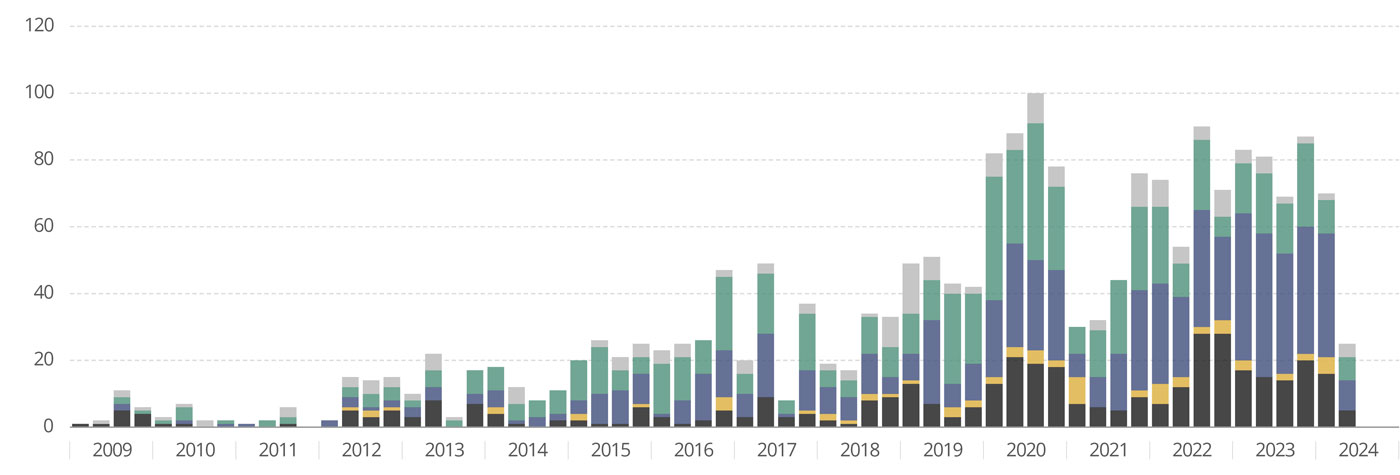
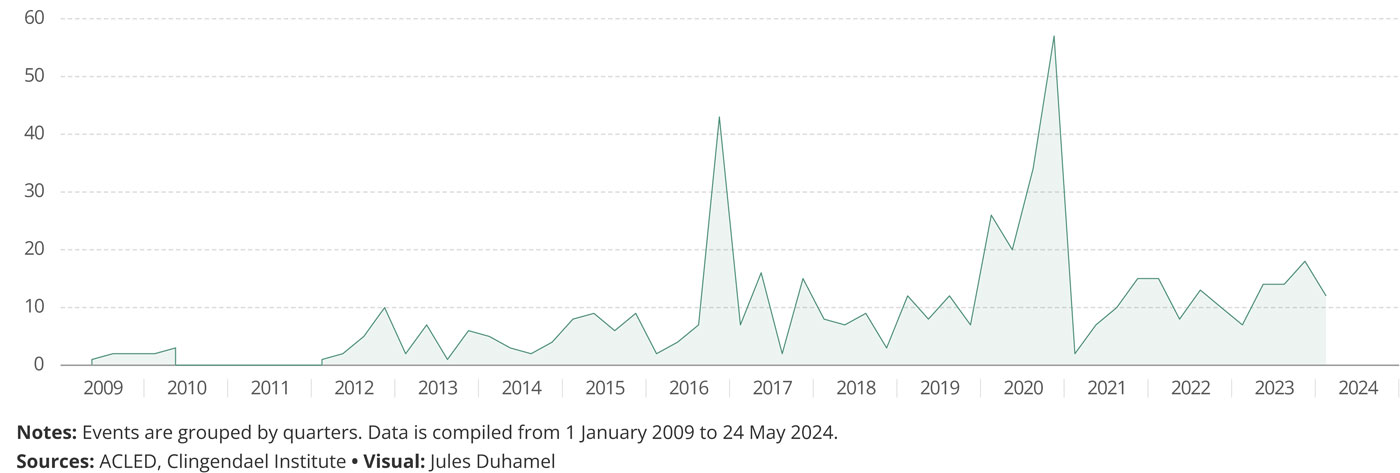
First, violence has accompanied Ghana’s democracy.[8] This has come in the form of vigilante groups with a strong role in the mobilization and intimidation of voters and politicians and (recent) claims of the instrumentalization of the security forces.[9] ACLED data confirms a clear upward trend in vigilante violence since 2008 (see figure 1).
The second problem is the role of money in politics. The 2000 and 2004 elections were (by then) labelled as the “most expensive on record” with party investments of $30 and $100 million respectively, or USD 5 and 12 per vote cast.[10] In 2007, Alan ‘Cash’ Kyerematen raised $13 million in one night.[11] From 2012 to 2016 the costs of running for office had increased by more than 50%, demonstrating that the “monetisation of party politics had worsened”.[12] A 2021 report argued that a presidential campaign alone now required $100 million.[13] Reports point to unlawful financing campaigns, such as illegal mining, fraudulent oil distribution business, procurement infractions and kickbacks.[14]
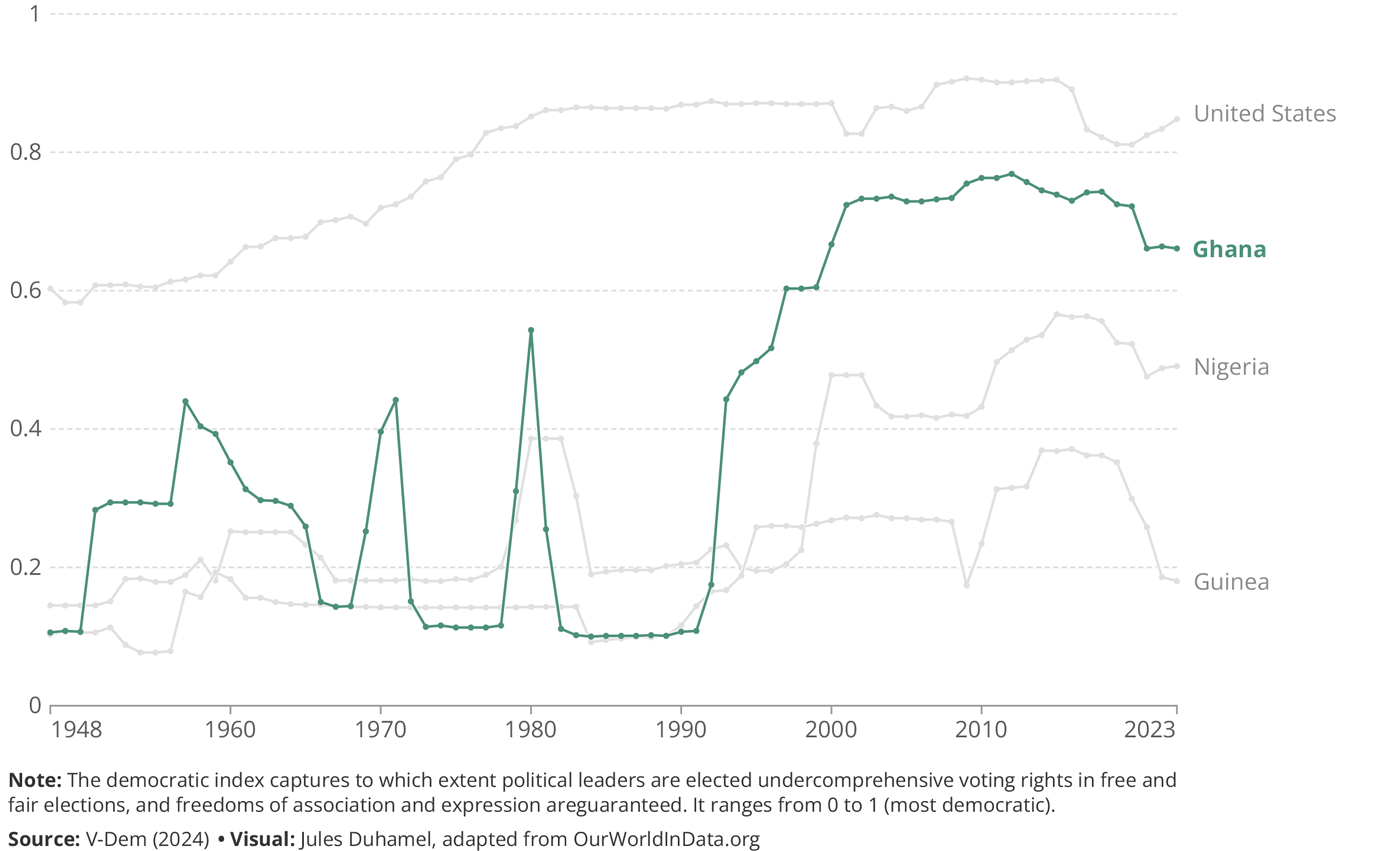
A third problem is institutional decay. Successive Ghanaian governments have made important steps in solidifying the country’s democracy since 1993, Accra has not been immune from global trends towards authoritarian tendencies.[15] Global autocratization has generally been gradual, mild and behind a legal facade.[16] Figure 2 displays the “Electoral Democracy Index” from the VDEM project showing a downward trend for Ghana too, since 2010.[17] Among many other signals, Ghana press freedom has dropped for consecutive years[18] and research shows that trust in the electoral bodies is sliding.[19] Heavy handed security responses and allegations of political manipulation have also undermined support in the police and other security forces. Indeed, gradual and mild but autocratic trends nevertheless.[20]
In short, Ghana is perhaps not the “beacon of democracy” that people take it to be.
The heart of the matter: hyper-partisan competition
The driving force behind these problems is extreme political competition. Electoral contests between the National Democratic Congress (NDC) and the New Patriotic Party (NPP) are won by an “extremely narrow margin of votes”.[21] Academics observe that elections “have increased in competitiveness since 1992”[22], that parliamentary elections are “keenly contested”[23] and that competition “has become so intense” that the ruling party faces powerful excluded party factions and opposition which “are always mobilizing support to win highly competitive elections.”[24]
Competition is fuelling zero-sum partisanship between the NPP and NDC, big-tents parties where networks of politicians and their followers coalesce to bid for power.[25] In order to gain support the parties resort to “competitive clientelism”[26]; doling out favours and private goods to followers [27] and the 20% of voters considered swing-voters, as well as vote-buying on the day of elections (e.g. 96% reportedly experienced vote-buying in a recent election).[28] This is increasingly supplemented by clientelism through providing public services or development, which voters progressively use to evaluate how politicians perform.[29] These public services – e.g., health facilities and roads – are not exclusive to supporters but are available to everyone.[30] However, this leads to more competition, as ethnic loyalties and voting weaken and former political heartlands become increasingly cut-throat.
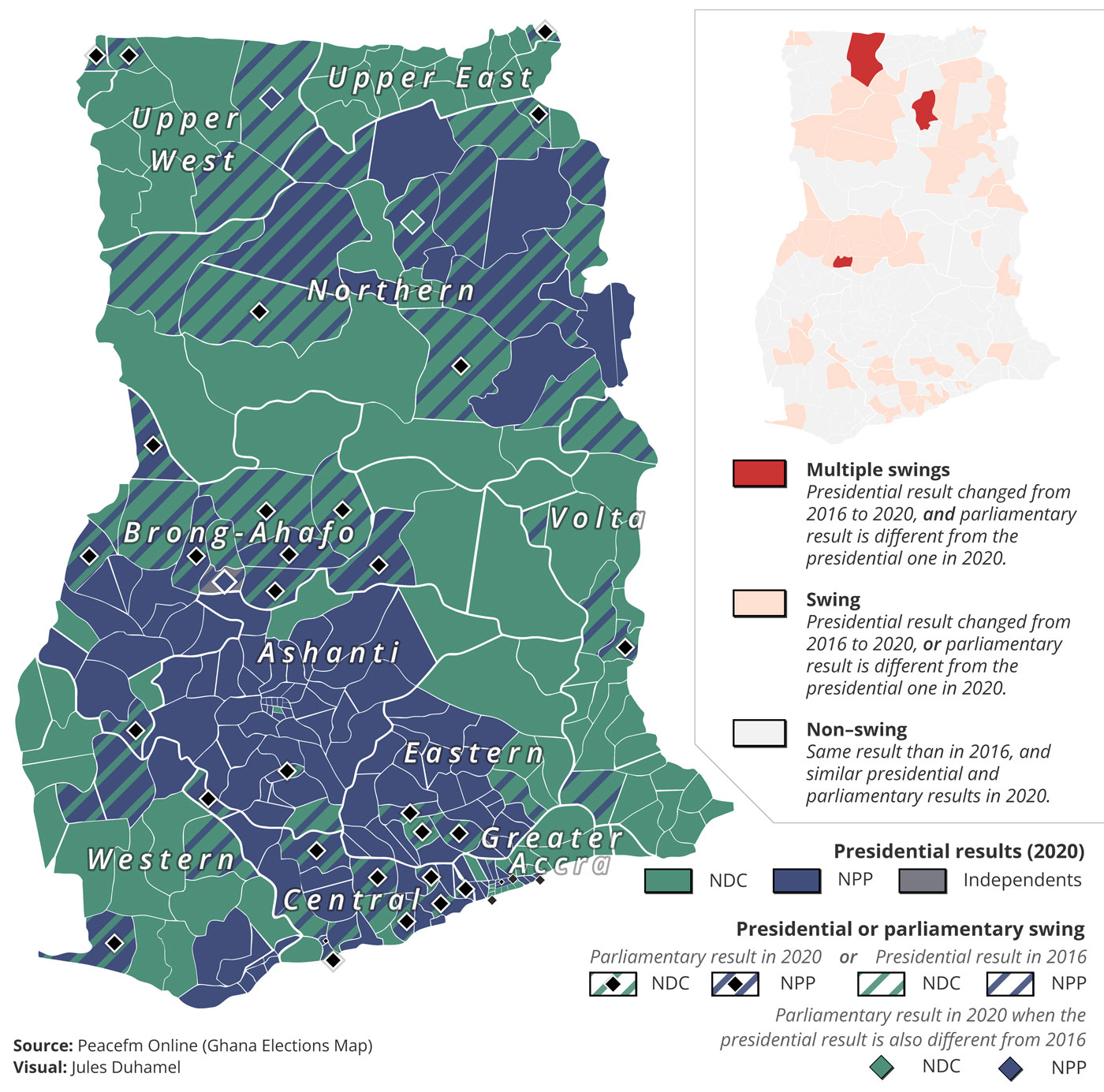
Figure 3 shows how hyper-competition produces ‘core’ constituencies but also more and more constituencies that are fiercely contested and can be won by the opponents.
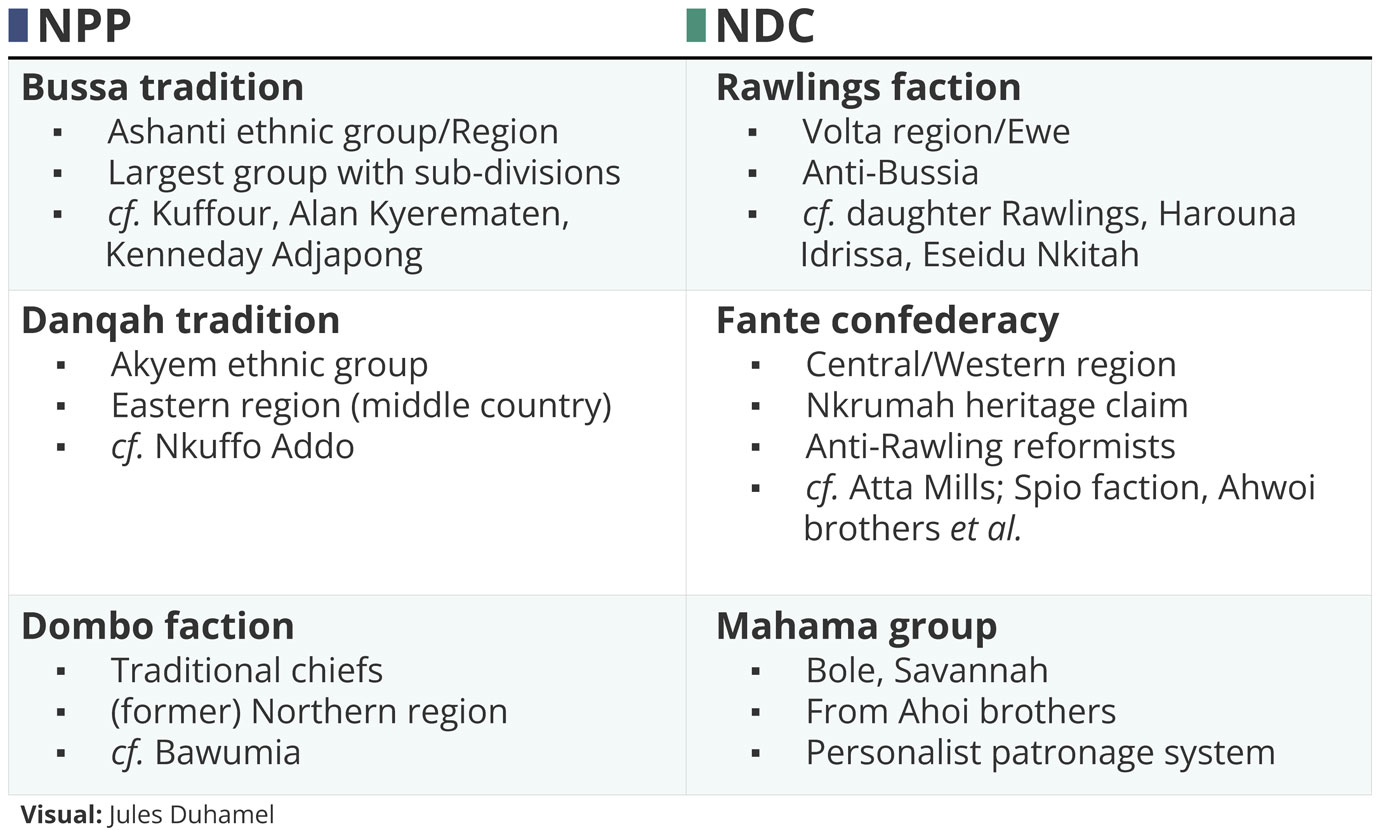
There is also fierce competition within the NDC and NPP (see table 1).[31] The NPP is composed of three large and often competing groups: the Busia faction from the Ashanti region (the former president Kufuor), the Danquah faction from the Akyem in the Eastern region (the president Akufo-Addo) and the more recent Dombo faction from the North (the aspiring president Bawumia).[32] The recent fallout between Alan ‘Cash’ Kyerematen (Busia) and the Dombo NPP candidate illustrates this competition. The NDC also has three main groups: the Rawlings faction (the Ewe in the Volta region), the Fante Confederacy (the Central and Western region, drawing on the Nkrumah tradition and the group surrounding the former president Atta Mills) and the Mahama faction/Gonja Octopus (a network surrounding Mahama). The recent replacement of Haruna Iddrisu – the former NDC’s minority leader in parliament – seems to have been linked to competition between the Mahama and Rawlings factions.[33] These tensions strongly play out at local levels, such as the mayor selection for Tamale.[34]
Gradual institutional decay and fierce partisan competition fuel policy failure across many domains. Research has found that uncompleted decentralization, the selective management of tensions between farmers and herders or resources extraction, the failure of policies to really formalize the mining sector and the limited effect of development initiatives are rooted in multiple forms of political competition.[35] For example, the implementation of a cash transfer programme for the poor (LEAP) “depended on the degree to which such interests were aligned with those of domestic political elites”.[36] The programme extended to parties’ own constituencies and was – for electoral reasons – expanded significantly immediately before the 2008, 2012 and 2016 elections.
Policymaking in Ghana is often just competitive politics on display. It is unlikely that, on the granular level, the implementation of policies on violent extremism will escape this trap.
Non-aggression and the ongoing threat of violent extremism
Yet Ghana’s competitive partisan politics is rarely connected to the threat of violent extremism.
Instead, recent reports on the threat of violent extremism in Ghana have produced long lists of familiar vulnerabilities such as farmer-herder tensions, youth unemployment, marginalization, chieftaincy tensions, and the distrust of government.[37] Such frustration-aggression models of pent-up grievances have long been dismissed in the academic literature; grievances alone do not produce conflict.[38] Instead, it is crucial to understand the calculus of potential conflict parties, for example, whether or not they have an interest in exploiting these grievances.[39]
For JNIM, Ghana currently functions as a supply line where militants obtain food, non-perishable supplies (e.g. dynamite, fuel, cattle, motorcycles), recruits, and find a place to rest and hide out (see below for further details).[40] Hence, the absence of real attacks on Ghanaian soil seems to result from JNIM’s calculus of not disturbing supply lines and places of rest as well as not provoking a relatively strong army.[41] Examples of people who are spared by JNIM by showing their Ghanaian identity cards fits this reading.[42]
Meanwhile, Ghana’s has worked on a multi-faceted approach to border security, including joint operations with neighbouring countries under the Accra Initiative, to prevent extremist infiltration. Yet, to avoid escalation it also appears to have accepted de facto non-aggression with JNIM. High-ranking government sources acknowledge that Ghana serves as a supply line and recognize that disrupting these networks could provoke violence. The threat of an attack “is why we don’t disturb them too much”, noted a high-ranking security officer.[43] This cautious strategy is also reflected by the limited activity of border security forces.[44] This cautious approach will likely continue as Accra tries to manage threats of violent attacks, particularly in the lead-up to the elections in December 2024.
Indeed, Ghana’s competitive politics is, once more, on display.
The reliance on non-aggression may lure Ghana into a false sense of safety. Figure 4 shows that the threat comes from three separate Katibats which operate directly on Ghana’s borders. One Katibat operates out of its main bases around Kompienga in eastern Burkina Faso where a cell in Kangagamore Forest – allegedly – poses threats to the Bawku region.[45] A specific threat (likely from this Katibat) has also emerged along the borders with Chereponi and Saboba.[46] Another Katibat operates from the Kalio and Tiaga Forest (Burkina Faso).[47] Militants have been dispatched to the border with Ghana around Bofian, Leo and potentially Yinga (Burkina Faso) and were responsible for the incident in Fatchu (Ghana) in October 2023.[48] A final Katibat led the Kafolo attack in Cote d’Ivoire in 2020, and the subsequent insurgency in Cote d’Ivoire. In 2021, there were certain activities in some of Ghana’s gold mines along the border with Cote d’Ivoire, but no recent presence has been reported.[49]
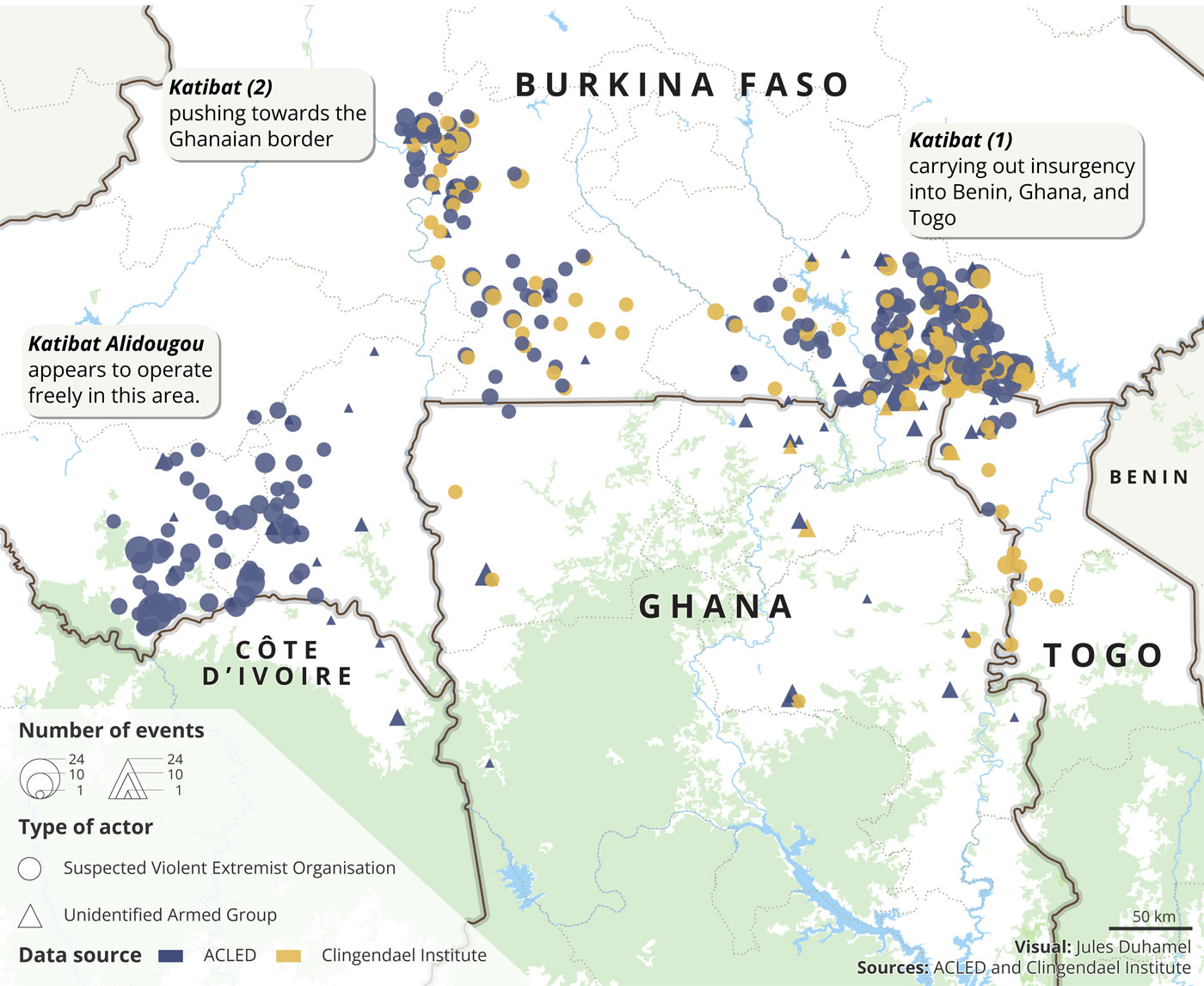
Figure 4 also maps all suspected violent extremist activity in and around Ghana. It is based on ACLED data and Clingendael Institute monitoring which has been set-up for this project since December 2023 as well as systematic cataloguing incidents in the grey literature.
This data points to 40 distinct data points of suspected violent extremist activity in Ghana since 2015, of which 28 have occurred since 2022.[50] Except for two violent incidents in Karaga in 2017 and 2018 respectively, activity in Ghana is non-violent, and involves movements of forces (10 incidents, sometimes fleeing from activity elsewhere), procurement and rest and recuperation (10 incidents), as well as recruitment (9 incidents, although most were before 2023). As Ghana’s ambassador to Burkina Faso noted in early 2024: “Believe it or not, they are able to come into Ghana and go back […], they roam, they come to our hospitals and go back.”[51]
These incidents should serve as a wake-up call that despite the non-aggression calculus, violent extremists are indeed active in Ghana.
Does politics fuel violent extremism?
Politics also rears its head in more concealed ways.
Existing studies identify at least six vulnerabilities that might facilitate the spread of violent extremism in Ghana.[52] These include land conflicts in the form of unclear tenure, pastoralist tensions and chieftaincy conflicts;[53] numerous chieftaincy conflicts, such as the well-known Bawku conflict;[54] the marginalization and unequal treatment of ethnic Fulbe (also known as the Fulani or Peul) (1% of the population)[55]; uneven development and high levels of unemployment;[56] vigilantism and youth marginalization; and[57] livelihood concerns in border zones.[58]
However, Ghana’s political context is glaringly absent in these assessments, despite the fact that most of these vulnerabilities are produced and, in some cases, exacerbated by Ghana’s competitive politics. For example, the Mamprusi-Kusasi chieftaincy conflict in Bawku is entangled in competition between the NPP and the NDC. Political contests are also at the heart of Ghana’s land conflicts as well as the problem of vigilantism.[59] Nonetheless, there is a clear gap in understanding the mechanisms by which Ghana’s competitive political systems fuel vulnerabilities that could be exploited by violent extremists.
A deeper understanding of Ghana’s politics and its relation to violent extremism is all the more important for a counterintuitive reason: Ghana’s fierce political competition might, in fact, act as a bulwark against violent extremists’ expansion.
Consider two examples. Despite the early ISGS presence in Bawku and continuous warnings that violent extremists might pick a side, there is no consistent evidence for these linkages and analysts are unable to point to a side that extremists could pick.[60] A similar situation occurred in neighbouring Ivory Coast when JNIM attempted to expand into Bounkani and encountered a strongly politicized context where intra-regime competition for the ethnic Lobbi and opposition ties to the Koulango (and a positive relationship with the Fulbe) made it difficult to build ties with potentially interested groups.[61]
In very simple terms, political competition might limit violent extremist expansion. Ghana’s political competition might be so localized and fierce that extremists are struggling to link up with interested groups. In fact, they might be outcompeted.
Research design and methods
This study explores the extent to which a relationship exists between the risk of violent extremism and Ghana’s political system and its nature. Specifically, it concentrates on what are considered to be important Ghanaian vulnerabilities to violent extremism: chieftaincy conflicts, the marginalization of the Fulbe and vigilantism.
For each topic, three questions were explored in detail: a) specific potential linkages with risks of violent extremist expansion into Ghana; b) the extent to which politicization currently takes place, particularly as elections are approaching; c) whether politicization reinforces risks that could be used by militants to expand into Ghana, or rather acts as a bulwark against any further infiltration.
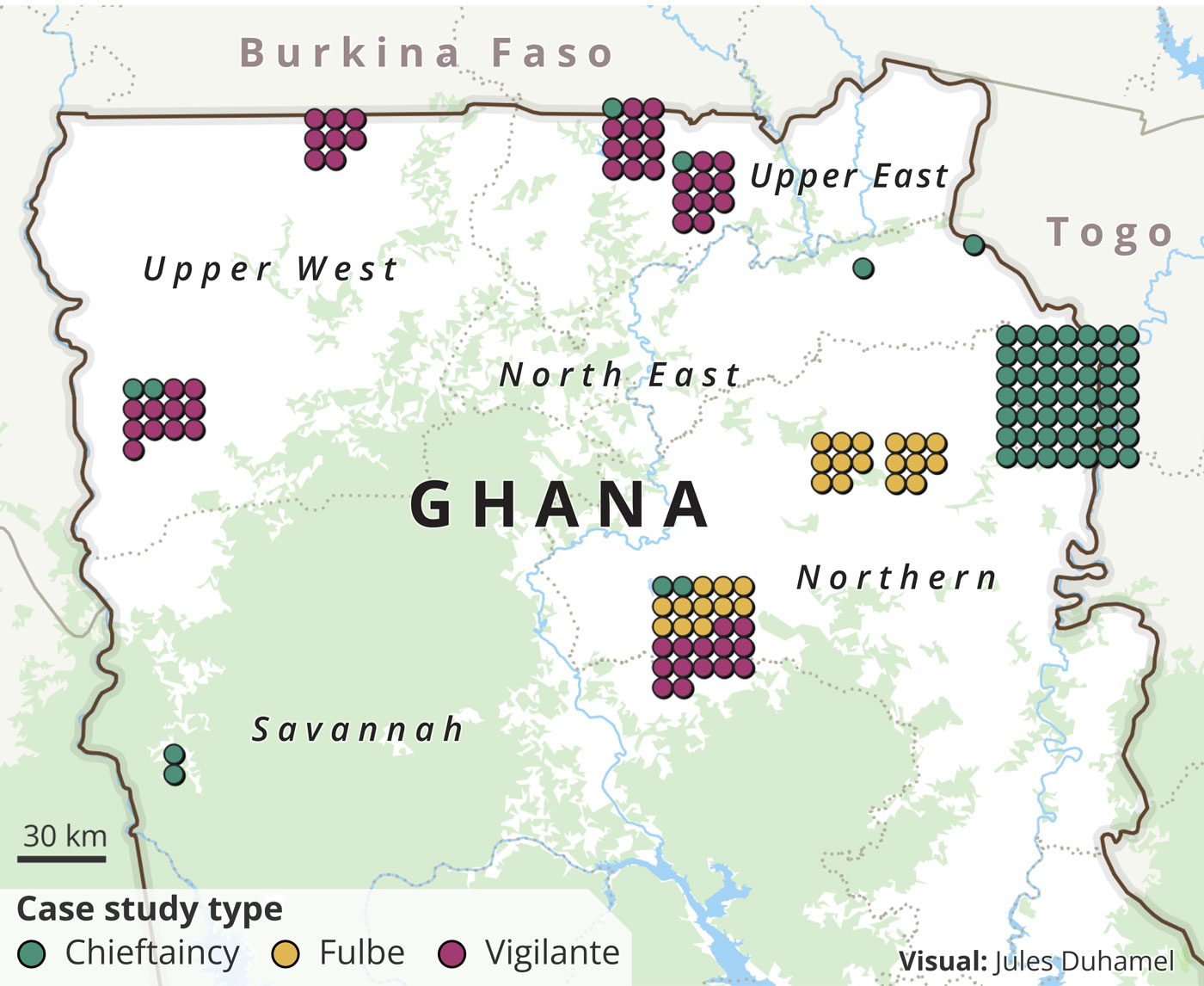
Data collection and case selection relied on two criteria: whether areas have recently experienced strong political competition between and within the NPP and NDC (see figure 3) and whether areas have been in close proximity to or linked with a violent extremist presence. Data collection on the Fulbe took place in Karaga and Gushegu and was supplemented with interviews in Tamale and Accra. The case study on vigilantes focused on Navrongo, Bolgatanga, Tumu and Wa and the regional hub of Tamale. Data collection for chieftaincy conflict concentrated on the North East, specifically a conflict in Chereponi. Separately, data collection was set up to monitor conflict and violent extremist movement.
The data collection involved 159 semi-structured Key Informant Interviews (KIIs, interview protocols in Annex 1). The topics and contexts were markedly different and were therefore led by separate analysts and consultants. On Chieftaincy, data collection was led by David Suaka Yaro of the University of Technology and Applied Sciences in Navrongo (60 KIIs).[62] Data collection on Vigilantes was led by Paul Nana Kwabena Aborampah Mensah of CDD-Ghana (58 KIIs).[63] Data collection and analysis on the Fulbe was led by James Courtright with an unstructured KII approach. Conflict monitoring was led by Eliasu Tanko (from December 2023 onwards). Figure 5 provides research locations and sampling.