
This chapter will present the 6 scenarios for the future of Belarus that were created within the scenario matrix presented in Figure 2 on the basis of the scenario workshop that was held in October 2024. Figure 9 shows how these 6 scenarios fit into the four quadrants of the matrix. The chapter also contains an analysis of the policy implications of each scenario. The policy analysis is most elaborate regarding the first scenario, which introduces the main trade-offs and functions as a point of reference to which the policy options in other scenarios are compared.
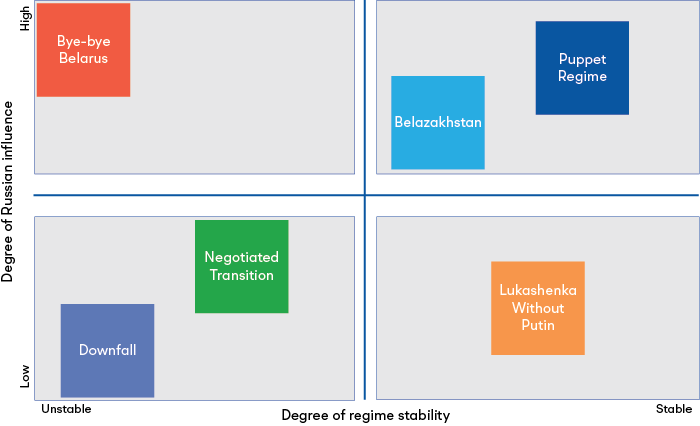
Scenario 1: Belazakhstan (medium/high regime stability, high Russian influence)
In this scenario, Lukashenka’s unexpected disappearance from the political scene due to health reasons leads to political instability in Belarus. Under the Kremlin’s patronage, a power transition is brokered to an authoritarian successor, who seeks rapprochement with Europe to restore Belarus’ multi-vector foreign policy and reduce the country’s dependence on Russia.
Lukashenka “wins” the January 2025 presidential election with significant electoral fraud, but without major protests. However, the Belarusian President then dies or is otherwise incapacitated relatively shortly afterwards, creating political instability. Elite cohesion diminishes as political, security, and business elites try to guess who is going to be the next president, so that they can bet on the “right horse” and be rewarded for it. Moscow, meanwhile, is concerned about potential political instability and sends an aircraft with senior Russian officials to Minsk to broker an orderly transition of power. While aiming to stabilise the situation, Moscow is not willing to attempt a take-over of Belarus. Having refused an offer by US President Donald Trump to freeze the war in Ukraine along the current frontline, Russia is still fighting the war, in which it has some momentum, and does not want to risk destabilising Belarus by trying to impose a new leader or taking direct control of its neighbour.
Russia brokers a compromise deal between Belarusian elites whereby presidential elections are held involving only vetted candidates deemed to be sufficiently pro-Russian (which does not include Tsikhanouskaya or other exiles). Lukashenka’s chief of staff and former minister of economic affairs, Dzmitryi Krutoi, wins the election with >55% of the votes after a second round of voting in what appears to have been a largely orderly and free election – even if certain candidates were excluded. While there were some reports of voter fraud, none of the candidates really had the administrative resources to skew the election result heavily in their own favour through large-scale vote rigging.
Belarus maintains close ties to and dependency on Russia. The Kremlin provides important support for the regime – including energy subsidies and loans – and Russia maintains its military presence in Belarus. Not incidentally, Krutoi’s first foreign visit is to Moscow for Putin’s birthday. Krutoi also continues to provide some support to the Russian military, including with training Russian soldiers, providing logistical support, and selling military equipment, but shies away from expanding Belarus’ involvement in the war in Ukraine, aiming not to anger Kyiv and the West too much. Meanwhile, the new Belarusian president tries to build an effective authoritarian regime domestically, but struggles to consolidate power like his predecessor had done. He manages to co-opt some of the other former presidential candidates, but his power base remains relatively shaky, especially among the siloviki.
Even though Krutoi’s primary foreign policy orientation is towards Moscow, he also seeks to restore a multi-vector foreign policy by cautiously seeking rapprochement with the West without raising the alarm in the Kremlin. He releases political prisoners, including prominent ones (subject to the condition that they leave the country), and significantly lessens political repression. Krutoi reaches out to Brussels and wants to come for a visit. A debate ensues among European member states about whether to accept Krutoi’s offer of détente or to continue isolating Minsk. The Baltic states and Poland in particular see Krutoi as just another Lukashenka and a vassal of Moscow, and push for the continued isolation of Minsk. However, other EU states – including both more Russia-friendly ones like Hungary and Slovakia in Eastern Europe and Western European ones such as France and Germany that want to normalise relations with Belarus and drive a wedge between Minsk and Moscow – are interested in a change in attitude towards Belarus.
If Krutoi’s multi-vector foreign policy fails, the war in Ukraine ends, and the Putin regime remains stable, this scenario could transform into scenario 2 (Puppet Regime). If, however, the Krutoi regime proves unstable, Moscow could be tempted to take direct control of Belarus and this scenario could morph into scenario 3 (Bye-bye Belarus).
Policy implications
This scenario confronts European policymakers with the choice whether to pursue a normative policy of continued diplomatic isolation and sanctions in the hope of democratising Belarus or to pursue pragmatic engagement to strengthen Belarusian sovereignty and the strategic autonomy of the new regime in Minsk. The normative approach puts pressure on Minsk to further liberalise the political system, but also threatens to increase Minsk’s dependence on Moscow and thereby strengthen Russian influence in Belarus in case Belarus does not democratise. The pragmatic approach facilitates the Krutoi regime’s attempts at recreating an effective multi-vector foreign policy that limits Russia’s influence, but at the price of lowering the pressure on the regime to democratise. Pragmatic engagement also comes at a certain reputational cost and can weaken the sanctions regime against Russia, although both costs can be at least somewhat mitigated by using Western leverage to demand concessions that lessen repression in Belarus but are not an existential threat to the regime and by tailoring sanctions in ways that bring limited benefits for Russia.
This scenario poses a number of policy dilemmas for the EU that can broadly be categorised along the normative-pragmatic approach spectrum set out in chapter 3. It essentially confronts European policymakers with the fundamental trade-off – laid out by Hansbury – between pursuing democratisation through sanctions and diplomatic isolation or strengthening Belarusian sovereignty through pragmatic engagement, although – as the chapter on the policy debate indicated – there are various middle grounds to be explored that fall in between these “ideal types.” Regardless of the chosen strategy, however, rapprochement would have to be conditional upon Belarus not becoming the staging ground for another Russian offensive against Ukraine.
By maintaining a substantial level of diplomatic and economic isolation of Belarus until the new regime takes more significant steps towards democratisation, a normative approach would create incentives for Minsk to pursue further liberalisation. The extent to which one deems such incentives to be potentially effective depends heavily on how likely one thinks that genuine democratisation will occur in Belarus, especially given Russia’s remaining interest and capabilities to project hard power in Belarus in this scenario. Moreover, Russia has significant tools – such as energy subsidies and financial support – to prop up the regime in Minsk even in the face of continued Western isolation, which weakens the pressure that the West can exert. A normative approach would also face the dilemma of whether to recognise Krutoi as the legitimate new president of Belarus, which could serve to encourage further steps towards rapprochement, but at the cost of weakening the position of the Belarusian democratic opposition in exile in Europe.
The key risk of pursuing the normative approach is that in case diplomatic isolation and economic sanctions do not entice the regime to implement further political liberalisation, Western policies will alienate Minsk and push it deeper into Moscow’s orbit. As such, if Minsk resists making the concessions that are required to have the sanctions lifted, this scenario could morph into scenario 3 (Puppet Regime). Similarly, European attempts to push for “bottom-up” democratisation through the support of civil society could also alienate the new rulers, who may see it as a threat to their rule and could therefore opt to move closer to Moscow to shield themselves from Western democratisation efforts.
A pragmatic approach, on the other hand, would seek to normalise diplomatic relations with Minsk, recognize Krutoi as the president of Belarus, and seek to lift economic sanctions in exchange for concessions that fall short of demanding the genuine liberalisation of the Belarusian political system. Such a policy would entail resuming official communications and sending ambassadors to Minsk, which would break Minsk’s diplomatic isolation from the West and thereby increase Krutoi’s bargaining power vis-à-vis Moscow and help him restore Belarus’ multi-vector foreign policy. A normalisation of diplomatic relations would also be a necessary condition for re-engaging Minsk in dialogue on key issues, such as human rights, political prisoners, forced migrations on the EU-Belarusian border, and Russia’s military presence in Belarus.
Nonetheless, sanctions relief is the key instrument for pursuing pragmatic engagement. Lifting economic sanctions is not just a means to diminish Belarus’ dependence on Russia, but also a key lever through which to extract concessions from Minsk – such as ending the forced migrations on the EU-Belarusian border, improving humanitarian conditions in Belarus (see below), and perhaps even limiting or reversing Russia’s military presence in Belarus (to the extent that that will prove possible for Minsk to negotiate with Moscow).
With Lukashenka gone, pragmatic engagement may also create new opportunities to promote soft Belarusisation through targeted subsidies for the Belarusian language, culture, and education reform, as a way to help Belarus differentiate itself more clearly from Russia and thereby increase the cost for Russia to pursue deeper integration with Belarus. At the same time, it remains hard to predict how successful such Belarusisation policies could become going forward, in part because of Mink’s prior hesitancy (under Lukashenka) to pursue such policies and in part because of the very limited success of the Soviet campaigns to promote the Belarusian language in the twentieth century (albeit in a very different societal and political environment). What does seem clear, however, is that pursuing Belarusisation primarily or even exclusively through the democratic opposition would come at the cost of limiting its reach in Belarus itself, where it could have the most impact. Moreover, by associating Belarusian identity primarily or exclusively with the opposition, this topic could become toxic for the new regime in Minsk.
The main cost of pragmatic engagement with the Krutoi regime would be that this policy strategy deprives Europe of its key lever to try to foster democratisation within Belarus. Moreover, pragmatic engagement with the Krutoi regime would also entail a certain reputational cost for the EU, although that cost would certainly be lower than it would be if Lukashenka were still in power. This reputational cost can be mitigated by using the leverage offered by the prospect of sanctions relief to gain concessions from Minsk that improve humanitarian conditions inside Belarus without existentially threatening the regime, such as a certain lowering of the level of repression, the further release of political prisoners, and improvements in the treatment of prisoners in Belarus.
Beyond reputational concerns, however, sanctions relief also threatens to create loopholes in the Western sanctions regime against Russia. As such, it would be more difficult to justify an alleviation of sanctions against Belarus as long as the war in Ukraine continues. Once the war ends, though, these concerns would weaken, although the extent to which they do will depend on the level of postwar tensions between Russia and NATO, as well as the broader European (and American) approach towards Russia – especially the extent to which the West’s Russia strategy will aim for containment or normalisation. Moreover, sanctions relief can be strategically tailored in various ways to diminish the costs in terms of creating loopholes for Russia. To begin with, personal sanctions against certain regime figures can be more easily maintained – or, in case of renewed repressions, reimposed – without fundamentally undermining Minsk’s opportunities to pursue a diversification of external relations, especially economic ones, beyond Russia. Secondly, even sectoral sanctions can differentiate, for instance by selectively targeting industries that rely heavily on Russian inputs (like the oil and/or nitrogen fertilizer sectors), have close connections with the Belarusian and Russian defence industries, and/or would not benefit substantially from integration with the European market, or by maintaining export controls on certain dual-use goods.
Apart from the trade-offs involved in pragmatic engagement, it should be kept in mind as well that in this scenario there are inherent limitations to what a pragmatic approach can achieve. Such an approach should not be expected to be capable of driving a wedge between Minsk and Moscow. Even if successful, the new regime in Minsk would have strong incentives to retain close ties with Moscow, in order to preserve important economic relations and subsidies, and quite possibly also to shield the new government from Western democratisation efforts. Russia’s persistent influence in Belarus and its capability and willingness to project power into the Eurasian region would also place limits on Minsk’s ability to distance itself from Moscow. EU and especially NATO membership would remain off-limits for Belarus. A pragmatic policy would thus aim to facilitate Belarus’ geopolitical hedging, rather than turning the country into a pro-Western state in the EU’s orbit. Where exactly the limits lie of what Moscow would allow is difficult – if not impossible – to predict without testing them out in practice.
One final consideration is in place here: namely, that the future of Belarus will also be shaped by the broader security context in the region. The higher tensions will be between Russia and the West, and especially between Moscow and NATO, and the more NATO’s deployments and military infrastructure will expand on the alliance’s eastern flank, the more difficult it will become for Minsk to diversify its external relations beyond Russia and to limit or roll back Russia’s military presence on Belarusian territory. In particular, future Ukrainian membership of NATO would raise Moscow’s strategic interest in keeping Belarus close and to militarise it further. Although the Belarusian case is relatively peripheral and unlikely to be decisive in shaping the larger European security architecture, Western policymakers would do well to keep in mind that decisions regarding the security architecture in (Eastern) Europe have repercussions in Belarus as well, and thus impact the security of NATO’s eastern flank in more than one way.
Scenario 2: Puppet Regime (high regime stability, high Russian influence)
In this scenario, the current trend of Minsk becoming increasingly dependent on Moscow continues. While Lukashenka remains nominally in power, he increasingly becomes a puppet of Moscow, although Belarus survives as an independent state on paper at least.
Lukashenka is re-elected in January 2025. Despite the substantial electoral fraud needed to give him a comfortable >85% of the vote, elite cohesion – and especially loyalty among the security forces – is sufficiently strong to prevent and dissuade large-scale protests from breaking out. Meanwhile, the war in Ukraine drags on, as Trump fails to broker an armistice that is acceptable to both Moscow and Kyiv. Russia continues to make significant progress on the battlefield, seizing more parts of Eastern and perhaps even Central Ukraine. With important war aims (in particular gaining full control over the Ukrainian provinces that Russia has formally annexed) having been achieved, Moscow scales back its offensive efforts in Ukraine and now has more bandwidth and resources to consolidate its position in Belarus as well. Given the stability of the Lukashenka regime, Putin has few incentives to try to annex Belarus. Keeping Belarus as a vassal state allows the Kremlin to maintain far-reaching control over its neighbour without having to bear the cost of directly governing the country and without having to risk serious unrest by formally incorporating the territory of the Belarusian state into the Russian Federation.
Meanwhile, Western policies of diplomatically and economically isolating Belarus drive Minsk ever deeper into Moscow’s embrace. Lukashenka continues to be increasingly concerned about his growing dependence on Moscow and tries to re-establish some ties with the West to diminish that dependence without overly provoking the Kremlin’s wrath. In line with Lukashenka’s recent attempts along these lines, the Belarusian President continues to periodically release some political prisoners and making other symbolic gestures to try to get Western countries to the negotiating table. For similar reasons, though potentially counterproductively, Lukashenka aims to keep his own pressure on Europe by continuing to facilitate the flow of migrants across Belarus’ borders with Poland, Lithuania, and Latvia.
As long as Lukashenka is not provided with options to counterbalance his dependence on Russia, he is increasingly forced to make concessions to the Kremlin. Among other things, Moscow is pushing for permanent Russian military bases on Belarusian territory, the introduction of the Russian rouble as Belarus’ currency, greater unification of legislation, as well as the privatisation of Belarusian state enterprises like Belarusian Railway, Belaruskali, Belavia, BelAZ, the Minsk Automobile Plant, the Mozyr and Naftan Oil Refineries, and the defence industry producers Minsk Wheeled Tractor Plant (which produces mainly military vehicles) and Peleng (optomechanical and optoelectronic equipment), which would then be bought up by Russian oligarchs loyal to the Kremlin and Russian state-owned enterprises.
Policy implications
This scenario presents a similar dilemma between normative and pragmatic approaches as the previous one, but with more limited potential effects of either strategy. With Lukashenka in power and Russia wielding substantial influence, in this scenario Minsk is even less likely to opt for genuine political liberalisation than in the previous scenario. At the same time, Lukashenka’s room to create a multi-vector foreign policy would be more limited than in scenario 1, even if he would encounter willing Western partners, while the reputational costs of engaging in rapprochement would also be higher for Europe. Regardless of the chosen strategy, NATO’s eastern flank would have to be reinforced.
It is important to stress that the status of Belarus as a vassal state of Russia in this scenario is potentially reversible, although actually reversing it will likely become more difficult over time as integration with Russia deepens; unless, of course, there is (like in the late 1980s and 1990s) a major reduction in Moscow’s willingness and/or capabilities to project hard power in the Eastern European region. Similar to scenario 1 (Belazakhstan), the EU’s response to the Puppet Regime scenario essentially comes down to a choice between a normative approach and more pragmatic alternatives, although the potential effects of both policy strategies narrows.
On the one hand, the normative approach has less promise here than in scenario 1 (Belazakhstan), since the Lukashenka regime will continue to have little incentive to make democratic concessions while Russia will have more leverage to dissuade any successor regime from following this path. With ample Russian support, Lukashenka can, moreover, relatively easily withstand the West’s democratisation pressure, even though this comes at the cost of the erosion of Belarusian sovereignty. After all, for the Lukashenka regime preservation takes precedence over preserving geopolitical autonomy. The normative approach would thus have to focus on playing the long game with Belarus and betting on (and preparing for) political change in the future, as well as on Russia’s hold over Belarus eventually weakening independently of the EU’s policy of isolating Belarus.
At the same time, while Lukashenka would still seek a normalisation of relations with Europe, his room for manoeuvre to create a multi-vector policy will have decreased, making it more difficult to create some space between Minsk and Moscow. It is also unlikely that Lukashenka in this scenario would be willing to accept European support for soft Belarusisation policies, given that the Belarusian national identity has been claimed primarily by oppositional forces that are now mainly in exile, while Lukashenka himself has always been hesitant when it comes to such policies and has distanced himself from them since 2020. Meanwhile, pragmatic engagement will be more difficult compared to scenario 1 due to higher reputational costs for Europe, given that Lukashenka is still in power and still politically toxic. Moreover, the war is still ongoing (at least at the start of this scenario), which creates an additional hurdle for rapprochement. Meanwhile, similar to scenario 1, it remains unclear how much room for manoeuvre Moscow would actually grant to Lukashenka in case the EU would create opportunities for a diversification of Belarusian external relations through diplomatic engagement and sanctions relief.
Regardless of which approach is chosen, NATO’s eastern flank would have to be reinforced in this scenario to counter a growing Russian military threat from Belarusian territory. This, however, would also make it more likely that Russia will maintain or even expand its military foothold in Belarus going forward, especially given that Lukashenka would also have less leverage vis-à-vis Moscow to oppose this.
This being a scenario that would be undesirable for Europe, it is worth considering how the West could strive to avert it. Since this scenario assumes a continuation of current policies and developments, a change of course would be a necessary (though not necessarily sufficient) condition for that. That would entail, first of all, a more pragmatic approach to Belarus, aimed at diminishing its dependence on Moscow through engagement. This scenario points to the fact that the longer the West waits before doing this, the more dependent Belarus will become on Russia and the more difficult it will become to implement such a policy strategy going forward. Policymakers will have to seriously consider at what point and under what conditions the potential benefits of a policy of pragmatic engagement would outweigh the costs.
Scenario 3: Bye-bye Belarus (low regime stability, high Russian influence)
In this low probability/high impact scenario, Moscow forces Minsk into joining the war in Ukraine. As the Belarusian armed forces suffer substantial losses, splits within the elite and large popular protests bring down the Lukashenka regime. The spectre of prolonged instability in Belarus simultaneously creates both the incentive and opportunity for Russia to annex Belarus. The six oblasts (provinces) of Belarus become oblasts of the Russian Federation.
Despite attempts by Trump to sign a ceasefire deal in 2025, Putin decides that Russia has better odds in attaining its objectives in Ukraine through a continuation of the war, betting on weak Western resolve. As the war drags on, however, the Kremlin increasingly realises the difficulties of making further progress in Ukraine without another large-scale mobilisation and a shift to a genuine war economy to boost military industrial production, which could significantly undermine Russian living standards and the legitimacy of the Putin regime. Meanwhile, Trump is angered by having been denied the opportunity to become a peacemaker in Ukraine and continues to support Kyiv, albeit by providing it with more of a lifeline to stay in the fight than the type of support that Ukraine would need to push back the Russian armed forces. Putin, in turn, decides to pressure Lukashenka into joining the war. Lukashenka resists, but ultimately has to cave in due to a combination of economic coercion and thinly veiled Russian threats to replace him, by force if necessary.
Belarusian armed forces grudgingly enter the war and promptly suffer substantial losses against the much better trained and prepared Armed Forces of Ukraine. This causes both splits within the political and security elites and a new wave of popular protests in Belarus. The protests target not just Belarus’ involvement in the war in Ukraine, but increasingly also the Russian “occupation” of Belarus. As a result of a split within the Belarusian security forces, Lukashenka’s repressive capacity is insufficient to put the genie back into the bottle, as military and internal security forces refuse to comply with orders to open fire on protesters.
An increasingly desperate Lukashenka turns to Moscow for direct support. Putin agrees to send in Russian armed forces, as well as National Guard and OMON military police units, to help those parts of the Belarusian security apparatus still loyal to Lukashenka to repress the protests, albeit at the further expense of Lukashenka’s already teetering popularity. Both important segments of the political and security elite and the population at large increasingly see Lukashenka as an incompetent leader and a Russian puppet who is incapable of safeguarding Belarusian sovereignty. Meanwhile, the Kremlin is worried about Lukashenka’s seeming inability to stabilise the Belarusian political system. The splits within the Belarusian elite give Moscow an opening to seize control of the country, as some key elites – not least in the security apparatus – side with Russia. Lukashenka steps down, allegedly for health reasons. A Russian hand-picked successor, Ivan Tertel’, the head of the Belarusian KGB, takes office as Belarus’ new interim president.
With Moscow’s backing, Tertel’ starts by bringing the Belarusian political and security elites into line, while purging dissenters. Russia, meanwhile, decides to go one step further, pressuring Tertel’ into organising a “referendum” on unification with Russia, which is engineered to pass with >80%. The six oblasts of Belarus are formally incorporated into the Russian Federation. Belarus thereby ceases to exist as an independent state. Many Belarusians, however, including some former security officials, are not willing to go quietly into the night, and keep on resisting the new political status quo, some even through armed rebellion. As a result, the Kremlin and loyal Belarusian elites crank up the repression in Belarus. As fighting against Belarusian partisans continues (with many captured partisans reportedly being executed) and the prisons fill up to the brim with political prisoners, between one and two million Belarusians decide to flee the country. Meanwhile, Moscow encourages Russian citizens from outside the six oblasts of the former Belarus to settle in the newly annexed territories. The Belarusian language is marginalised and the territory of the former Belarus is heavily militarised, becoming an important military outpost for the Russian armed forces at the western borders of the Russian Federation.
Policy implications
This scenario leaves the EU with very limited policy instruments to influence developments in Russian-annexed Belarus. No meaningful policy differentiation between Belarus and Russia is possible. European policymakers would do well not to recognise Russia’s annexation and instead to recognise a Belarusian government in exile. Even more urgently than in scenario 2, NATO’s eastern flank would have to be reinforced. European policymakers would also have to come to terms with another refugee crisis, as Belarusians would likely try to move into Europe in large numbers.
In this scenario, the EU’s ability to influence developments in Belarus is extremely limited. The annexation of Belarus by Russia means that there are no meaningful options to promote the democratisation of the Belarusian political system, the “soft Belarusisation” of the nation, or to facilitate the restoration of Belarus’ multi-vector foreign policy. Meanwhile, the issue of sanctions against Belarus becomes completely unified with the sanctions regime against Russia. Meaningful policy differentiation between Russia and Belarus becomes impossible. The EU could consider imposing a full economic blockade on Belarus, as it did with Crimea, though the impact of that would remain largely symbolic, given that Belarus is already heavily sanctioned and would be seamlessly integrated into the Russian Federation.
Moreover, similar to Crimea after 2014 or the Baltic states after the Second World War, the West would do well not to recognise the annexation of Belarus by Russia. Although it may seem unlikely that Russia’s annexation could be reversed in the foreseeable future, it is useful to keep this door open. This also means that the EU would have to recognise a government in exile for Belarus, similar to how the West did for the Baltic states in the wake of World War II. Since there would no longer be a Belarusian government in Minsk to communicate with, the political cost of recognising a government outside of the borders of Belarus would be virtually non-existent.
The Belarusian democratic opposition in Europe could be encouraged to form a government in exile. This raises questions, though, about how to select the people and institution that deserve backing. Already now, there are competing groups within the Belarusian democratic opposition in exile. That diversity is likely to increase as more and more Belarusians go into exile, even people who may not be highly supportive of some of the key figures of the first wave of political emigration. It might make sense to facilitate some kind of democratic process by which this government is elected at least among Belarusians in exile. Simply imposing someone – for instance, Tsikhanouskaya – to lead this government in exile would perhaps be easier, but may undermine the legitimacy of this government. Whatever decision is made, it will be important for the EU to make that decision jointly – and ideally together with its allies outside of Europe.
With Belarus being a part of Russia, Russia’s military posture in Eastern Europe would significantly strengthen. The threat to the Baltic states would become particularly acute, as it would become significantly easier for Russia to control the Suwałki Gap separating Kaliningrad province from the Russian “mainland,” thereby cutting off the land bridge between the Baltic states and their NATO allies. NATO would thus have to seriously reinforce its eastern flank (even more urgently than in scenario 2, Puppet Regime), expanding European militaries and defence industrial production, and deploying heavy brigades to the east. In addition, Russia’s military position vis-à-vis Ukraine would also become more menacing with the incorporation of Belarus, and that threat would become permanent.
Finally, this scenario would raise the question of what to do with the million or more Belarusians who may want to flee to Europe. It may be tempting to invoke another temporary protection directive, but, as the Ukrainian case is increasingly beginning to show, that in and of itself does not provide a long-term solution. The long-term solution that the EU will eventually choose regarding the status of Ukrainian refugees will likely influence – and may positively inform – the choice that would be made in the case of Belarusian refugees.
Given that this scenario is highly unfavourable for the EU and NATO, an important question is how it can be avoided. A policy of pragmatic engagement aimed at strengthening Belarus’ sovereignty and strategic autonomy through the diversification of its external relations seems to be the most effective policy tool for this, although it also comes with certain costs, as discussed above. At the same time, however, we need to acknowledge the limited agency that Europe – or the West more broadly, for that matter – has in trying to avert this scenario, especially given the current high level of Minsk’s dependence on Moscow. A lot of cards are now in the hands of the Kremlin.
Scenario 4: Lukashenka Without Putin (high regime stability, low Russian influence)
In this scenario, Lukashenka remains in power after Putin’s failing health removes the latter from the Russian political scene, leading to internal instability in Russia and a weakening of its grip on Belarus. This gives Minsk significantly more freedom in structuring its foreign relations, while Lukashenka’s interest in lowering his dependence on Russia – especially a Russia that suffers from an economic recession – pushes him to seek a normalisation of relations with Europe.
Lukashenka comfortably “wins” the January 2025 presidential election, without the large-scale fraud that is necessary to give him >85% of the vote triggering mass protests. Relatively shortly afterwards, however, Putin unexpectedly dies or is incapacitated. A protracted succession struggle unfolds in Moscow, as no clear successor to Putin emerges who has both the sway among the key patron-client networks of Russia’s political, security, and economic elites and the popular support needed to consolidate his power. Faced with internal turmoil, Moscow decides to freeze the war in Ukraine along the current lines, making use of the ceasefire deal that Trump offers and which Kyiv sees itself forced to accept as well due to threats from Washington to otherwise cut all American military and financial support.
This change in Russian influence does not mean that the new leaders in Moscow have a fundamentally different geopolitical worldview from that of Putin. They still believe that Russia is a great power; that this great power status should be based on Russia having a regional sphere of influence in Eurasia; and that both Belarus and Ukraine are of key strategic importance for Russia and, moreover, share deep cultural roots with Russia. This means that Russia’s low leverage over Belarus is likely to be temporary. Reminiscent of past resurrections of Russian power following the Revolution of 1917 and the Soviet collapse of 1991, the Kremlin will likely again extend its influence over Belarus once a new regime in Moscow consolidates its power and Russia’s power projection capabilities increase accordingly. Moreover, by that time Moscow may also choose to restart the war in Ukraine.
In the meantime, however, this situation of (temporary) Russian weakness provides Minsk with an opening to rethink its foreign policy. Lukashenka uses this opening to launch another diplomatic offensive to restore relations – and primarily economic ones – with Europe. This is further incentivised by the brief recession and subsequent protracted stagnation of the Russian economy as a result of Western sanctions and the inflationary pressures unleashed by the war. These developments harm the Belarusian economy, which is still heavily dependent on the Russian Federation. In order to minimise the economic fallout from this and to have some hope of economic growth in the near future, Belarus needs to diversify its economic ties beyond Russia. Lukashenka releases political prisoners and signals that he is willing to discuss ending the forced migrations across the border with Poland, Lithuania, and Latvia. On the other hand, a weakened Russia also leaves Lukashenka somewhat exposed to democratising influences from the West, which forces him to be cautious in his attempts to seek rapprochement with Europe.
Policy implications
This scenario poses a similar policy choice between normative and pragmatic approaches as scenario 1, but with more opportunities for both strategies. On the one hand, continued isolation by the West has a greater chance of destabilising the Lukashenka regime in this scenario, given Russia’s weak economy and diminished Russian support for Belarus. On the other hand, Lukashenka has more leeway and incentives to pursue a multi-vector policy here. The fact that the war in Ukraine has ended and that Belarus is distancing itself from Russia also lowers the cost of pragmatic engagement for the West in certain respects, although the fact that Lukashenka remains in power in this scenario raises the reputational costs of rapprochement in other respects.
Here, the EU faces a similar policy dilemma between a more normative and more pragmatic approach as in scenario 1 (Belazakhstan), although the absence of Russia as strong support for the Lukashenka regime and a potentially significant spoiler of its attempts to diversify its external relations creates new opportunities for the West, as well as for Lukashenka.
While Lukashenka remains as adverse to political liberalisation in this scenario as in scenario 1, continued economic isolation from the West in this scenario is more likely to destabilise his regime and open up opportunities for political change (similar to scenario 5, Negotiated Transition, below). On the other hand, if a normative approach is pursued and fails, this scenario could morph into something akin to scenario 1 (Belazakhstan) or 2 (Puppet Regime) over time, as Russia again becomes stronger and its capabilities to project power in its Eurasian neighbourhood increase accordingly.
As far as pragmatic engagement is concerned, Minsk will have significantly more leeway to diversify its foreign policy than in scenario 1 (and even more so compared to scenario 2), given Russia’s weakness. As such, the relative payoffs of pursuing pragmatic engagement are higher in this scenario than in scenario 1, while the cost of offering sanctions relief to Belarus will decrease as the war in Ukraine has come to an end and as Minsk increasingly distances itself from Moscow. On the other hand, the fact that Lukashenka is still presumed to be in power also raises the reputational costs of rapprochement somewhat in other respects. Moreover, Lukashenka’s political survival at the top of the Belarusian political system will also likely block opportunities to support Minsk in implementing soft Belarusisation policies, especially given the fact that the pressure emanating from Moscow for Belarus to integrate more deeply with the Russian Federation is significantly lower in this scenario than in scenarios 1 and 2, thereby weakening incentives to pursue such policies.
Furthermore, leveraging rapprochement in order to roll back Russia’s military presence in Belarus could also be more successful in this scenario than in scenario 1 (Belazakhstan), as Minsk will have both strong incentives to obtain sanctions relief and more leverage in negotiations with Moscow. This effect could, however, be countermanded by Ukrainian accession to NATO, which seems more likely in this scenario in which Russian weakness limits Moscow’s ability to pressure Kyiv and the West into giving up the prospect of Ukrainian NATO membership, while future Russian revanchism against Ukraine seems likely.
Scenario 5: Negotiated Transition (low regime stability, low Russian influence)
In this scenario, Lukashenka’s regime is significantly weakened by popular unrest resulting from an economic recession and the deaths of Belarusian conscripts sent to fight in Ukraine on Russia’s side, while a long war of attrition and mounting economic problems weaken Russia’s ability to project power into Belarus. Lukashenka sees himself forced to start a negotiated power transition to a new president, while he himself tries to maintain substantial control as the chairman of the All-Belarusian People’s Assembly. Meanwhile, the KGB and a new class of Belarusian oligarchs become additional autonomous political forces in an increasingly pluralist, but still illiberal, political landscape.
Just like in the previous scenario, Lukashenka comfortably gets through the January 2025 presidential elections. Shortly afterwards, Trump sets out to cut a deal with the Kremlin over Ukraine. To his surprise, however, the US president discovers that Putin’s demands – including the demilitarisation of Ukraine, the secession to Russia of all the regions the Kremlin claims to have annexed (including territories that Russian forces do not control), and the installation of a Russian puppet regime in Kyiv – are not only unacceptable to Kyiv and most of Europe, but even to most of the American Republican Party and Trump’s own foreign policy advisors, as giving in to them would show American weakness reminiscent of Joe Biden’s chaotic withdrawal from Afghanistan.
Disillusioned with the Kremlin and angered by his inability to bring peace to Ukraine, Trump ramps up – as he has threatened to do – US aid to Ukraine. Furthermore, in the wake of Russia’s refusal to sign a peace deal, Europe also rallies its support for Ukraine and the European defence industry increasingly supplements key American arms supplies. The Russian armed forces, meanwhile, are increasingly hampered by a lack of weapons and munitions, as Soviet-era depots are depleted, while the Russian economy increasingly buckles under sanctions and the financial pressures of the war. The Ukrainian armed forces inflict significant losses on Russia, as the war of attrition continues at high mutual cost to both sides.
Over the next few years, these developments erode Russia’s power projection capabilities into the post-Soviet Eurasian region. Meanwhile, Moscow keeps pressuring Lukashenka to join the war, but the Belarusian President is just strong enough to resist this pressure. Instead, a compromise is reached whereby Lukashenka agrees to start recruiting “volunteers,” including among Belarusian prisoners, for Russia’s armed forces. Rumours soon spread that the Belarusian armed forces and KGB put considerable pressure on vulnerable Belarusians at the bottom of society to sign contracts with the Russian armed forces. Many Belarusian “volunteers” return home in body bags. As unrest over Belarusian casualties in the war spreads through society, Moscow’s subsidies and financial support for Minsk diminish, while the Belarusian economy simultaneously suffers from the contraction of the Russian market. Popular unrest spreads to the political and security elites as well, as many start to question the sustainability of Lukashenka’s leadership. This, in turn, creates opportunities for people to protest more and more openly against the regime.
In an attempt to stabilise the regime and preserve at least his acquired wealth and some of his power, Lukashenka opts to compromise with other members of the ruling elite surrounding him by agreeing to a negotiated power transition with the aim of restoring political stability at the cost of minimal political change. The elites surrounding Lukashenka, meanwhile, also have an incentive to facilitate a managed regime change, which would help them push aside the unpopular Lukashenka and placate the protestors, while simultaneously preserving their positions and the wealth they managed to acquire under Lukashenka.
Siarhei Rumas, a former prime minister under Lukashenka, is chosen to head a transitional government in preparation for new presidential elections. Lukashenka, meanwhile, remains the chairman of the All-Belarusian People’s Assembly and hopes to preserve his influence in the new political environment through this institution, primarily in order to protect himself and his accumulated wealth from his successor. At the same time, the KGB gains more autonomy and emerges as a third centre of power, next to the ABPA and the presidency. Furthermore, the economic crisis prompts the regime to implement some market reforms, including the privatisation of some major state enterprises, in the hope of giving up some state control over the economy in exchange for better economic prospects. Corrupt privatisation deals end up creating a class of Belarusian oligarchs, which further diversifies the political landscape.
As a result of these developments, presidential and parliamentary elections become more competitive, although the continued abuse of executive power by state officials and the barring of candidates from outside of Lukashenka’s former regime still skew the political playing field in numerous ways. Even so, the new balance of power prevents anyone from simply “engineering” election results the way Lukashenka had been doing in previous years. In response, the US normalises diplomatic relations with Minsk and even begins to lift some of the sanctions against Belarus, while being careful not to create major loopholes in the sanctions regime against Russia.
Policy implications
This scenario calls on European policymakers to support Belarus’ civil society and more open political system in the hope of institutionalising democratic gains. This, in turn, calls for a restoration of normal diplomatic relations, while the offer of targeted sanctions relief could provide important leverage to extract strategic and humanitarian concessions from Belarus. European policymakers should also aim to support Belarusisation policies that strengthen Belarusian national identity distinct from Russia’s. At the same time, a major policy dilemma remains as to what extent the EU should make this rapprochement dependent on further political liberalisation. Similar to scenarios 1, 2, and 4, a normative approach creates incentives for further democratisation but at the cost of potentially isolating Belarus and driving it into dependency on Moscow if Minsk proves unwilling to democratise further. A pragmatic approach, on the other hand, solidifies the gains of rapprochement and thereby Belarusian sovereignty, but at the cost of removing incentives for democratisation.
The opening up of the Belarusian political system in this scenario – however flawed it still is – provides sufficient ground for both adherents of a more normative and of a more pragmatic course to support Belarusian civil society (constrained as it still is) and Belarus’ still imperfect democratic infrastructure. A prerequisite for effectively doing that would be the restoration of normal diplomatic ties with Minsk and at least some sanctions relief, although the fact that the war in Ukraine is still ongoing (at least at the start of this scenario) imposes certain constraints – or at least additional costs – on alleviating sanctions against Belarus, since these could create loopholes in the sanctions regime against Russia. European policymakers (preferably in coordination with other Western allies) could seize this opportunity to extract strategic and humanitarian concessions from Belarus – such as ending the forced migrations to the EU, limiting (or, if possible, even rolling back) Russia’s military presence in Belarus, and releasing political prisoners – in exchange for targeted sanctions relief, focusing primarily on certain sectors of the Belarusian economy (such as the aviation, potash fertiliser, and timber industries)[137] that have substantial potential to export to Europe while not relying heavily on Russian inputs.
The EU could also consider providing some kind of economic aid to Belarus, which would serve both “idealists” and “realists” by helping to stabilise Belarus’ gains in political pluralism and by solidifying the increasing diplomatic and economic ties to the West. But providing aid to Belarus would be a politically difficult proposition following all the aid that Europe has already been providing to Ukraine. Looking for opportunities to support the new regime in Minsk to promote soft Belarusisation policies can also be acceptable to both sides of the policy divide in the West.
At the same time, major policy dilemmas remain, which revolve largely around the extent to which Europe wants to make rapprochement – the restoration of normal diplomatic relations and relief from economic sanctions – dependent on further political liberalisation, including the welcoming back of the democratic opposition in exile to be allowed to engage in the political process inside Belarus.
Those favouring a more normative approach aimed at democratising Belarus could make the further alleviation of sanctions dependent on progress regarding political liberalisation, such as, for instance, demanding the inclusion of the opposition in exile in the Belarusian political process and the release of political prisoners. They would likely also want to threaten reimposing sanctions and diplomatic isolation in case Belarus backslides in terms of domestic repression and authoritarianism. This could put more pressure on Belarus to pursue democratic reforms, but may also drive Belarus closer to Russia if a new authoritarian regime manages to consolidate and seeks to shield itself from Europe’s democratising influences.
A barrier to Belarusian democratisation in this scenario is the still very limited prospect of potential EU accession. To begin with, the Belarusian population currently does not support EU accession and it is unclear to what extent that would change in this scenario. In addition, the Belarusian political system still remains highly flawed. Moreover, while Russia is relatively weakened in this scenario, it may not be so weak that it would sit by idly if it had the idea that the West was dragging Belarus into its own “sphere of influence,” especially given that tensions between Russia and NATO remain high over the ongoing war in Ukraine in this scenario. Even short of using military force, Russia holds significant (though diminished) leverage vis-à-vis Belarus in terms of energy subsidies and access to the Russian market that it can use as carrots and sticks to influence Minsk’s foreign policy decisions.
On the other hand, Europe can choose to pursue a more pragmatic course in which rapprochement is not tied as closely to political liberalisation. Democratic backsliding in Belarus could be dealt with in ways that leave restored diplomatic and economic relations intact, for instance by imposing (largely symbolic) sanctions on individual officials so as to preserve Belarus’ gains in strategic autonomy and sovereignty.
Scenario 6: Downfall (low regime stability, low Russian influence)
In this low probability/high impact scenario, severe economic and political instability in Russia snowballs into Belarus, sweeping away the Lukashenka regime and creating prolonged economic and political instability that places Belarus on the verge of becoming a failed state.
While Lukashenka again gets through the January 2025 elections unscathed, a perfect storm hits Belarus from the east as the Russian economy collapses. Already facing similar strains from Western sanctions and the financial demands of the war as in the previous scenario, the Russian economy is now also hit by a substantial decline in oil prices. As a result of this acute economic crisis, Moscow is ready to sign an armistice with Ukraine, brokered by Trump, that freezes the conflict along the current frontlines. Kyiv, however, refuses these terms, seeking to exploit this moment of Russian weakness to regain territories occupied by Russia. Although the Trump administration halts all military and economic support to Ukraine in retaliation, Ukraine still receives backing from some of its European allies and decides to fight on. Despite Ukrainian zeal and Russian weakness, however, the territorial gains that the Ukrainian armed forces make on the battlefield are slow and costly.
Faced with economic collapse at home and humiliation in Ukraine, elite and popular support for Putin crumbles inside Russia, and mass anti-regime protests appear on the streets of Russia’s major cities. Putin is removed in a palace coup, while a new regime struggles to regain political and economic stability and armed rebel fighters declare independence in Chechnya, in a crisis reminiscent of the 1990s. Russia is thus forced to turn inward and has very limited capabilities to try to influence Belarusian politics and foreign policy, as it struggles to fend off the continued offensives of the Ukrainian armed forces.
Although Russia’s implosion suddenly releases Minsk from Moscow’s stranglehold, the severe recession in the Russian economy snowballs into an economic crisis in Belarus. Russian subsidies and financial support diminish, while Russian demand for Belarusian exports collapses and Belarus’ own oil export revenues plummet. An already precarious Belarusian economy is thrown into a severe crisis, leading to mass protests and unrest among the political and security elites. There are splits within the Belarusian regime which facilitate a renewed public willingness to protest. Mass protests break out. Reminiscent of Ukrainian President Viktor Yanukovych’s fate in 2014, Lukashenka flees to Dubai.
Unlike the Euromaidan Revolution in Ukraine, however, a deep and prolonged period of political and economic instability takes hold in Belarus. No one succeeds in effectively filling the power vacuum that Lukashenka leaves behind, nor to get the economy going again. A combination of economic crisis and corrupt interests leads to a privatisation programme that ends up distributing major state-owned assets to a select few officials and businessmen with good political connections. There is an increase in organised crime, and many officials and KGB agents now become integral parts of these growing criminal networks. In collusion with entrepreneurs, KGB officials, and/or other state officials, organised crime becomes involved in – and at times even takes control of – significant chunks of Belarus’ production capacities and foreign trade, pocketing substantial shares of the resulting profits. With Belarus on the verge of becoming a failed state, around one million Belarusians decide to emigrate to Russia and the EU.
Like in scenario 4 (Lukashenka Without Putin), Russia’s inward turn in this scenario is due to supposedly temporary limited capabilities and not accompanied by a fundamental change in strategic outlook. As such, Moscow is very worried about the instability in Belarus, but lacks the capabilities to do something meaningful about it. In fact, Russian troops stationed in Belarus increasingly participate in all kinds of illicit economic activities in Belarus. Like Belarusian KGB agents, many Russian soldiers in Belarus become “violent entrepreneurs”[138] who sell their services to protect businesses and harass their competitors.
Policy implications
This scenario poses some significant challenges for Europe, while at the same time placing severe constraints on what the EU can achieve in its relations with Belarus. While the EU will be forced to deal with an expansion of Belarusian illicit trade and organised crime, as well as the influx of significant numbers of Belarusian refugees, it would have to look for ways to stabilise the Belarusian political system and economy with limited instruments being available. Any decision about the pursuit of a normative or pragmatic strategy towards Belarus would have to be postponed until after Belarus has been stabilised.
Belarusian organised crime, illicit trade, and the influx of up to a million Belarusian refugees into the EU create significant challenges for European policymakers in this scenario. The rise in organised crime and illicit trade would call for strong border controls on the EU-Belarusian border, while the influx of large numbers of refugees would make it difficult to screen individuals effectively. Similar to scenario 3 (Bye-bye Belarus), difficult decisions would have to be made regarding the short- and long-term protection of Belarusian refugees in Europe.
Extreme versions of this scenario, in which Belarus becomes a fully-fledged failed state, could even include non-state actors – or state actors acting on their own accord – getting hold of conventional weapons, using them to create their own paramilitary forces and/or selling them on the black market. The greatest potential threat would, of course, be for Russian nuclear weapons in Belarus – if there are indeed any, which remains unclear – to fall into the wrong hands. Thankfully, that seems like a very remote possibility, given that Russia has a very strong interest in preventing that from happening as well. It would really require a simultaneous, deep and rapid collapse of the social order in both Russia and Belarus for something like that to become possible.
Beyond dealing with the immediate crises created by instability in Belarus in this scenario, the priority of EU policy should be to help stabilise the Belarusian economy and political system, essentially steering Belarus into a version of scenario 5 (Negotiated Transition) or, if a new authoritarian regime manages to consolidate itself, scenario 4 (Lukashenka Without Putin). Sanctions relief would make sense for both humanitarian and (geo)political reasons, although the continuation of the war in Ukraine creates difficult trade-offs here, as some measures of sanctions relief that could help stabilise the Belarusian economy could also create loopholes in the sanctions regime aimed at Russia. Moreover, sanctions relief could make it easier for illicit trade from Belarus to reach the EU, while the profits from EU-Belarusian trade are likely to end up in the pockets of organised crime networks and corrupt officials. Similarly, some form of financial aid to the government in Minsk could be helpful, but it would be difficult to ensure that that money will be allocated towards the public good, given that officials will likely have a great deal of leeway to pocket that money.
Stabilising the political system and restoring central state capacity in Belarus will be a necessary condition for achieving economic and social stability. But, here again, the European Union’s instruments are limited. The EU could try to strengthen political forces inside Belarus that it sees as more favourable to its interests by normalising diplomatic relations with them and making them into the de facto go-betweens to lobby for sanctions relief (and, possibly, aid), but none of this will guarantee that the new political system will crystallise in accordance with European interests or even that centralised state control will be quickly re-established.
Although this scenario is relatively unfavourable for the West compared to the other scenario in this quadrant of the scenario matrix (Negotiated Transition), there is not that much that Europe could do to avoid it. A great deal of the instability that is hitting Belarus in this scenario is coming from Russia. An argument could be made that a pragmatic approach of helping Belarus to diversify its external economic relations could help it to cushion the impact of the economic turmoil coming from Russia, but even that cushioning effect would be limited, as the Belarusian economy would remain substantially dependent on Russia even under an effective multi-vector foreign policy with a significant restoration of economic ties with Europe.