
Behind the veil of seeming stability, Belarus is facing a crisis that could potentially become existential. The Western sanctions and diplomatic isolation, imposed in response to the Lukashenka regime’s repression of the mass protests in 2020 and its facilitation of Russia’s full-scale invasion of Ukraine in 2022, have made Minsk dangerously dependent on Moscow, to the point where they threaten the survival of Belarus as an independent state.
European policymakers – and their Western partners elsewhere in the world – thus face a fundamental policy dilemma. If they stick to their current normative or principled approach of isolating Belarus diplomatically and economically in the hope of pressuring Minsk into distancing itself from Russia and liberalising the Belarusian political system, they risk that Belarus will become a full-blown vassal and military outpost of the Russian Federation, which may even decide, under certain conditions, to annex its neighbour.
The alternative would be for Western policymakers to opt for a more pragmatic or “Realpolitik” approach that strives to engage Belarus diplomatically and economically regardless of the many flaws of the Lukashenka regime (or an authoritarian successor) in order to provide it with a geopolitical alternative to Russia. In opting for pragmatic engagement, this approach would strive to strengthen Belarusian sovereignty and increase its strategic autonomy, albeit at the cost of removing incentives for Belarus to democratise. In addition, a pragmatic turn also involves reputational costs and can create loopholes in the Western sanctions regime against Russia.
Because there is no easy solution to this policy dilemma, this report will refrain from providing a policy recommendation for one or the other strategy. To begin with, both strategies involve significant costs as well as potential benefits. Moreover, the choice for either strategy is not just a matter of making up the balance between those costs and benefits, but also depends on the likelihood of potential benefits to materialise (in particular the likelihood of Belarus democratising), about which there is no consensus, as well as on how one weighs the importance of certain values and interests in foreign policy. Therefore, this report opts to outline and analyse the trade-offs between different policy options in order to provide policymakers with a map for understanding the dilemmas that they face and the choices that they can make.
To help policymakers prepare for possible future scenarios of the political development and geopolitical orientation of Belarus over the next 5 years, as well as to provide insight into the effects, limitations, and trade-offs of various policy strategies, this report builds a model of 23 variables, clustered in 5 categories, that are key to understanding the possible futures for Belarus. By aggregating the most important factors into two key factors – the stability of the Lukashenka regime (or an authoritarian successor) and the level of Russian influence – this report builds a scenario matrix with four quadrants in which 6 scenarios are worked out (Figure 1):
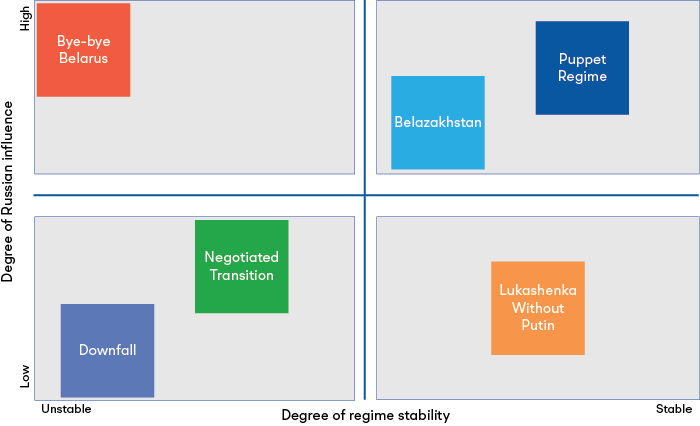
Most of these scenarios present European policymakers with a choice between a normative and a pragmatic approach, or some middle ground in between these two ideal types. Generally speaking, the normative strategy becomes more viable the weaker Russian influence and Belarus’ authoritarian regime become. That does not mean, however, that those scenarios necessarily call for a normative approach, as these same factors also increase the potential payoffs of a pragmatic approach in those scenarios. In scenarios 3 (Bye-bye Belarus) and 6 (Downfall), however, this policy dilemma is suspended, as either Belarus ceases to exist as an independent state or any decision about the pursuit of a normative or pragmatic strategy towards Belarus would have to be postponed until after Belarus has been stabilised. Furthermore, scenarios 2 (Puppet Regime) and 3 (Bye-bye Belarus) transform Belarus into a de facto military outpost of the Russian Federation and call for the reinforcement of NATO’s eastern flank, even though in scenario 2 this will further constrain Lukashenka’s foreign policy options to diversify beyond Russia. Pragmatic engagement is also the most effective way for Europe – and the West more broadly – to try to avoid these two unfavourable scenarios in which Russia’s influence over Belarus further expands.
In addition, this reports provides the following more general recommendations:
A real policy debate that is grounded in an understanding of the opportunities, limitations, and trade-offs of the different strategies on offer is urgently needed. The fact that there are no easy solutions regarding Belarus does not mean that there are not important choices to be made; and the longer we postpone making them, the more likely it is that events will develop in ways that will limit European agency to shape them going forward.
European policymakers also need to differentiate analytically between Russia and Belarus, even if they for the time being prefer to treat them in similar ways. This report clearly shows that the interests of the Lukashenka regime and the aspirations of Belarusian society are profoundly different from those of Russia.
The focus of the policy debate on Belarus should be on the question when the benefits of a more pragmatic engagement with Minsk begin to outweigh the costs. These benefits include primarily strengthening Belarus’ sovereignty and strategic autonomy, as well as the ability to extract concessions – such as a release of political prisoners and an end to forced migrations – in exchange for measures that normalise diplomatic and economic ties between Belarus and Europe.
Policymakers should also create a roadmap that lays out the concessions Minsk would have to make in exchange for specific measures to restore diplomatic relations and alleviate sanctions. By clarifying what Europe expects Belarus to do in exchange for the rapprochement that Minsk so urgently seeks, and by breaking up the normalisation of diplomatic and economic relations into smaller, more manageable chunks, Minsk’s incentives to comply with these demands would increase while the cost of doing so would become more manageable for Minsk.
Finally, policymakers need to think more strategically about Belarus. As the analysis in this report shows, the choices that are made regarding Belarus are intimately connected to larger strategic issues regarding Russia, Ukraine, and NATO’s eastern flank. Vice versa, Europe’s and NATO’s Russia strategy, the decision on NATO membership for Ukraine, and Europe’s postwar security architecture more broadly will impact the autonomy that Minsk can create for itself, and thus also indirectly the extent to which Belarus will likely turn into a military outpost of Russia. Moreover, the Kremlin is likely to link the issues of the security architecture of Ukraine, Belarus, and NATO’s eastern flank in future negotiations with the United States, and Europe (defined as the EU and European NATO allies) should ensure it has its position clearly defined and articulated to avoid being left out of these discussions.