
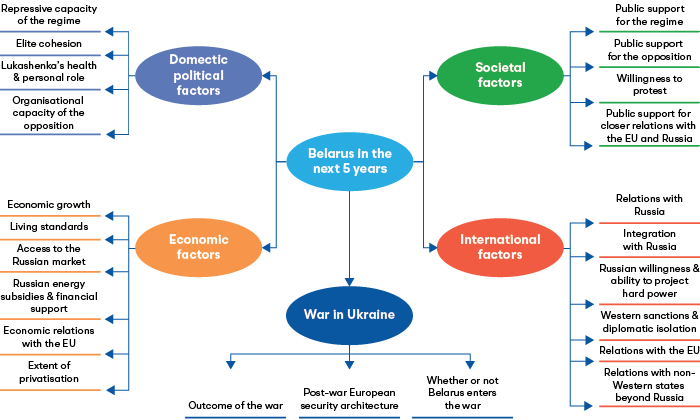
This chapter discusses the key factors shaping the future political system and geopolitical orientation of Belarus that have been identified in the recent policy and academic literature. Following the template of the Clingendael Institute’s recent scenario study on the Russian Federation,[28] these factors have been divided into 5 categories: domestic political factors, economic factors, societal factors, international and geopolitical factors, and factors specifically related to the war in Ukraine. Given that these factors are often strongly interdependent, the analysis below will also attempt to sketch out some of the main causal links between them.
Figure 3 provides a brief schematic overview of the various factors of influence on the future political system and geopolitical orientation of Belarus that are discussed and analysed in this chapter. These factors form the foundation for the two key aggregate factors that structure the scenario matrix used in this report to build the scenarios for the future of Belarus that will be laid out and analysed in chapter 4.
Domestic political factors
The first category of factors concerns the domestic politics of Belarus. Figure 4 shows the results of the survey held among the participants of the Clingendael Institute’s October 2024 Belarus scenario workshop on the impact of domestic political factors. Experts gave significant weight to the regime’s repressive capacity, elite cohesion, and Lukashenka’s health and political role, but much less to the ability of the opposition to Lukashenka to shape the future political system and geopolitical orientation of Belarus.
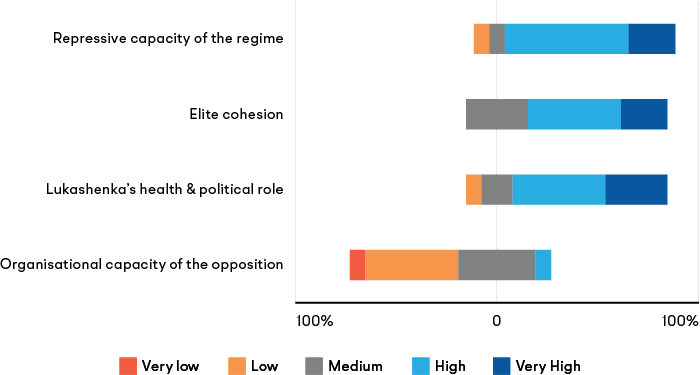
As in many – if not all – authoritarian regimes, the repressive capacity of the Lukashenka regime is key to maintaining its stability.[29] Especially after the decline in Lukashenka’s popularity (see below) and the 2020 protests, the role of repression in maintaining the stability of the regime has become indisputable. A key role in the substantial repressive apparatus that Lukashenka has under his control is played by the Committee for State Security (Komitet gosudarstvennoi bezopasnosti, KGB; abbreviated as KDB in Belarusian), which, unlike its Russian sister institutions (the FSB and the Foreign Intelligence Service, SVR), has maintained its Soviet-era name. If the repressive capacity of the state were to diminish in the future, this would likely pose an immediate existential threat to the regime of Lukashenka or a potential authoritarian successor. At the same time, a stable repressive capacity should not be equated with stable levels of repression, as the regime can – and does – ramp up and scale down the severity of its repression at will as long it maintains this capacity.[30]
The repressive capacity of personalist authoritarian regimes like Lukashenka’s is largely a function of elite cohesion. As long as key security elites remain loyal to the president, it is very hard – if not impossible – for protesters to overthrow these regimes.[31] Indeed, one of the key factors that enabled the Lukashenka regime to survive the 2020 protests – apart from Russia’s support – was the fact that the ruling class, and in particular the security forces, remained united and loyal.[32] Of course, these elites depend on Lukashenka for their current positions and – by extension, given the level of corruption – their private wealth. Therefore, the price of turning against Lukashenka is high. Nonetheless, splits within the Belarusian elites could occur in the case of a major crisis, such as a deep economic crisis or the Belarusian armed forces entering the war in Ukraine on Russia’s side, both of which could be accompanied by mass protests.[33] Alternatively, elite splits within post-Soviet authoritarian regimes have often occurred when a top political patron – usually, like in Belarus, a president – either left the political scene or was expected to do so soon.[34]
Indeed, Lukashenka’s health and political role are another key factor shaping the future of Belarus. Given the general consensus that Lukashenka will never allow substantial political liberalisation to take place, his removal from power is seen as a sine qua non for the potential future democratisation of Belarus. Indeed, various analysts have expressed (cautious) optimism that the disappearance of Lukashenka from the political scene will open up opportunities for the country to democratise.[35] At the same time, a comparative analysis of (Eurasian) authoritarian regimes shows that the fall of one dictatorship, even if temporarily followed by an opening up of the political system as various elite groups vie for control, is usually followed by the establishment of another authoritarian regime as elites again consolidate around a new leader without fundamentally liberalising the institutions of the political system.[36]
In connection with that, the way in which a potential transition of power to a successor would take place could be highly consequential for Belarus’ political future. Based on examples from other post-Soviet states, Andrey Makarychev and Stefano Braghiroli have outlined three pathways of domestic political development in Belarus in the near future. The first one is the “Putin story,” which entails a lifelong presidency for Lukashenka that leaves the succession question wide open. That seems to be Lukashenka’s preferred option, presumably because any potential successor can become a potential rival. The second option is the “Nazarbayev story: a guided soft transition of power to a loyal successor.” As the Kazakh case has shown, however, this is not without risks for former presidents. Although Lukashenka recently expanded the powers of the All-Belarusian People’s Assembly (ABPA), making it the highest organ of state power, there is no indication that he plans to follow Nursultan Nazarbayev’s lead and relinquish the presidency during his lifetime, while using the ABPA to preserve influence. Instead, it seems that the purpose of the newly empowered ABPA is for the elites surrounding Lukashenka to be able to hold onto power after he departs from the political scene. The third option, the “Yanukovych story,” revolves around “another wave of mass-scale protests triggering Maidan-like repercussions in Belarus.”[37] This is undoubtedly Lukashenka’s nightmare scenario and it did seem possible in 2020. Perhaps a more important issue than the exact mechanism of the succession is what political reforms would be enacted after the power transition, especially if those would substantially change the relations between the core branches of government.[38]
The above factors have so far focused exclusively on the Lukashenka regime. But while the regime is the key actor in Belarusian politics, it is certainly not the only one. The organisational capacity of the opposition is also an important factor. This became particularly clear in late 2020, when the Belarusian opposition united to an unprecedented extent and posed a serious challenge to Lukashenka’s regime. Since then, however, questions have arisen about the political relevance of the democratic opposition, which is now in exile. For starters, the unity of the exiled opposition is fraying while its influence in Belarusian society seems to be waning. In addition, the opposition in exile seems to be increasingly orienting itself towards serving the interests of the Belarusian diaspora. The position taken by the democratic opposition in exile to aim for the withdrawal of Belarus from all alliances with Russia and instead to join the EU is indicative of its disconnect from Belarusian society, given that such a position is not shared by the majority of Belarusians inside Belarus.[39] There is also no concrete evidence that the opposition in exile enjoys majority support inside Belarus itself.[40] An important question is thus whether the opposition in exile can remain relevant, and ideally connect to political forces inside Belarus, or whether its role will become purely symbolic.[41]
Economic factors
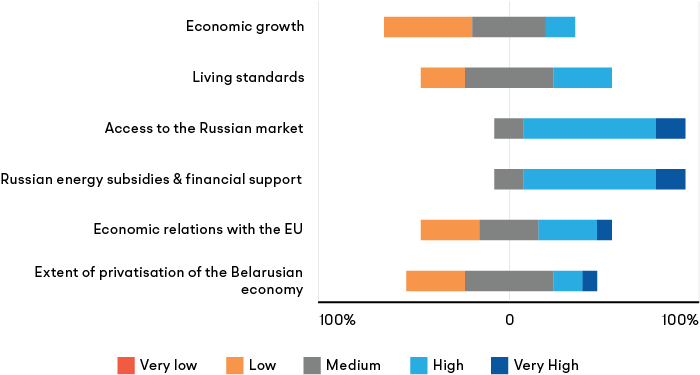
Economic factors also potentially play an important role in shaping the future of Belarus, not in the least because they influence regime stability. The results from the expert survey presented in Figure 5 show, however, that the participants in the Clingendael scenario workshop generally saw economic factors as less important in shaping the future of Belarus than domestic political factors. Not only that, but expert assessments of the impact of the economic factors also differed more widely than those of domestic political factors, indicating that the experts were less certain about the role that these economic factors play in shaping the future political development and geopolitical orientation of Belarus. The only two standout economic factors that were deemed impactful at a comparable level with factors indicating the strength of the regime were the factors related to the Russian economy (access to the Russian market and the level of Russian economic support).
Judging by the academic literature on the better studied Russian case (which under President Putin has a relatively similar personalist authoritarian regime to Lukashenka’s), there are two main factors linking economic growth to regime stability. First of all, economic growth provides the regime with the means to reward – and thereby to maintain the loyalty of – key elites on which it depends.[42] Based on her communication with Belarusian government and security officials, Tatsiana Ashurkevich reported that “Lukashenka’s elites will follow orders only as long as the regime satisfies their financial expectations.”[43] That may be somewhat of an oversimplification, as elites will not defect in the absence of a seemingly viable leader who could replace Lukashenka, but it does nonetheless point to the importance of funding in maintaining the loyalty of key elite patron-client networks.[44]
Secondly, to the extent that economic prosperity translates into increases in living standards (including through government policies like social spending), it enhances regime legitimacy and thus lowers the chance of protests and the costs of repression.[45] Indeed, Lukashenka’s popularity in the earlier stages of his rule was in large part based on his ability to provide stability and rising living standards, while his inability to prevent the erosion of Belarusian living standards in later years played an important role in fuelling the discontent that led to the protests of 2020.[46] After 2010, the Belarusian economy stagnated alongside its much larger Russian neighbour, whose generosity in subsidising its smaller neighbour had also declined significantly since the 2000s.[47] Authoritarian rulers thus face an important trade-off with regard to how they use their wealth – to put it simply, the question is to what extent they enrich themselves and their cronies and to what extent they allow the population at large to benefit from growth or to suffer from downturns.[48]
Unlike Russia and many other post-Soviet states, resource-poor Belarus is not primarily an exporter of commodities, but instead of manufactured products. Nonetheless, like most other post-Soviet states, a lack of post-Soviet investment – especially Foreign Direct Investment, or FDI, which played a key role in modernising the manufacturing bases of post-communist economies in Eastern Europe – gradually eroded the competitiveness of Belarus’ manufacturing base over time.[49] As a result, access to the Russian market has been key for Belarus to maintain its manufacturing exports, and thereby its economic stability.[50] Between 1995 and 2020, the share of Belarusian exports that went to Russia remained relatively stable at around 45%.[51] But after 2020, the Russian Federation’s share of Belarusian foreign trade increased substantially, from 49% in 2021 to 60% by the autumn of 2022.[52] And already by mid-2023, Russia’s share accounted for 70%, while its share of Belarusian exports was thought to exceed 90%.[53] Moreover, similar to other Soviet cities, Belarusian towns regularly rely heavily on one or two industrial employers, meaning that trouble inside these companies can easily spill over into social unrest.[54]
Energy subsidies and financial support from Russia also play a pivotal role in maintaining the stability of the Belarusian economy. The already dubious profitability of Belarusian industry is dependent on subsidised Russian gas imports, especially for energy-intensive products like steel or fertiliser. Moreover, Belarus has benefited from subsidised imports of Russian crude oil, which it refines and processes into petrochemical products domestically, and then exports at world market prices.[55] The size of these energy subsidies is substantial, though difficult to estimate accurately – not in the least because the level of subsidisation has fluctuated significantly over time, probably between around 10% and 20% of Belarusian GDP (and an even more significant share of the state budget).[56] In addition to energy subsidies, loans from Russia have also played an important part in stabilising the state finances of Belarus. These loans have been provided directly from Moscow or indirectly through the Eurasian Development Bank, in which Russia is the largest shareholder. By cutting off Belarus’ access to Western financial markets, Western sanctions have in recent years further increased the country’s dependence on Russian finance.[57]
Despite Russia’s key role in the Belarusian economy, the EU is an even greater economic powerhouse in the region. As such, it is unsurprising that economic relations with the EU – and, specifically, trade with and investment from Europe – are also an important factor shaping the future of Belarus, as these have the potential to diminish the Belarusian economy’s dependence on Russia and to provide Belarus with better developmental prospects more generally, especially given the weak long-term growth potential of the Russian economy. Indeed, when the economic downturn in Russia in 2014-2015 caused a serious economic crisis in Belarus, it convinced Minsk to diversify its foreign trade more evenly between Russia, the EU, and the rest of the world – the so-called 33:33:33 formula.[58] But despite the fact that the share of Belarusian trade with the EU had increased steadily since the turn of the century, these exports were less diversified than Belarus’ exports to Russia, as they remained dominated by refined oil and petroleum products, produced for the most part with crude oil imported from Russia.[59] Following 2020, Belarus’ foreign trade formula was revised to 50:25:25,[60] and we have already seen that Russia’s de facto share of Belarusian foreign trade by now well exceeds that aspirational figure of 50%.
Flows of goods and capital between Europe and Belarus have been repeatedly obstructed by Western economic sanctions against Belarus, most of all after the 2020 crisis and Russia’s 2022 invasion of Ukraine.[61] The actual economic impact of Western sanctions, however, has not only been a function of their severity, but also of Moscow’s ability and willingness to compensate Minsk for the damage done by them. Thus, for instance, Minsk actively sought rapprochement with the West in 2015, even though sanctions back then were much less punitive then they are today, at least in part because the Kremlin was less supportive and the Belarusian economy was also hit by the simultaneous recession in Russia.[62] In contrast, the Belarusian economy grew by 3.9% in 2023,[63] as substantial Russian energy subsidies and continued Russian growth offset the impact of Western sanctions that were more severe than those in 2015.[64]
Unlike Russia, Belarus never attempted to enact far-reaching privatisation in the wake of the Soviet collapse in December 1991. As a result, state-owned enterprises still dominate the Belarusian economy.[65] This also means that Belarus, unlike Russia or Ukraine, does not have a class of private business oligarchs. Nonetheless, the role of the state in the Belarusian economy gradually decreased in the wake of the economic recessions in 2009 and 2015-2016, as private enterprise began to fill niches abandoned by the state, such as tourism and the IT sector. According to the International Monetary Fund, the state’s share in economic output declined from 70% to 50% between 2014 and 2018. Even so, the public sector has remained by far the largest employer in the country.[66]
The extent of the privatisation of the Belarusian economy impacts not just the future development of the Belarusian economy, but is also a factor shaping Belarusian politics. For starters, privatisation could lead – especially when paired with improvements in governance –to important inflows in FDI, which would bring much-needed capital and technology transfers. After all, the key reasons why Belarus missed out on FDI compared to more economically successful post-communist states in Eastern Europe has been the absence of large-scale privatisation and the relatively poor protection of property rights in Belarus.[67] Substantial privatisation remains politically tricky, however, given that it would not only loosen the grip of the state on the economy and employment, but also provide inroads for Russian business – private and state-owned – to increase its foothold in Belarus.[68] A larger private sector is also thought to be beneficial for the development of civil society and autonomous political movements.[69]
Societal factors
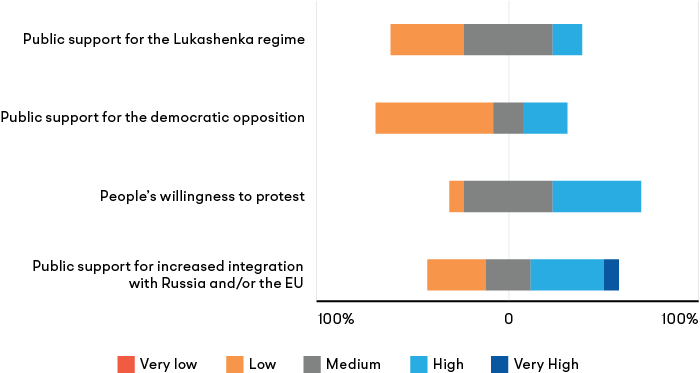
The results of the expert survey on the impact of societal factors on the future of Belarus (Figure 6) are quite similar to the results for the economic factors in that experts widely disagree on the importance of these factors in shaping the future political system and geopolitical orientation of Belarus. The same was also true for the organisational capacity of the opposition in Figure 3, which, although classified as a domestic political factor, is of course closely related to the factors under discussion in this section.
Despite the key importance of the regime’s repressive capacities for maintaining political stability, public support for the Lukashenka regime is not irrelevant. In fact, personal popularity is highly useful for authoritarian leaders, as it makes it less likely that people mobilise to protest against these regimes (thereby also lowering the cost of repression) and signals to key elites that defecting to an opposition candidate or intra-regime rival is not a good idea.[70] Lukashenka was for a long time quite popular and would likely have won elections even in the absence of the fraud that was being committed to boost his numbers, although that popularity steadily eroded over time. Of course, Lukashenka’s popularity existed in a context in which the media were firmly under the regime’s control and opposition figures could not freely operate; but his popularity was real nonetheless. Moreover, the importance of Lukashenka’s popularity was shown by the fact that its collapse played a critical role in sparking the protests of 2020. On top of the economic ills, Lukashenka’s failure to take any serious action in the face of the Covid-19 pandemic further undermined his already faltering legitimacy.[71]
Although accurate numbers are not available, it is clear that Lukashenka’s popularity had tanked by 2020. Independent internet polls in 2020-21 showed Lukashenka’s popularity at around 3-6%,[72] which is most likely a substantial understatement, but still a rough indicator of the lack of support for him. A public opinion poll conducted by Chatham House in April 2021 showed that more than half of Belarusians thought that Lukashenka should leave by the end of that year, while 27% supported him staying on until his term would end in 2025, and only 10% supported Lukashenka staying on beyond that.[73]
Just as Lukashenka’s popularity is important, so is, of course, public support for the democratic opposition. Like the popularity of the regime, public support for the opposition is also hard to gauge and figures differ. According to the April 2021 Chatham House poll, only 27% of respondents trusted Tsikhanouskaya, whereas 42% did not, although those were better scores than the 29% (trust) and 53% (don’t trust) that Lukashenka received. Curiously enough, significantly more people thought that Lukashenka, rather than Tsikhanouskaya, would make a good (25% vs 10%) or the best (23% vs 4%) president. Equally interesting is the fact that across all these measures, the jailed opposition candidate Viktar Babaryka (the former chairman of the Belgazprombank, owned by Russian Gazprom and Gazprombank) scored higher than both Tsikhanouskaya and Lukashenka.[74]
Public support for the regime and the opposition are closely connected to another important societal factor, namely the willingness to protest. At the same time, a lack of public support does not easily translate into a willingness to protest, given that the cost of protesting openly often remains prohibitively high for many – if not most – people. According to another Chatham House poll from January 2021, around 37% of urban Belarusians formed the core of the protest movement, while 45% did not take to the streets despite being tired of Lukashenka. Another 18% of city-dwelling Belarusians supported Lukashenka.[75] Vice versa, the fact that the likelihood of large-scale protests erupting in Belarus is currently deemed very low[76] says relatively little about the level of support that exists for the Lukashenka regime (or the opposition, for that matter) inside Belarus. Moreover, as we also saw in 2020, a willingness to protest should not be equated with regime change, as authoritarian regimes tend to be resilient as long as key (security) elites remain loyal to the dictator. But large-scale protests can undermine support for a dictator and provide elites with incentives to defect.
Another relevant aspect of Belarusian public opinion is public support for increased integration with Russia and/or the EU. The polls have consistently shown support for the preservation of Belarus as an independent state. Support for the merging of Belarus and Russia into a single state has been consistently under 10% among the Belarusian population.[77] Opinion polls also consistently show that Belarusians want good relations with both Russia and the West, rather than making a choice between them. According to the April 2021 Chatham House poll, 79% of Belarusians had a positive attitude towards Russia, while the number for the EU was only somewhat lower at 60%. And while only 9% of respondents wanted Belarus to be exclusively in the EU as opposed to 32% in a union with Russia, a substantial 46% preferred to be in a union with both at the same time. Moreover, 58% of Belarusians wanted to remain in the Collective Security Treaty Organisation (CSTO), while 35% preferred to see a neutral Belarus not belonging to any military alliance and only 7% favoured NATO membership.[78] Other polling figures also indicate that prior to February 2022 around 60% of Belarusian respondents favoured a policy of neutrality or equidistance with the major powers. Even after Russia’s full-scale invasion of Ukraine further undermined the viability of a neutral position in between Russia and Europe, still a large majority of around 45% to 50% continued to favour some form of neutrality.[79]
Such polling data reveal some important facts about Belarusian society. Although Belarus and Russia have similar political systems, the geopolitical attitudes of their populations are profoundly different. Whereas Russian attitudes seem to reflect their country’s great power status (or, at the very least, aspirations), Belarusian attitudes seem to conform closely to the geopolitical position of Belarus between Russia and Europe, as well as to Minsk’s preference for a multi-vector foreign policy. In line with this, unlike the Ukrainian Euromaidan protests, the 2020 protests in Belarus were not about foreign policy orientation or a “civilisational choice” between Russia and Europe, but about grievances regarding domestic politics and governance, and specifically regarding President Lukashenka.[80]
International and geopolitical factors
While the categories of domestic factors discussed above (domestic political, economic, and societal factors) are important in shaping the future of Belarus, the country obviously does not exist in a geopolitical vacuum. Therefore, we now turn towards the international and geopolitical factors that shape the future of Belarus. As Figure 6 shows, the experts who participated in the Clingendael Institute’s October 2024 Belarus scenario workshop scored the impact of the international and geopolitical factors related to Russia consistently high. They were, however, much more divided about the role that the West and non-Western states beyond Russia (primarily China) could play in shaping Belarus’ future.
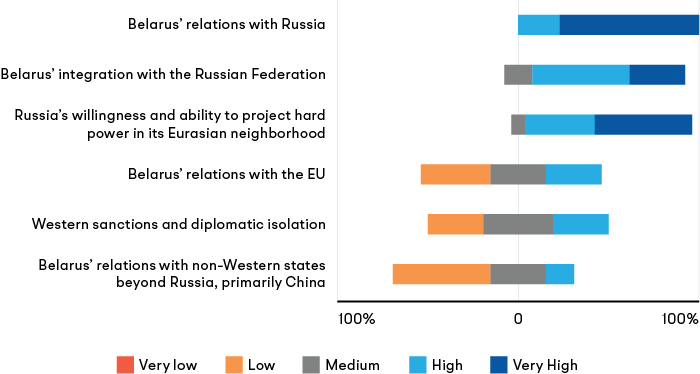
Given Belarus’ economic dependence on its eastern neighbour, Moscow’s support for Lukashenka’s authoritarian regime in Minsk, as well as Russia’s military dominance in the region and Moscow’s perception of Belarus as a key strategic asset in its sphere of influence, Belarus’ relations with Russia are absolutely key to shaping the future course of the country. This crucial relationship between Minsk and Moscow has been characterised by partially overlapping but at the same time also profoundly conflicting interests. While Moscow attempts to gain influence in Belarus at minimal cost, Minsk has attempted to extract economic benefits (such as subsidies and market access) while preserving its sovereignty and autonomy as much as possible. The result has been a rocky relationship, marked by disputes over the level of economic support from Moscow (primarily in terms of oil and gas subsidies), as well as steadfast resistance by Lukashenka to furthering the Kremlin’s integration agenda wherever it extended beyond the economic sphere. As such, for Lukashenka the relationship with Moscow has always remained a double-edged sword. On the one hand, Russia’s support helped to keep the Lukashenka regime in power and shielded it from Western pressures to democratise. On the other hand, Russia poses the single greatest threat to Belarusian sovereignty.[81]
Conflicting interests meant that the relationship between Moscow and Minsk has been subject to frequent and substantial volatility. From the early stages of his presidential rule, Putin proved unwilling to unconditionally prop up the Lukashenka regime, while Minsk did not want to pursue deep integration with the Russian Federation.[82] In relation to that, repeated conflicts over the supply and prices of natural gas and oil broke out throughout the 2000s and 2010s. Between 2007 and 2011, Russia’s state-owned Gazprom also used the threat of price hikes for natural gas to acquire Beltransgaz, the company (formerly owned by the Belarusian state) that controls Belarus’ natural gas infrastructure (including the pipeline network).[83] Moscow has also repeatedly (most notably in 2015) pressured Belarus to house a Russian military base on its territory, which Lukashenka has resisted, not wanting to bring in the type of Trojan horse that had facilitated Russia’s rapid military takeover and annexation in Crimea in 2014.[84] In response to Minsk’s refusal to pursue deeper integration with Russia and Russia’s own mounting economic troubles, the Kremlin was less generous with its energy subsidies to Belarus in the years leading up to the 2020 protests than during the 2000s.[85] After 2022, however, Moscow’s economic support for Belarus increased once again, as the stability of the Lukashenka regime became a military priority for the Kremlin.[86]
Despite Lukashenka’s resistance thereto, over time Belarus’ integration with the Russian Federation – symbolically represented by the Union State of Russia and Belarus – has gradually deepened, especially since the protests of 2020 and the full-scale war in Ukraine. This integration can be divided into three aspects: economic, political, and military. Economic integration was the topic on which Minsk’s and Moscow’s agendas overlapped most closely. In 2015, Belarus became a founding member of the Eurasian Economic Union (EEU) – a customs union that was Moscow’s flagship project to further the integration of Eurasia under Russian leadership. Even though EEU integration did not develop, as Moscow wanted, beyond a common external tariff, and despite internal obstacles to free trade remaining substantial, it essentially superseded the economic dimension of the Union State project.[87] As discussed above, in recent years Western sanctions have made the Belarusian economy more dependent on Russia than Minsk ever intended.
Russia’s political and military integration agendas have always been more controversial in Minsk, which understands full well how such integration threatens Belarusian sovereignty. Indeed, the Kremlin’s attempts to erode Belarusian autonomy and Lukashenka’s efforts to preserve it is the key divergence of interests in the relationship between Moscow and Minsk.[88] Lukashenka has certainly made political concessions to the Kremlin since 2020 – notably his recognition of Russian sovereignty over Crimea.[89] So far, however, he has been able to prevent the formal dilution of his power over Belarus, despite his increased dependence on Moscow.
At the same time, the expansion of Russia’s military presence in Belarus – which Lukashenka long resisted – has proceeded apace since 2020,[90] and may recently have also acquired a nuclear component. Despite the absence of proper Russian military bases in Belarus and Russia’s military retreat from northern Ukraine, there remain an estimated 2,000 Russian soldiers in Belarus.[91] This increased military presence seems to further constrain the strategic room for manoeuvre that Minsk has, potentially even posing a direct threat to the continued existence of Belarus as a state that is separate from the Russian Federation. Even so, there are still significant obstacles to a de facto or de jure annexation of Belarus by Russia. Among them, as we have seen, is resistance on the part of not just the Lukashenka regime, but also the Belarusian population. An additional downside of annexation from the Kremlin’s point of view would be that Russia would have to take full financial responsibility for the Belarusian people and economy, something which it has shown to be reluctant to do since Putin came to power.[92]
The extent to which Belarus is currently a Russian vassal is disputed. Especially since 2022, various analysts and many Western policymakers have treated the Lukashenka regime as a satellite of the Kremlin and an extended arm of Putin’s foreign policy.[93] Others, however, argue that Lukashenka has maintained a not insignificant, though shrinking, degree of autonomy from Moscow, which the Kremlin has tolerated as it does not want to risk political instability in Belarus, primarily because of Belarus’ role as a military asset for Moscow in the Ukraine war.[94]
Of fundamental importance for Belarus’ geopolitical room for manoeuvre is also Russia’s willingness and ability to project hard power in its Eurasian neighbourhood. Within the framework of the strategic culture that dominates the Kremlin (and Russia’s political and security elites more broadly), it seems clear that Russia would use all the means in its arsenal – up to and including military force – to prevent a potential Euro-Atlantic integration of Belarus. Since Moscow (like Minsk) tends to see popular uprisings as attempted Western coups, the Kremlin is also likely to intervene to save the regime in Minsk in case a “colour revolution” would take place.[95] However, if at some point in the future, for whatever reason, either Moscow’s hard-power capabilities or its geopolitical worldview would radically change, this could open up new opportunities for Minsk to redefine its own geopolitical orientation.
Apart from Russia, the European Union is the other key potential partner of Belarus. Belarus’ relations with the EU have been shaped by the often conflicting forces of Belarus seeking closer ties with the EU, primarily to diversify its economic opportunities and balance against dependence on Russia, while resisting EU pressures to liberalise its political system and uphold human rights. From Lukashenka’s perspective, rapprochement with the EU has been most desirable when relations with Moscow have soured and when the Russian economy has faced a downturn; and most feasible when Lukashenka has not felt a substantial domestic threat to his rule. However, the regime has been much more willing to sacrifice its relations with Europe whenever it has felt existentially threatened from within.[96] After all, regime survival has always remained more important than maximising geopolitical autonomy, which in itself only indirectly contributes to regime survival. Ever since 2014, and especially since 2022, seeking rapprochement with the EU has been further complicated for Minsk, not just by Western sanctions, but also because it has to be extra cautious not to give Moscow the impression that it is bandwagoning with the West – thereby potentially provoking Russian military aggression similar to what Moscow unleashed against Georgia and Ukraine.[97]
And just like Belarus’ relations with Russia, its relations with the EU have also fluctuated strongly over time, for a while seemingly taking on a kind of cyclical nature. Major attempts by Minsk at rapprochement started in 2007-2008 and 2014-2015 when relations with Russia worsened and the Russian economy was in crisis. At the same time, Russian military aggression in Georgia and Ukraine during those years enabled Lukashenka to make himself look valuable to the West as a defender of Belarusian sovereignty, despite his democratic shortcomings. Even so, rapprochement remained conditional upon Lukashenka releasing political prisoners and on Western hopes of political liberalisation in Belarus. As such, these periods of rapprochement alternated with the imposition of Western sanctions whenever Lukashenka would brutally crack down on protests, usually following elections (notably in 2010 and 2020).[98]
Western sanctions and diplomatic isolation are an important variable shaping the level of Minsk’s dependence on Moscow. The sanctions imposed on Belarus by the EU and US in the wake of the Lukashenka regime’s crackdown on the 2020 protests have, in a sense, simply been the latest iteration in a back and forth of the EU putting pressure and reducing pressure on Belarus in the years prior to it. Apart from economic sanctions, EU member states stopped appointing new ambassadors to Minsk, replacing them instead with chargés d’affaires, and most member states have also stopped receiving Belarusian ambassadors themselves.[99] This swiftly brought an end to Minsk’s attempts to pursue a multi-vector foreign policy in years prior to this. Moreover, the extent of the sanctions imposed on Belarus, its role in the invasion of Ukraine in 2022, and the raised geopolitical stakes for Russia not to lose further influence in the post-Soviet Eurasian region have raised questions as to what extent the current level of integration between Russia and Belarus is reversible.[100] In response to the sanctions, Lukashenka has also engineered a forced migration crisis on the Belarusian-EU border (primarily the border between Belarus and Poland), presumably in an attempt to get the Europeans back to the negotiation table in order to bargain for sanctions relief or other forms of European support. In response, the EU allocated millions of euros to Belarus for repatriation flights and humanitarian aid.[101]
Despite the fact that relations between Belarus and Europe have never been worse, Minsk has recently been signalling its interest in resurrecting Belarus’ multi-vector foreign policy by restoring relations with both the EU and the US. Lukashenka and other top Belarusian officials have said so explicitly on various occasions. Belarus also introduced visa-free travel for Polish, Latvian, and Lithuanian citizens in 2021, which was unexpectedly expanded to include citizens of 35 European countries in July 2024.[102] In recent months, Minsk has also been releasing some political prisoners (while simultaneously arresting new ones), presumably with the same goal of creating conditions for rapprochement with the West (just like it did in 2008 and 2015).[103]
Recent efforts by Minsk to diversify its economic, security, and diplomatic relations beyond Russia and Europe have prompted analysts to consider the potential of Belarus’ relations with non-Western states beyond Russia, primarily China. On the one hand, Belarus has in recent years been deepening trade ties with the People’s Republic of China (PRC), as well as seeking increasing investment and financial support from China, as a way to balance its dependence on Russia. Minsk has also joined the Chinese-led Shanghai Cooperation Organisation in July 2024 to diversify security cooperation beyond Russia, shortly after which Belarus held joint military exercises with China near the Polish border. On the other hand, the PRC’s trade with, and FDI towards, Belarus lag well behind Russia’s, while the severing of economic ties between Belarus and Europe since 2020 has undermined Chinese interest in including Belarus in its Belt and Road Initiative.[104] As such, Belarus’ efforts to strengthen relations with China as a way of hedging against Russia seem to remain largely aspirational for the time being.
Factors directly related to the war in Ukraine
Russia’s full-scale invasion of Ukraine in February 2022 has been such a rupture in the geopolitics of Eastern Europe – indeed, in international politics at large – that it deserves to be dealt with separately from the other international and geopolitical factors. Specifically, it has created three new key factors shaping the future of Belarus. The result of the expert survey among the participants in the scenario workshop (Figure 8) show that these experts quite consistently rated factors directly related to the war in Ukraine as (highly) impactful in shaping the future political system and geopolitical orientation of Belarus.
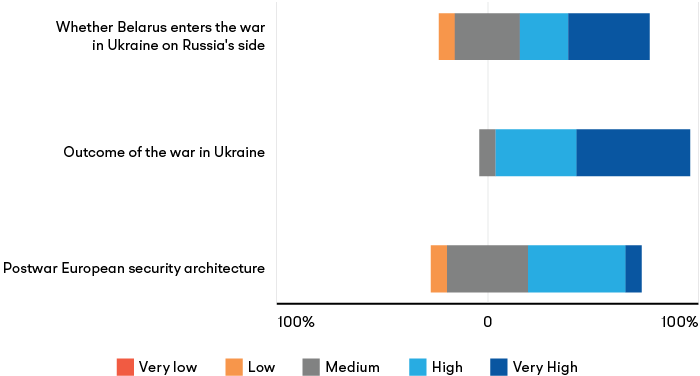
The first of these factors is whether Belarus enters the war in Ukraine on Russia’s side or not. So far, the Belarusian armed forces have not become directly involved in the war in Ukraine and Lukashenka has done everything to prevent this from happening. The Kremlin, presumably, has not pressed Minsk to do so, because the cost in terms of the potential destabilisation of the Belarusian regime would probably outweigh the battlefield benefits that the involvement of the Belarusian armed forces could bring.[105] Indeed, analysts generally concur that direct Belarusian involvement in the Russo-Ukrainian War – or even the expectation thereof – would pose a serious threat to the stability of the Lukashenka regime, especially given that the Belarusian armed forces would probably suffer high casualty rates, and may even be routed outright. It would be the type of crisis that could cause not just large-scale popular unrest, but even splits within the ruling elite.[106] Sociological research shows that only between 3% and 10% of Belarusians support the Belarusian army joining the war in Ukraine on Russia’s side.[107] Even so, it remains an open question whether (and under what conditions) Lukashenka would be able to resist if Putin were to pressure him into joining the war effort.
The second key factor shaping Belarus’ future that is directly related to the war is the outcome of the war in Ukraine. Artyom Shraibman has warned that both a Russian victory and a Russian defeat in Ukraine could lead to attempts to end Belarusian sovereignty. If Russia were to lose in Ukraine, Moscow may want to claim Belarus as compensation. Alternatively, if Moscow were to win in Ukraine, it could embolden the Kremlin and give it more leeway to increase its pressure on the Lukashenka regime. And, if a direct war between NATO and Russia would break out, Belarus would find itself right in the crosshairs, becoming a potential target of direct NATO attacks. Therefore, Shraibman has argued that the best outcome for Lukashenka may be for the war to become a stalemate or end in a cease-fire without a decisive victor.[108]
So far, insufficient attention has been paid to the impact that the postwar European security architecture could have on the future of Belarus. As Shraibman has pointed out, in future negotiations on a new European security architecture the West would likely demand that Russia withdraw its military presence in Belarus,[109] although it remains unclear how this could actually be achieved. It is interesting in this regard that, according to polling data, a majority of Belarusian citizens are opposed to having Russian nuclear weapons on the territory of their state.[110] Furthermore, an important question remains how the futures of Ukraine and NATO-Russia relations are intwined with Belarus, specifically regarding Russia’s future military presence in Belarus.