
Stolen cattle from the Sahel are just one small, albeit growing, element of West Africa’s wider livestock market. Multiple studies over the past decades have shown that most livestock are raised in Burkina Faso, Mali, Niger and northern Nigeria, and either owned and traded as capital in those countries or sent to markets in population centres along the coast for consumption.[23]
Ghana, with a population of 34 million people, has one of the highest levels of gross domestic product per capita in the region. The country has long been a net importer of live animals, mostly from Burkina Faso. Indeed, Ghana imports more than 90% of its consumption requirements of livestock.[24] Within Ghana, livestock are raised in rural communities in the north (usually by hired Fulbe herders), then either transported to urban areas in the north or sent further south.
The domestic and international trade in livestock in Ghana occurs largely through a network of cattle markets, ranging from small weekly markets in rural communities in the north to bustling entrepots in the south. Rural northern markets sell between 90 and 600 head of cattle every week; the busy Ashaiman market in the capital Accra handles an estimated 1,200 to 3,000 cattle every week.[25]
Connecting these two poles are a network of intermediary markets, mostly in the centre and north, which attract livestock from across northern Ghana but also for export.[26] Cattle at smaller markets are purchased either by local butchers for slaughter or by cattle dealers who will either raise the cattle further or transport them to intermediary markets such as Tamale, Techiman or Buipe for resale; or, in a smaller number of cases, directly to Kumasi or Accra. Cargo trucks are the most common means of transporting cattle (rather than on foot as pastoralist do).[27]
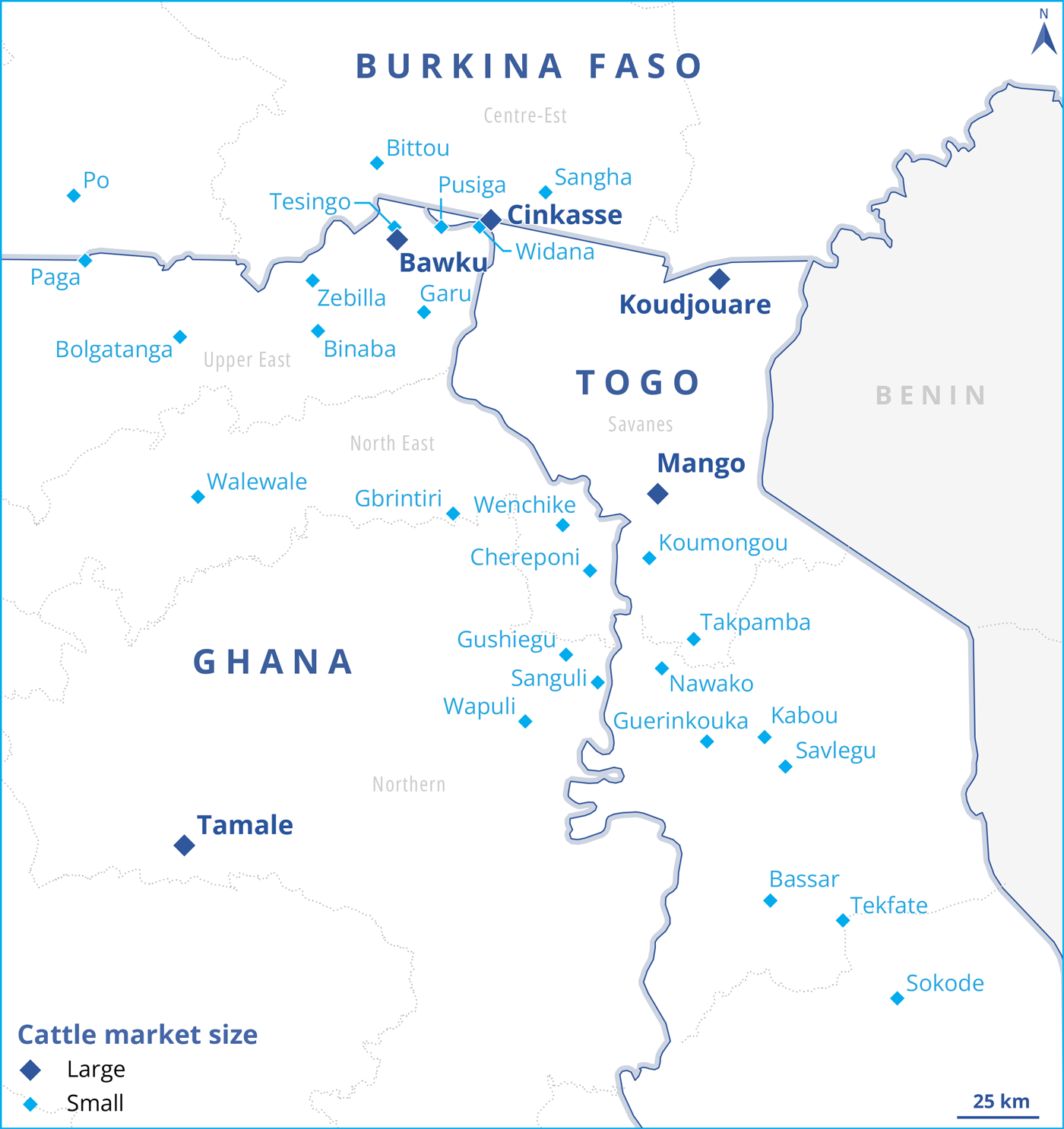
Ghana’s north-eastern tri-border area sits at the “origin” of the country’s developing livestock market network. Bawku,[29] Pusiga, Widana, Garu, Paga and Bolgatanga in Upper East; Gbintiri, Bunkpurugu, Chereponi, Tessa and Walewale in North East region; and Gushiegu in Northern region all have markets that source livestock from surrounding rural communities (Figure 2).
Pre-conflict cattle market dynamics
The tri-border region has historically been a hub for cattle rustling and smuggling.[30] Over the past decade, cattle rustling and smuggling networks in the tri-border region have become enmeshed in the war in the Sahel. Following the ousting of Blaise Compaoré as president of Burkina Faso in 2014, bandits, smugglers and cattle rustlers who had profited from the forests and porous borders in the country’s Centre-Est region grew bolder and more active, leading to a gradual increase in stolen livestock entering north-eastern Ghana.[31] Further east, groups of Ghanaian butchers would pre-finance bandits to steal livestock in Togo – sometimes opportunistically poaching stragglers from semi-nomadic herders, and at other times tracking and ambushing herders and seizing whole herds – and smuggling them into Ghana.[32]
Once in Ghana, stolen cattle from Burkina Faso and Togo were either distributed among butchers locally at the border or transported to intermediary markets deeper in Ghana (Figure 2).[33] Generally speaking, smaller numbers of cattle (under 20 head) were kept in forest areas or in private domiciles in towns and slaughtered over a period of days. Their meat was often sold to local restaurants or individuals. If the livestock numbered between 20 and 50, butchers would sell or trade them with other butchers in nearby towns. If there were over 50 head of cattle, which was more often the case when the cattle rustling was pre-financed, they would be loaded onto a truck either at the border or outside a border town and sent directly south to markets and abattoirs in Kumasi, Techiman or in the Volta region.[34]
The expansion of the Burkinabe conflict and changing dynamics in Togo have resulted in important changes, which we consider below.
Expanding Burkinabe conflict (2018–2022)
The steady escalation of the war in south-eastern Burkina Faso has led to an explosion of cattle rustling. As insurgents gradually expanded from the north into the country’s east in 2018, they used the forested border areas in Centre-Est region as a rear base – and a pipeline for moving stolen livestock south.[35] They embedded themselves in the area by tapping into smuggling networks and recruiting from among bandits, hunters, herders and artisanal gold miners.
Insurgents also engaged directly in cattle rustling in Burkina Faso. Interview respondents indicated that initially insurgents would steal whole herds from isolated herders in forested areas. They collaborated with cattle rustling gangs, but were not yet using cattle rustling as a tool of war to target specific villages.[36] This more opportunistic cattle rustling reportedly intensified in early 2022 when the insurgents began an active offensive in Centre-Est, destroying phone towers, setting up roadblocks, and attacking rural police stations and mayoral offices.[37]
Insurgents’ and bandits’ cattle rustling tactics fundamentally changed in late 2022. Across Burkina Faso, including in Centre-Est, the government actively recruited thousands of civilians into the ranks of the VDP, which enforced government control over urban areas and mounted roadblocks outside towns. A small number of individual rogue VDP members have also been accused of engaging in cattle rustling, sometimes as part of a strategy to displace communities suspected of supporting insurgents.[38]
Meanwhile, the insurgents responded to the VDP’s expansion by escalating their attacks on communities where VDP members had been recruited, including stealing their cattle.[39] The insurgents also reportedly began to demand what they referred to as zakat in the form of livestock from communities under their control, albeit in a disorganised and haphazard fashion not comparable to their practices in places such as Youwarou in Mali’s Inner Niger Delta.[40] While most bandits either joined the insurgents or the VDP, small groups of bandit cattle rustlers continued to operate by rounding up livestock that had wandered away from villages as populations fled.[41]
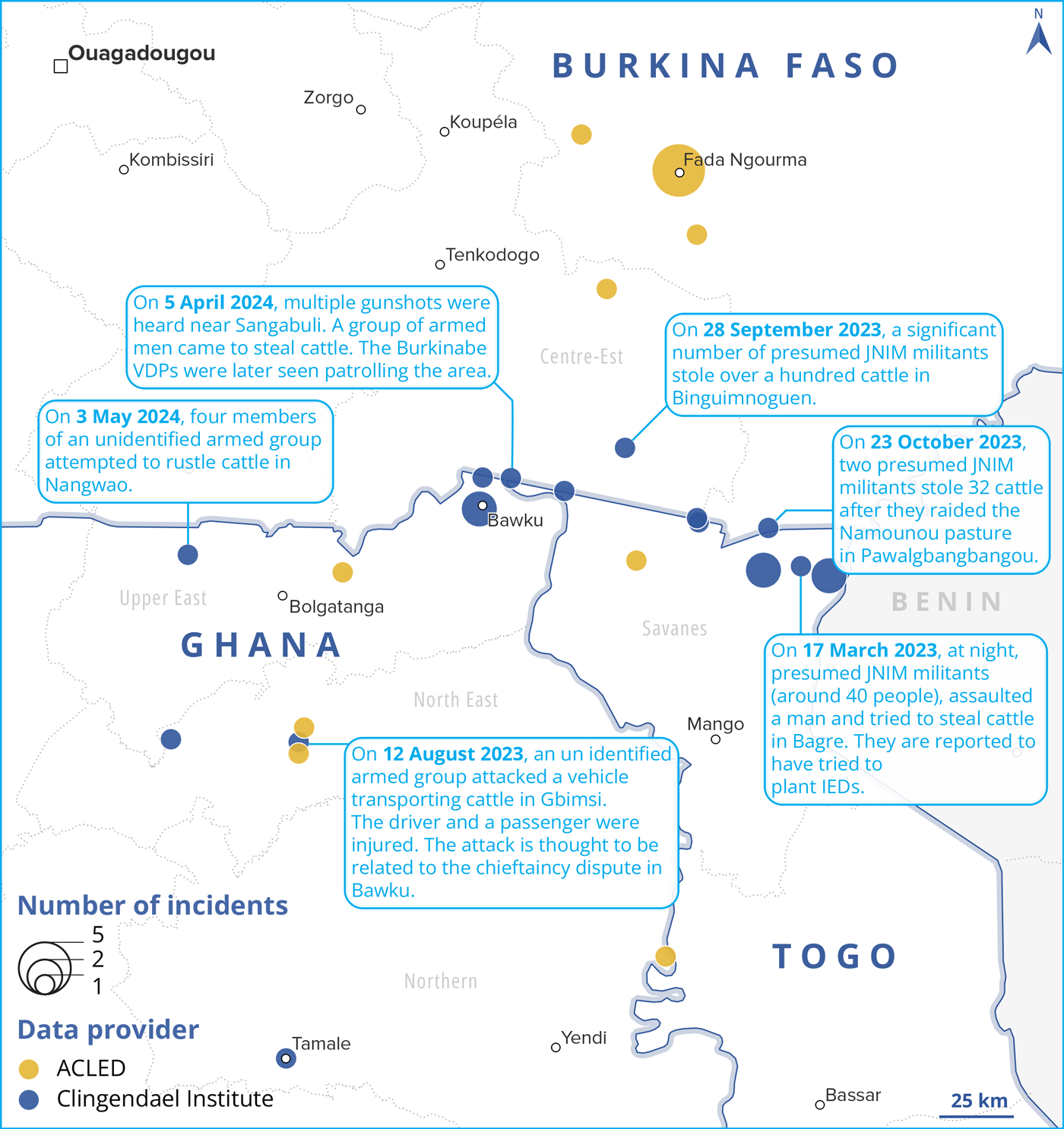
In Ghana, although cattle rustling occurs, it is not as organised or on the same scale as in Burkina Faso (Figure 3). The household survey in early 2024 of 150 respondents in Upper East Ghana close to Paga on the border with Burkina Faso, found that 34% of respondents perceived cattle rustling as the most important threat to their community (followed by 12% who identified ‘food shortage’ due to banditry as the primary threat).[42] While bandit groups operating on the Ghanaian side of the border are likely to be responsible, one should not rule out the possibility that other armed groups from Burkina Faso might occasionally cross the border to steal cattle disguised as bandits.
Togo’s trajectory: Rising insurgent presence and cattle rustling
The situation has evolved differently in north-eastern Togo. After suffering its first JNIM attack in late 2021, attacks became more frequent in mid-2022. While insurgents ambushed Togolese security forces and killed civilians they accused of working with the military, they also engaged in opportunistic cattle rustling, stealing from herders they encountered in forested areas or from communities following an attack (see cattle rustling incidents in Figure 3).
JNIM attacks and the government’s response, moreover, have changed cattle routes to and from Togo. Koudjouaré was once one of Togo’s largest livestock markets and an important place to sell stolen cattle. But after the Togolese military deployed in 2018, and as the conflict in Burkina Faso intensified, most cattle were moved to Cinkassé and Mango.[43] Insecurity also depressed the Cinkassé market, which went from selling between 500 and 750 head of cattle per market day to between 250 and 400.[44]
Meanwhile, evidence of a (temporary) insurgent presence in the area between Chereponi in Ghana and Mango in Togo also appears to have affected local cattle rustling dynamics.[45] Respondents in Chereponi and Saboba reported that the Ghanaian butcher-financed bandits who operated in Togo (mentioned above) had since disbanded following the killing of well-known bandits since mid-2023.[46]
Respondents gave different reasons for the killings but assessed that JNIM-linked insurgents were responsible. Household survey findings on the border between Mango (Togo) and Chereponi (Ghana) also indicated that 25% of the sample population had concerns about the extremist presence in the area. The reasons why insurgents killed these bandits are not clear, however. Some claimed the victims were tracked and killed by the insurgents in an attempt to regulate and reduce cattle rustling.[47] Others claimed that the victims had run into insurgents in the forest and had been killed to prevent them from revealing the insurgents’ position.[48]
One should not conclude that insurgents in Togo were attempting to reduce cattle rustling, as they have done in in Mali’s Inner Niger Delta.[49] There was only one incident. Moreover, as of early 2024, participants in focus groups in Chereponi argued that cattle rustling was still continuing, while the household survey in the same area found that over 35% of respondents felt their households continued to be affected by the theft of “crops and livestock”.[50]