


China’s role in peacekeeping
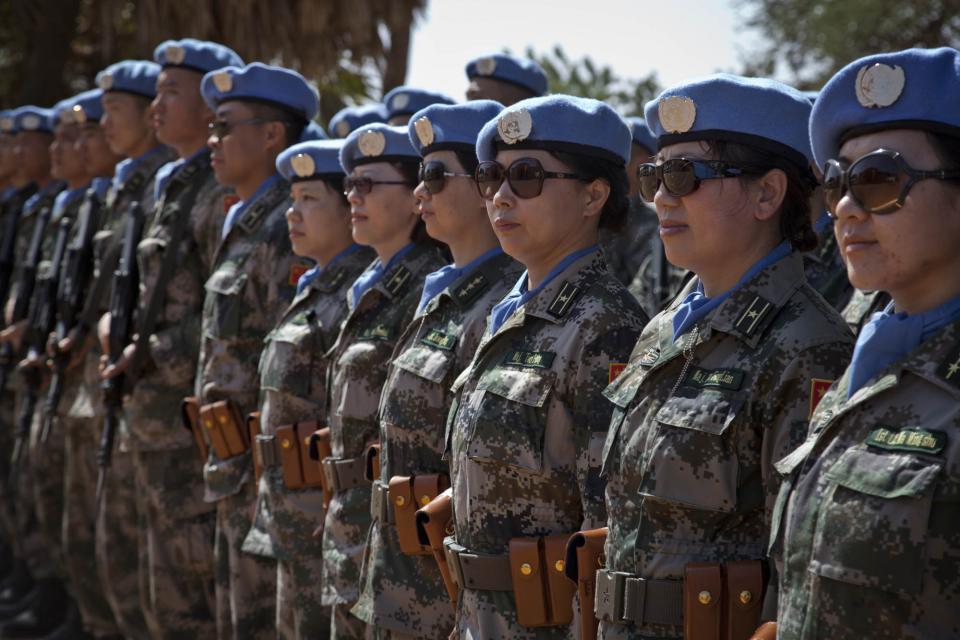
On 25 November 2014, Senior Research Fellow Frans-Paul van der Putten of Clingendael gave a keynote speech at a seminar on China’s role in international peacebuilding and conflict mitigation. This public event was organised by the Netherlands Ministry of Foreign Affairs and took place at the Hague Institute for Global Justice.
The topic of Frans-Paul van der Putten’s talk was China in the international political arena, and was aimed at describing the context in which China approaches peace operations. He outlined China’s evolving overall role as a global security actor, and its security interests in regions such as Africa and the Middle East. During his talk, the speaker mentioned that although the term ‘peacebuilding’ is included in the title of the seminar, it is noteworthy that in fact the Chinese government feels uncomfortable with this term. Peacebuilding suggests a relatively high degree and long term of foreign involvement in a post-conflict situation. Such involvement goes beyond ending a crisis situation and is aimed at adjusting the social, economic and political context. The Chinese government rather favours a more limited degree of foreign involvement.
The diverging views on the concept of peacebuilding between the West and China are indicative of the differences between the two sides when it comes to peace operations in third regions. Unlike most Western governments and non-governmental organizations, China prefers a pragmatic, case-by-case approach rather than an approach that is based on the universality of liberal values. Therefore, in order to identify which aspects of China’s involvement a United Nations peace mission, such as MINUSMA in Mali, may recur in the future and which are unique to that particular situation it is necessary to understand how the Chinese government looks at this.
China’s approach is flexible and evolving, which means that cooperation with the West is possible not so much as a matter of principle but depending on specific circumstances. In this context, contrasting views on national sovereignty and foreign intervention are not the core obstacle in Sino-Western relations. Instead, Chinese opposition to the Western practice of values promotion is a key issue that limits Beijing’s willingness to closely align its approach to conflict regions with Western policies. Other factors that impose limitations include Sino-Western geopolitical rivalry and China’s long-standing aim of positioning itself as the leader of the developing world. This raises the question whether and how such limits affect cooperation between China and a country such as the Netherlands within a mission such as MINUSMA.
Van der Putten’s main message therefore was that the starting point for improved Sino-Western cooperation in the sphere of peacekeeping is to acknowledge the major differences that exist between Chinese and Western views, interests, and approaches. Only by taking these into account does it become clear where the potential for cooperation can be found. Case studies on Chinese and Western involvement in ongoing missions such as MINUSMA are important to better understand these differences and the potential for cooperation.
Dr. Frans-Paul van der Putten is currently conducting a study on China’s role in MINUSMA, the United Nations peace operation in Mali, as a part of the Sahel Programme of the Conflict Research Unit of Clingendael.
Return