


Clingendael–CEPS Roundtable: The Geopolitics of the Clean Industrial Deal
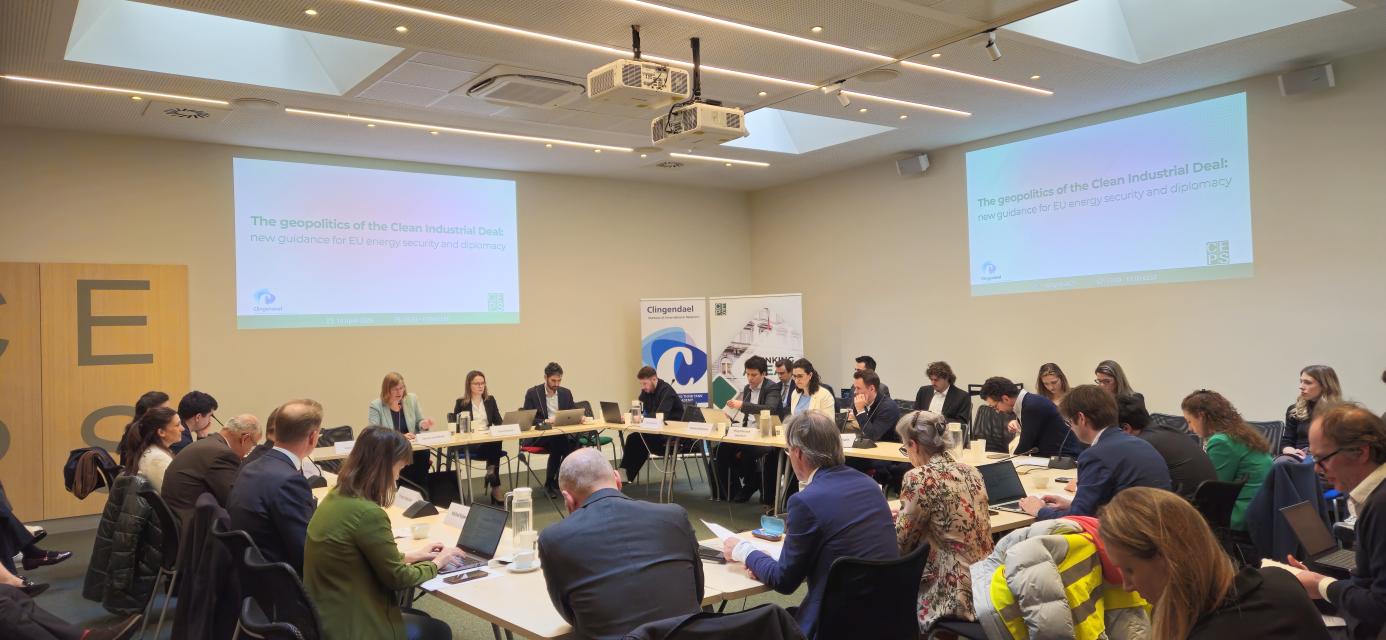
Amidst geopolitical turmoil and tariff tensions, the Clingendael Institute and the Centre for European Policy Studies (CEPS) co-hosted a high-level roundtable in Brussels titled The Geopolitics of the Clean Industrial Deal: New Guidance for EU Energy Security and Diplomacy.
The event convened around 60 stakeholders from EU institutions, national governments, think tanks, industry, and civil society to explore how the EU can make the external dimension of its Clean Industrial Deal more geopolitics proof.
The roundtable explored dilemmas and interlinked challenges, such as competing with cheap Chinese clean tech, the risks of de-industrialisation in Europe, involving European companies in the EU’s Global Gateway and dependency on US LNG exports to Europe. Discussions focused on trade-offs, productive narratives, policy levers and approaches to diplomacy to bolster the EU’s energy security and competitiveness—while aligning climate and energy, industrial, development and foreign policy objectives.
Framed by an opening statement by Louise van Schaik (Head of EU & Global Affairs Clingendael Institute) and Karel Lannoo (Director CEPS), two panels addressed key questions on resource security, global partnerships, and critical (inter)dependencies.
Roundtable I: “Securing energy and raw materials: positioning the EU amid intensifying global resource competition”
With contributions from Thomas Auger (Cabinet of Teresa Ribera), Tomasz Jerzyniak (DG ENER), San Bilal (ECDPM), Michiel Nijdam (Port of Rotterdam), and Laura Atienza (DG INTPA), this session highlighted that energy transition is an energy security imperative. The discussion focused on the challenges of securing supply chains for critical minerals and energy supplies, the key role of integrating a new trade and investment approach under Global Gateway, as well as the importance of a credible external narrative.
Roundtable II: “Industrial security and international partnerships: aligning EU energy transition objectives with geopolitical realities”
Speakers included Tibor Stelbaczky (EEAS), Nicolas Berghmans (IDDRI), Margit Wunsch Gaarmann (NKT), and Bruno Tobback (MEP), who explored how to advance industrial security and strengthen critical energy infrastructure resilience against external risks and sabotage. The debate focused on EU companies’ position vis-à-vis Chinese investments, the significant innovation already happening yet also still needed in Europe’s clean- and high-tech sector, and the implications of this for partnerships and trade deals with third countries.
Key takeaways:
- There is a growing need for a clearer, more strategic and credible narrative towards partner countries about what the EU has to offer, and what the interests are that are driving its external engagement.
- Advancing industrial competitiveness and sustainable energy resilience will require better alignment of the EU’s foreign policy, energy diplomacy, trade and investment instruments with its industrial policy objectives abroad.
- Strategic dialogues between the Commission and the private sector tend to focus only on how to ‘protect’ Europe’s industries; what is missing is a dialogue on the foreign policy and partnership dimensions of the CID.
- EU instruments under Global Gateway need to strengthen the international dimension of EU competitiveness by strategically supporting European companies, for example through export credit agencies.
- Levelling the playing field by revising regulations like CBAM is critical to attain “made in Europe”, especially for clean- and high-tech industries that are under pressure by overcapacity, e.g. from China.
- There is a common understanding that energy transition is an energy security prerogative; in order to deliver concrete policies under this shifting paradigm, better alignment across different DGs and portfolios in the European Commission is critical.
Held under Chatham House Rule, the roundtable provided space for an honest exchange and forward-looking reflections that will continue to inform the ongoing work and research of Clingendael and CEPS on energy transition, geopolitics and EU external engagement.


