


Clingendael trains Water Professionals from the Arab World
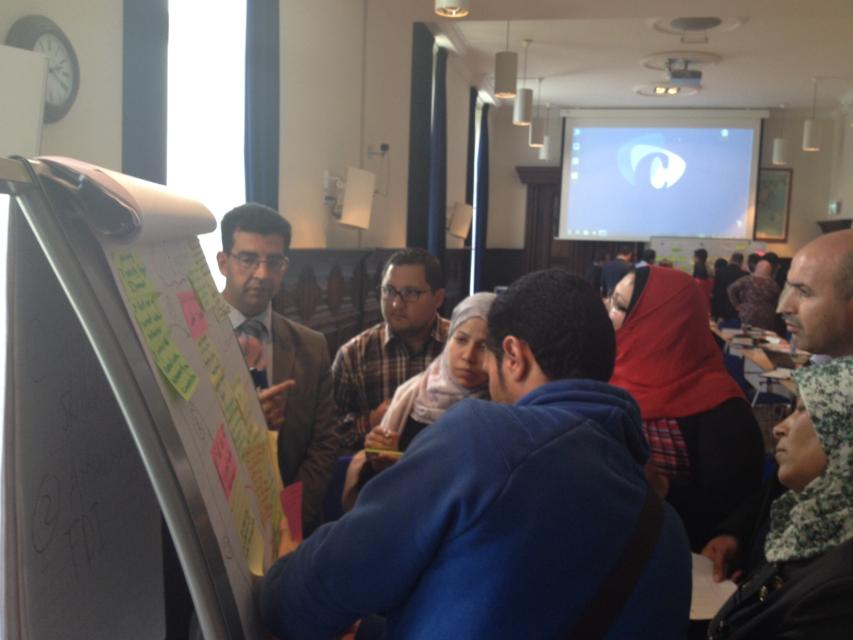
Last week Clingendael – organised the first part of a two-week training course on Water Management for twenty five professionals from Egypt, Jordan, Tunisia and Morocco. This training was organised with Clingendael in the lead and in close cooperation with UNESCO-IHE and WaterFocus, while made possible by funding from the Dutch Ministry of Foreign Affairs.
The participants embarked upon an intensive week of training that took them from Huys Clingendael to the canals of Delft and even as far as the former islands of Schokland and Urk.
Dutch Water Management
The first week of training was aimed at making introductions and exposing the participants to the Dutch experiences and expertise in the field of Water Management. During a fieldtrip to Flevoland, for example, the participants witnessed firsthand the famed polders, dykes and in particular the massive pumps used to regulate the water levels in the former Zuiderzee (South Sea).
 They also paid a visit to the Water Management Center in Lelystad, where they saw how the Netherlands tracks the current and predicted water levels in both the North Sea and rivers basins of the Rhine, Schelde and Meuse. This tracking technology was found to be quite impressive, but equally inspiring was the level of cooperation and information-sharing by the countries along these rivers that forms the foundation of such a system.
Exchanges and Skills
However, this training was not aimed at merely exposing the participants to the Dutch expertise in water management. The participants were also encouraged to share their own experiences and knowledge in water management with Dutch experts through expert lectures, a business and networking event and an interview carousel, but perhaps more importantly amongst themselves. Such exchanges along with specific skills training would then better equip the participants to cope with the challenges in their own water sectors.
These challenges varied greatly between the participating countries, of which some are currently still going through political transition as well. Jordan on the one hand is faced with water scarcity and a massive influx of refugees from Syria, while Morocco is at the moment faced with high levels of precipitation and the dangers of flooding. Egypt on the other hand is dealing with a large population boom and increasing demand for water in its agricultural sector, whilst Tunisia also has to deal with limited amounts of available surface water and dropping ground water levels.
World Cafe
At the end of the training participants were given the opportunity to put their newly acquired skills, knowledge and shared perspectives to the test by presenting a rough plan for dealing with these challenges. During this particular world café session, participants received feedback from both their colleagues and experts from UNESCO-IHE and WaterFocus .
 The same group of participants will soon travel to Morocco for the second week of training, where they will further develop their skills and plans for dealing with the challenges in their water sectors. Experts of Clingendael, UNESCO-IHE and WaterFocus will train skills such as negotiating, change management and project management. We wish them the best of luck and a most fruitful week of training!
More information?
For further information, please feel free to contact Mariska Heijs, project manager Course in Water Management.
- 28 April 2015