


Key-note speeches of Albanian Ministers at Clingendael
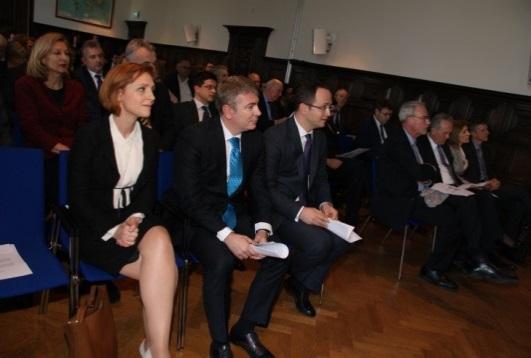
On Monday the 30th of March, the Clingendael Institute, in close cooperation with the Albanian Embassy, had the honour of hosting H.E. Mr Ditmir Bushati (Foreign Minister of Albania) and H.E. Mr Damian Gjiknuri (Minister of Energy and Industry of Albania). Both Ministers gave a keynote speech, followed by a fruitful Q&A, moderated by Ron Ton, Director of Clingendael Academy.
When is a Region a True Region – Some Thoughts on the Western Balkans
 Minister Bushati emphasised the importance of uniting the region through working towards European values. This would be a viable strategy, since Albanian citizens still identify with the EU process in spite of recent challenges. Shared values, according to the Minister, are one of the most important factors in identifying a true region. This is also reflected in the record of 100% alignment with EU foreign policy that the country boasts.
However, frozen disputes and different policy alignments within the Western Balkans show that the EU is needed to maintain peace and security in the region. The Berlin process is a crucial step towards strengthening the integration of the region in the EU. Improving the regional interconnectivity within the Western Balkans would accelerate growth and remove differences between leaders of the different countries.
Additionally, in the Q&A, Minister Bushati stated that the term Western Balkans should be substituted by the term Adriatic Europe as a denominator of the region. The usage of Adriatic Europe would improve the validity of analyses of the needs of Europe in that region, as well as reflecting the shared values that link the two regions, which, in light of the EU candidate-membership status, is essential.
Energy Security - Potentials and Challenges of Natural Resources in Albania
 Minister Gjiknuri highlighted the importance of energy diversification for the region and for the EU, which implies that Albania wants to move away from mainly relying on hydropower by exploring the possibilities of natural gas. Since Albania has excellent potential in both onshore and offshore oil and gas reserves, exploring and promoting this potential can facilitate such a shift. This shift is also reflected in a number of serious reforms in the energy sector, concerning for example privatisation and combating energy theft. These reforms have yielded impressive results so far, but there are still many more challenges to overcome. Many of these challenges can be overcome by furthering regional cooperation. TAP and IAP will play an important role not only in energy diversification but also in the unification of the region and Europe, offering a perfect platform for increased regional cooperation.
The EU has the potential to tap into the European Fund for Strategic Investment, and allocate these funds to energy projects in South-Eastern Europe would be a strategically wise choice, since it would offer a possibility to lower the European dependence on Russia. Additionally, Albania is a good location for onshore as well as offshore oil exploration and production, which also contributes to the aim of lowering energy dependence. These points were all reiterated in the Q&A, with the additional emphasis on Albania’s eagerness to attract foreign investors with capacity and resources, to make full use of the opportunities that the country offers.
- 7 April 2015