


Panel Discussion 'One year after Majdan' at Clingendael
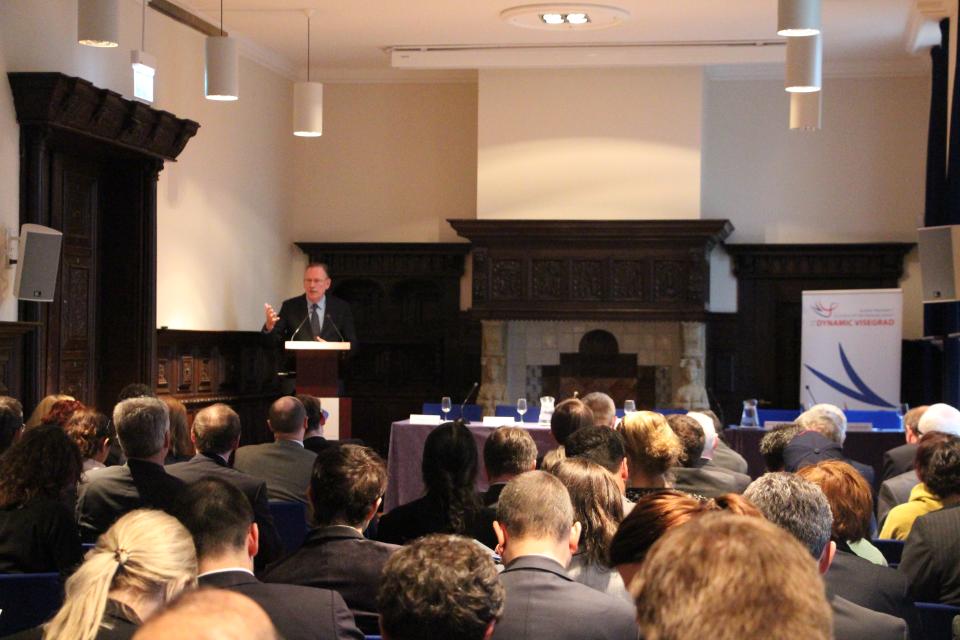
[[{"type":"media","view_mode":"media_large","fid":"5127","attributes":{"alt":"","class":"media-image","height":"320","style":"width: 320px; height: 213px; margin: 1px 7px; float: right;","width":"480"}}]]On Thursday, the 26th of March, a panel discussion on the topic “One year after Majdan: Central European views on situation in Ukraine” took place at the Clingendael Institute. The discussion was held at the initiative of the Slovak presidency 2014/2015 of the Visegrad Group and was organised jointly with all Visegrad members embassies (Slovakia, Poland, Hungary and the Czech Republic) and the Embassy of Germany. Each of the five countries was represented by a prominent speaker: Petr Drulák, (Vice-minister of Foreign Affairs of the Czech Republic), Kai-Olaf Lang (Senior Fellow at the German Institute for International and Security Affairs), László Vasa (Deputy Director General at the Institute for Foreign Affairs and Trade, Hungary), Henryka Mościcka-Dendys (Vice-minister of Foreign Affairs of Poland) and Vladimír Bilčík [[{"type":"media","view_mode":"media_large","fid":"5124","attributes":{"alt":"","class":"media-image","height":"278","style":"float: left; width: 330px; height: 191px; border-width: 0px; border-style: solid; margin: 7px 9px;","width":"480"}}]](Senior Researcher at the Slovak Foreign Policy Association). The event was moderated by Jan Marinus Wiersma, Senior Visiting Fellow at the Clingendael Institute.
The speakers shed light on the positions of their respective countries on the political modernisation in Ukraine and how each of the Visegrad countries is assisting Ukraine in this process. The question of sanctions against Russia for the annexation of the Crimea and the war in the East of Ukraine was also raised. Moreover, the unity and solidarity of Visegrad countries and their position in the EU regarding the current crisis in [[{"type":"media","view_mode":"media_large","fid":"5128","attributes":{"alt":"","class":"media-image","height":"310","style":"width: 320px; height: 207px; margin: 7px; float: right;","width":"480"}}]]Ukraine was also discussed alongside a number of more practical issues specific to each of the Central European states. Possible measures to facilitate solution of the crisis were also brought up. Informal reception bringing together diverse participants in the seminar – diplomats, researchers and students – followed the main event.