


At the Top of Our Interests: a Comprehensive and High Standard Atlantic Trade Agreement
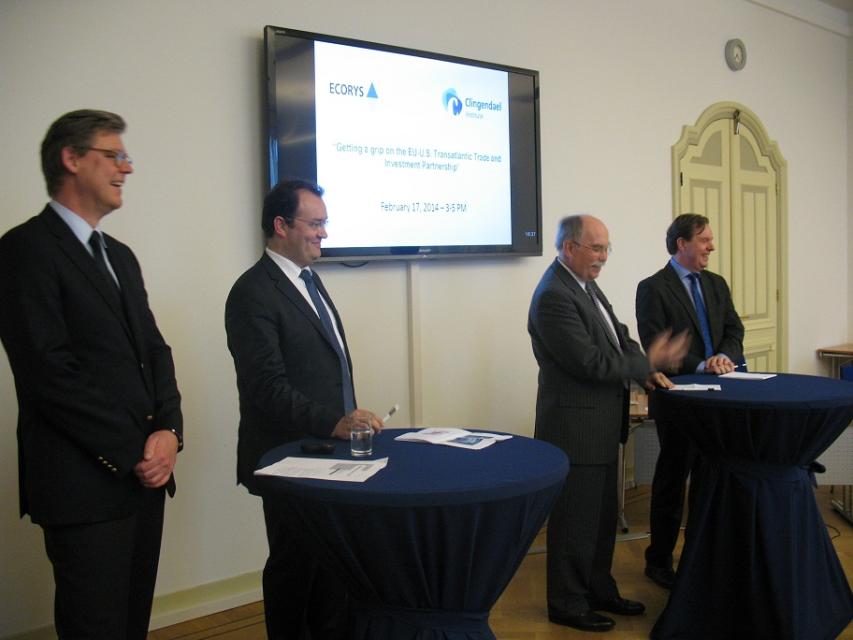
On 17 February 2014, at the Clingendael Institute, four acknowledged speakers presented their views on the Trans-Atlantic Trade and Investment Partnership (TTIP). The seminar ‘Getting a grip on the EU-US TTIP’ gave a unique peep behind the scenes and on the key players and issues surrounding the agreement. It could not only provide a boost for the economy and create jobs across the Atlantic, but the TTIP may also be of significant influence on the geopolitical global power balance.
TTIP: at the very top of our interest list
Shaun Donnelly, Vice President of the US Council for International Business, opened the seminar. For the U.S. business community, TTIP is “at the very top of our interest list”. He envisaged a high standard and comprehensive agreement, boosting trade across the Atlantic. “Don’t lower the level of ambitions”, warned Donnelly. Even if both sides differ on fundamental issues, combined efforts could provide for a beneficial outcome on both sides.
High-hanging fruit
Donnelly explained that the process of regulated trade and investment across the Atlantic is not new. Because of earlier attempts in the same direction, most of the smaller issues around an Atlantic free trade area have already been resolved. “The low hanging-fruit is already gone”, but the high-hanging fruit should not hold the EU and US back. The central problems surrounding TTIP are highly complex regulatory issues: both sides of the Atlantic have their own product standards. But, so said Donnelly, “now is the time to find a solution”. Both the EU and U.S. are experiencing economic underperformance, and the competitors are becoming stronger every year. In establishing the TTIP, the Atlantic partnership would provide “trade leadership across the globe”.
Dutch perspective
A European and Dutch perspective was given by Simon Smits, Director-General for Foreign Economic Relations. He agreed with Donnelly on the fundamental importance of the TTIP, but he still foresees problems for the Netherlands with the low-hanging fruit issues. Replying to Donnelly’s remark on European transparency issues, Smits smilingly said: “We don’t want to make you wiser than you already are!”
Dr. Koen Berden, Managing Director at ECORYS, also stressed the importance of the TTIP agreement. Although not the only obstacle to pass, regulatory issues should receive the most attention, according to Berden. With a striking example of a lipstick producer and the associated regulatory issues for chemicals, Berden explained that the easiest way to overcome these problems is via a step-by-step approach. “The more ambitiously this is executed, the more the impact it will have on the market.”
Geopolitical interests
The geopolitical implications of TTIP were addressed by Peter van Ham, Senior Research Fellow at the Clingendael Institute. Because both the EU and U.S. are losing ground strategically to especially China and India, it is vital to think about this agreement in terms of strategic interests. The EU is still an economic powerhouse, but Van Ham stressed that the TTIP agreement is essential in keeping it that way. It would help tie Europe further to America economically, while at the same time strengthening the Atlantic alliance and the NATO partnership. This way, we keep the “western rulebook dominant”.
At the end of the seminar, the four speakers debated the issues with the audience. While all had different views on how to achieve the end-goal, they were in agreement with regard to the fundamental importance of the TTIP agreement for both Europe, the United States, and the Atlantic partnership.