Armenia’s Changing Relationship With Russia
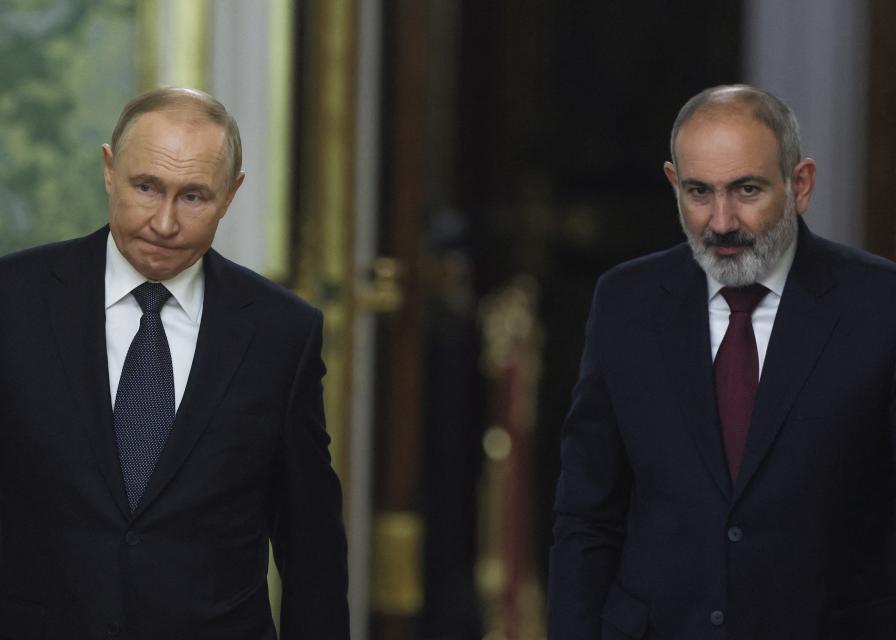
- Armenia is distancing itself from Russia after Moscow failed to support it in the conflict with Azerbaijan
- Armenia is diversifying its foreign policy toward the EU and US to reduce reliance on a single partner
- Armenia still depends on Russia—especially in trade, energy, and the economy—making it hard to make 'either-or' choices
- The EU can help Yerevan reduce its reliance on Russia by deepening cooperation in these areas
- Continued European backing for Armenia’s democratic development through incentives and conditionality is essential
Walking the Geopolitical Tightrope
This paper analyses the changing relationship between Armenia and Russia in the areas of general diplomacy, economics and trade, defence and security and societal attitudes. It argues that while Armenia’s disappointment in Russia is deepfelt and the effort to distance from it genuine, the long-standing dependencies on Russia in terms of energy, economics and trade, coupled with Armenia’s geographic isolation, make it difficult for Yerevan to make zero-sum geopolitical “either – or” choices. Thus, changes in Armenia’s approach to its relationship with Russia are based not on exchanging one global power (Russia) for another (the West), but rather on a diversification policy, with a significant but not exclusive role reserved for the US and EU. Nevertheless, the interests of both Armenia and the EU are aligned on diminishing Armenian dependence on Russia as well as deepening Armenia’s democratic development. Many challenges and difficulties will have to be faced, however, first and foremost related to Armenia’s geographical isolation, before the country’s bid to overcome its dependence on Russia can be deemed a success.
Russia’s full-scale invasion of Ukraine in 2022 has had far-reaching consequences well beyond the immediate conflict. One such consequence is the decline of Russia’s regional power and influence, as well as a modification in its bilateral relations, including with countries it traditionally considered as allies. This paper analyses the evolving relationship between Russia and Armenia and explores what these changes mean for both bilateral ties and the EU’s role in the region.
Authors

Related
See all
Neither secure nor co-operative? The potential futures of the OSCE