Western leaders must stop buying into Eritrea’s rehabilitation campaign
- In spite of a long-standing rebranding campaign, Eritrea remains a problematic regime both domestically and regionally
- Eritrea’s authoritarian regime increasingly operates in Europe, using transnational repression, posing serious threats to public order and regional security
- European policymakers need to reassess their stance toward the regime in order to avoid reinforcing and endorsing the legitimisation of Isaias’ autocratic leadership
Commentary by Bertille Spindler
On July 4, 2025, a noteworthy decision was made: 25 out of 47 voting member states at the UNHRC deemed it necessary – yet again — to renew the Special Rapporteur’s mandate on Human Rights in Eritrea.
Eritrea’s repressive apparatus is responsible for a substantial number of refugees arriving in Europe, and this repressive apparatus is increasingly extending into Europe itself. Recent investigations and prosecutions of Eritrean nationals accused of intimidation, extortion, and transnational repression have brought the regime’s coercive reach into European courtrooms, revealing how authoritarian control abroad directly affects European public order and security. These developments underscore the urgency for European governments to re-engage with Eritrea — not as a matter of diplomatic convenience, but as a pressing security and humanitarian issue rooted in the regime’s long-standing autocratic practices.
This commentary argues that the Eritrean leadership’s attempts at rebranding conceal long-standing authoritarian practices and a concerning human rights situation. President Isaias Afwerki and his allies’ efforts should not mislead European governments, who must reconsider their engagement with the Eritrean government based on a clear understanding of its role domestically and regionally. Any measure aiming to stabilize the region, improve adherence to human rights, or respond to Eritrean refugees coming to Europe, requires that European policymakers reassess their current stance toward the regime. To support this argument this commentary sets out a brief overview of the political conditions within Eritrea, contrasts it with Asmara’s international narrative, and subsequently highlights actions European policymakers could take in their engagement with Eritrea.
I – From hope of independence to an opaque autocratic regime
After a 30-year armed struggle for liberation and independence, Eritrea successfully defeated the Ethiopian army and declared sovereignty in 1993. Globally, this was seen as a moment of hope for Eritreans, marking the end of imperial rule. However, former rebel leader Isaias Afwerki turned those hopes into disillusionment by transforming this small coastal country into an opaque autocratic system. Given the regime’s restrictions, independent reporting remains limited, but available evidence reveals a grim picture.
Human rights abuses in Eritrea are widespread and systemic. The regime’s most notorious policy is the obligatory and indefinite National Service Programme (NSP), which forcibly conscripts youth immediately after high school, sometimes even before.
Isaias Afwerki and his close advisors have plunged the country into a severe economic and social crisis.
The most powerful testimony of Isaias’ repressive policies is the long-standing depopulation phenomenon experienced by the country for more than thirty years now. Between 2015 and 2025, almost half of the population- predominantly the youth- fled the country.
The state uses myriad intimidation tactics to monitor, coerce, and exert control over members of the diaspora.
Whether inside or outside of their country’s borders, Eritreans can never truly escape the regime they have dangerously attempted to flee. Even on European soil, where people come to find a haven, Eritrean exiles are still under the threat of their home country. The long-standing ‘diaspora tax’ forces Eritreans working abroad to pay a 2% tax on net income to the government. Non-compliance includes the loss of consular assistance and threats to family members still in the country. This snapshot offers a stark illustration of the lived reality for Eritreans.
II- Asmara’s attempts to shift the narrative: Why is it picking up steam?
Faced by international sanctions and an arms embargo, Eritrea has been actively promoting a counternarrative that positions itself as a model of authentic African liberation. While international discourse—particularly that shaped by his (former) Ethiopian counterparts—tends to portray Isaias as the leader of an isolated autocracy, his own narrative tells a very different story. In this narrative, Eritrea stands out amongst its African counterparts because it achieved genuine independence and rejected foreign aid, making it one of the only African examples of a truly liberated and sovereign nation.
If this narrative is seemingly gaining more ground in recent years, it is partly due to shifting geopolitical dynamics in the Horn. The year 2018 was a key turning point for Eritrea and the region. After 20 years of frozen hostility, both countries – Ethiopia and Eritrea- signed a historic peace agreement formally ending their long-established feud. The de-escalation was made possible by the fall of the long-lived, dominating political party in Ethiopia, the Tigray People’s Liberation Front (TPLF), which maintained a hardline stance against Eritrea.
Notwithstanding this hopeful sign of regional stabilization, it also created space for the Eritrean regime to operate with less scrutiny, while continuing its repressive policies unchallenged. In recent years, the Eritrean regime and its allies have multiplied the attempts to disseminate the regime’s narrative. From publishing books, receiving invitations to international panels and forums, as well as a proliferating network of pro-government accounts on social media.
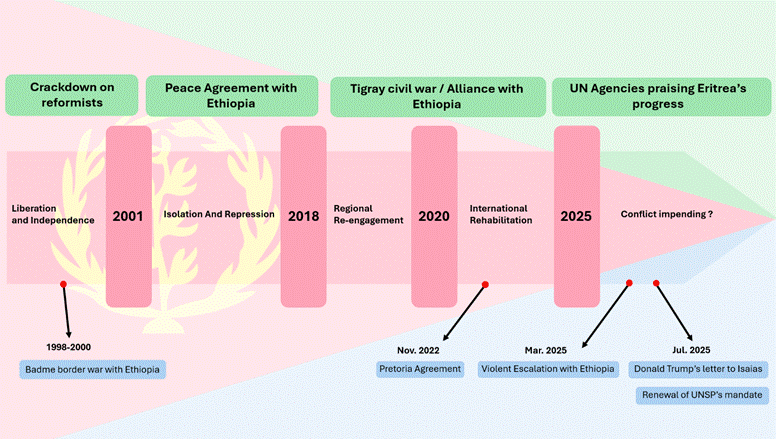
Figure 1: Timeline of key events in Eritrea’s political trajectory and international rehabilitation
The 2018 peace agreement with Ethiopia rekindled European optimism that Eritrea could finally open up—economically and politically. This shift has made Isaias’s narrative increasingly appealing in Europe, where countries now celebrate their cooperation with Eritrea instead of keeping it discreet as they once did. Proof lies in the recent visit of an Italian delegation culminating in the signing of a new cooperation agreement, enhancing bilateral ties in various sectors.
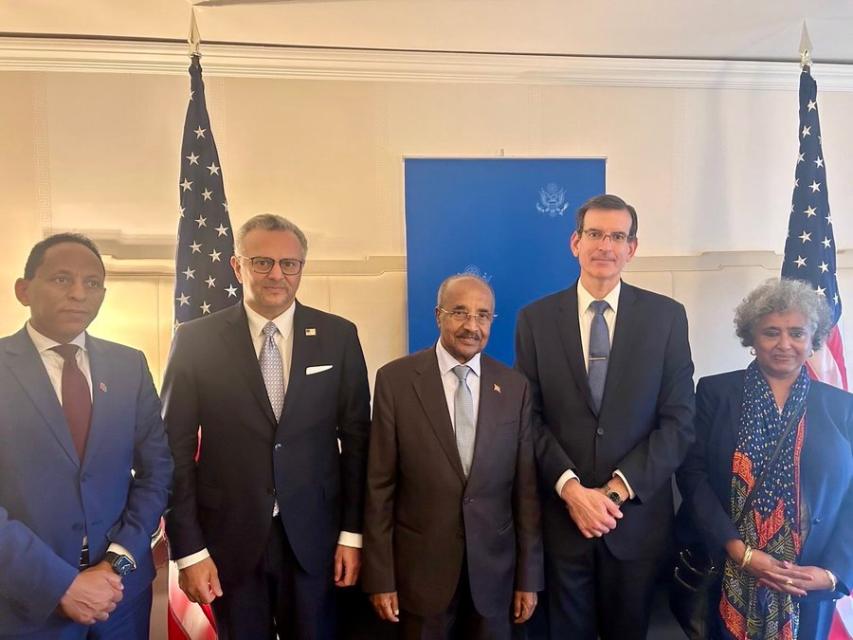
In celebrating technical progress but omitting to include in the analysis the prevailing political repression and systemic human rights abuses, such actors risk legitimizing the regime’s image makeover, whilst decreasing international pressure to reform. U.S. President Donald Trump’s call for rapprochement with Eritrea signaled a broader shift toward legitimizing the regime. This trajectory persisted, culminating in the recent meeting between Eritrea’s Foreign Minister Osman Saleh and U.S. Senior Advisor Massad Fares Boulos during the UN’s 80th General Assembly — the first of its kind in decades.
Normalizing relations with the regime while turning a blind eye to human rights abuses not only undermines international legal standards but also erodes the credibility and global influence of Western actors.
III- Urging European policymakers to do more
As Eritrea’s regime continues to benefit from a carefully curated narrative of resilience and sovereignty, European policymakers should carefully reassess their engagement to ensure they do not inadvertently reinforce this discourse. The international community must recognize that by engaging with President Isaias Afwerki’s regime without scrutiny, it risks endorsing authoritarianism and undermining its own principles on human rights and good governance. This, in turn, jeopardizes stability in the region and fails to address the conditions that ultimately drive the exodus of Eritrean refugees. There are simple, low-cost measures that can be taken immediately.
Firstly, universities, research institutes, and event organizers should adopt a more critical approach when selecting speakers, avoiding invitations to regime-affiliated figures whose participation could serve to legitimize official narratives. It is crucial to establish clearer boundaries to prevent regime-linked actors and unofficial propagators from shaping international discussions uncritically.
Secondly, European policymakers hold a pressing responsibility in addressing the central issue of transnational repression, of which Eritrea has been accused, and several Eritrean nationals are on trial in the UK.
Thirdly, European policymakers seeking to address both the humanitarian crisis and the democratic aspirations surrounding Eritrea can draw on several existing institutional mechanisms. They could leverage the EU Global Diaspora Facility (EUDiF): This platform provides technical support and funding to diaspora organizations. It can be strategically used to empower Eritrean communities in Europe to lead advocacy campaigns, civic education programs, and development initiatives that reflect their own democratic demands. This platform can also serve the purpose of providing these organizations with institutional protection and legitimacy. Finally, this tool could help bridge diaspora expertise with practical EU policy-making.
Furthermore, they could utilize the Migration and Mobility Dialogue (MMD II): This framework offers an avenue to link migration cooperation with human rights benchmarks, enabling the EU and its member states to press for concrete political and governance reforms in Eritrea. European policymakers could use it to channel funding into protection programmes for Eritrean refugees, subjected to transnational repression.
Last but not least, European engagement needs to be conditional: While the EU has not fully resumed its “dual-track” approach with Eritrea, engagement continues in sectors like health, cultural heritage, and agriculture, amongst others. Development cooperation and diplomatic presence in Asmara should be conditional on the regime allowing independent human rights evaluations and committing to open civic spaces—especially as the country approaches a likely leadership transition.