
Open the geopolitical mapping in full-view mode
Over the past few years, Central Asia has witnessed a positive trend toward greater collaboration. The political climate in the region has become less tense and much more cooperative compared to the Central Asian republics’ first 25 years of independence after the dissolution of the Soviet Union in 1991.
This is visible in the interactive online mapping of geopolitical actors and relations in Central Asia in Figure 1, which is largely made up of green lines representing positive relationships. This trend kicked off in 2016 when Uzbekistan began to open under the new leadership of Shavkat Mirziyoyev, who cut ties with the isolationist policy of his predecessor Islam Karimov. Uzbekistan borders all four other Central Asian republics and Mirziyoyev aims to improve relations with these neighbours. In this process, personal relations among leaders are a driving force that directly translates into the intergovernmental relations in the region.
Taking some exceptions into account, such as escalating tensions between Kyrgyzstan and Tajikistan over the past few years (which will be described later in this chapter), state-to-state relations have vastly improved compared to ten years ago, in line with the personal relations of the leaders of Central Asia.
This becomes evident with the increase in consultative meetings between Central Asian heads of state and other representatives of government. Since 2017, these annual meetings in different Central Asian countries have functioned as pivotal platforms for regional cooperation.[11] While the substance of the meetings does not always translate into concrete action, the fact that countries meet – even without external partners such as Russia, China, or the EU – to discuss a common vision for the region is an exceptionally positive development. In fact, before 2016, there was limited dialogue among the countries and regional cooperation was more difficult; the Central Asian countries are all more confident now.
Especially since Russia’s full-scale invasion of Ukraine in 2022, Central Asia has increasingly grown as a region. This appetite for closer relations/interactions is fuelled by the realisation that Central Asia will stand much stronger together, which is coupled with a wish to reduce dependency on foreign actors, first and foremost Russia and China, while continuing to cooperate with them as most important partners. This is an indispensable element to prevent being “mere pawns in the strategic manoeuvres of great powers”.[12] On top of this, many of the challenges faced by Central Asian countries are regional in nature, such as in the areas of water, energy, climate change, and security (which will be discussed later in the following chapters).
Kazakhstan and Uzbekistan, for example, place Central Asia at the core of their foreign policy priorities.[13] The countries of the region share an order based on “sovereignty, diplomacy, international law, authoritarianism, and great power management” that binds them together,[14] as well as bonds based on shared culture, history and religion.[15] In terms of physical connections as well, Central Asia has gradually been shaped through roads, railroads, electricity grids, waterways, and other infrastructure – starting from the ancient Silk Road towards the Soviet Union. Although these connections have been partially demolished after the collapse of the Soviet Union, this enabled people from different parts of the region to come into contact with one another: a “hidden integration”.[16] Central Asia can in fact be seen as – and considers itself to be – a distinct region.
Despite the underlying characteristics that define the Central Asian region, a strong common regional identity remains absent – an issue that has attracted renewed attention.[17] And Central Asia is not a homogenous region, including Turkic-speaking peoples (in Kazakhstan, Kyrgyzstan, Uzbekistan, and Turkmenistan) and Persian-speaking populations (in Tajikistan). The countries also have different histories of nomadic and sedentary cultures, and there are major internal divisions between cities and rural areas.
Despite further regional cooperation and a renewed realisation of the necessity to do so, Central Asia is not heading towards EU-style integration. Such steps have been considered in the past, for example through the establishment of the Central Asian Union in 1994 that all countries except for Turkmenistan joined. However, this initiative did not succeed due to the conflicting interests of (candidate) members, internal disputes, and the rise of other multilateral initiatives initiated by the larger neighbours of Central Asia, such as the Shanghai Cooperation Organisation (SCO) and the Eurasian Economic Union (EAEU).[18]
Since then, serious steps towards institutional regionalisation have not been taken for various reasons. One of them was that the economic interests of individual countries, particularly Kazakhstan, outweighed the benefits of cooperation within Central Asia. It proved much more lucrative to become part of initiatives led by external actors, such as the EAEU, the SCO, or the Chinese Belt and Road Initiative (BRI), rather than to create a truly Central Asian organisation.[19]
As a result, Central Asia does not have an equivalent to organisations such as the Association of Southeast Asian Nations (ASEAN), the African Union (AU), or the North American Free Trade Agreement (NAFTA), with the exception of regional institutions with a specific goal in mind, such as the International Fund for Saving the Aral Sea (IFAS).
Bringing Central Asia together
During past years, there have been significant initiatives aimed at bringing together the five countries plus an international partner – the so-called C5+1 platforms. Japan was the first to engage with the region through this platform in 2004[20] and was followed by 11 more countries, including the US,[21] the EU, Germany, Russia, and China, among others. In 2024, the US launched the B5+1 forum for the first time.[22] This is the business counterpart of the C5+1, aimed at accelerating Central Asia’s economic integration. These platforms are key to spur dialogue and cooperation with, and among, Central Asian countries and to facilitate regional solutions for common challenges.
Although Turkmenistan participates in the C5+1 formats and consultative meetings between the heads of state, it adheres to a strict policy of neutrality. Turkmenistan has declared itself to be “permanently neutral”, which was formally adopted as a declaration in the United Nations General Assembly (UNGA).[23] Hence, Turkmenistan has distanced itself from multilateral organisations such as the SCO and the Collective Security Treaty Organisation (CSTO) and prioritizes bilateral links over regional ones.’
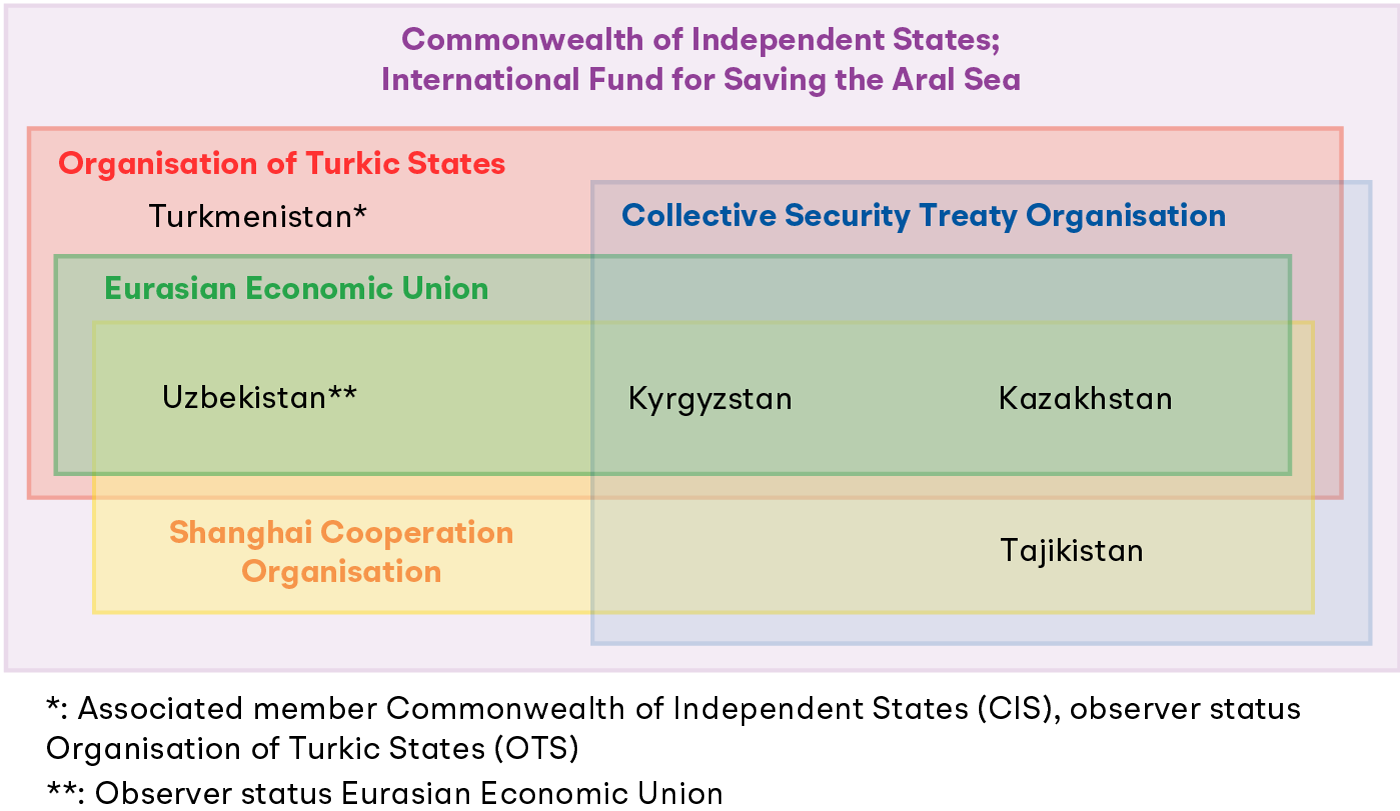
Most Central Asian countries aim to pursue a so-called multi-vector foreign policy, in which the republics are open to working with as many partners as possible. This idea is well illustrated by Kazakhstan’s President Kassym-Jomart Tokayev, who has said that his country wishes to have a “Great Gain for all in the Heart of Eurasia” instead of a Great Game, and to deepen relations with all neighbours and other countries interested in doing so.[24]
This policy of working with as many partners as possible is not necessarily new and follows logically from the geographical location of Central Asia, with both Russia and China as larger neighbours,[25] and the history of the Silk Road. Since the war in Ukraine escalated in 2022, however, this policy has received a new impulse for Central Asia.
Central Asian countries do not wish to align themselves with only one country or bloc, nor do they wish to turn their back on Russia. The aim of the multi-vector foreign policy for Central Asia is rather to be enemies with no one and to retain close relations with Russia and China, while taking full advantage of the economic benefits that other partners have to offer. This simultaneously decreases their dependency upon their large neighbours.[26]
The next chapters will analyse the various dynamics at play in the geopolitics of the region.