
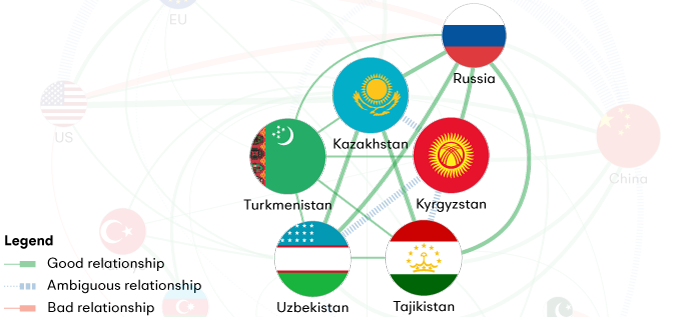
Open the geopolitical mapping in full-view mode
In November 2023, during Putin’s visit to Kazakhstan, a video went viral showing Kazakhstan’s President Tokayev beginning his remarks in Kazakh, while the Russian delegation hastily reached for their translation headsets.[58] This awkward moment prompted questions about whether Tokayev’s remarks were indicative of Russia’s waning influence in Central Asia. What was not shown, however, was how this was merely a brief intermezzo in a long Russian-language dialogue. Nevertheless, it left observers wondering to what extent Russian soft power and influence are truly waning in Central Asia.
Despite such questions surrounding Russia’s declining power in the region, it remains a crucial systemic factor in Central Asia. Russia wields both hard and soft power through its historical, linguistic, and cultural connections, while also maintaining control over regional institutions, military presence, security apparatuses, diaspora populations, and economic dependencies.[59]
Hard power: Russian regional organisations, security, energy, trade
Russian-led regional organisations
Russia’s systemic presence in Central Asia is reflected in its central role in the region’s regional political, political-security, and economic organizations. The country leads the Eurasian Economic Union (EAEU), the Collective Security Treaty Organization (CSTO), and the Commonwealth of Independent States (CIS).[60] Through these organisations, Russia had yielded significant influence over the Central Asian states’ economies, elites, academic communities, and societies.[61]
| Uzbekistan |
Kazakhstan |
Tajikistan |
Kyrgyzstan |
Turkmenistan |
|
|---|---|---|---|---|---|
| CIS |
X |
x |
x |
X |
*(Associated member) |
| EAEU |
*(Observer) |
x |
X |
||
| CSTO |
x |
x |
X |
Already before the Russian full-scale invasion of Ukraine, Russian scholars argued that while the Central Asian states are indeed actors with agency that increasingly adopt multi-vector foreign policy, the “integration of Central Asian nations with Russia and China [is] the only available option”, considering political and military integration through these organisations.[62]
Russian military presence
Although China has exceeded Russia in terms of total trade with the region, Russia continues to be the main security guarantor in Central Asia.[63] Besides maintaining a significant military infrastructure in three out of the five Central Asian states, Russia also plays a key role in preserving the internal stability of the Central Asian regimes. For example, Russia’s military closely followed the violent events across Kyrgyzstan in 2010, although it did not intervene despite requests from the Kyrgyz government.[64] In contrast, when violent unrest amongst the Kazakh population led to mass protests in cities across the country in January 2022, the then newly installed President Tokayev asked the CSTO for help. In response to the protests, 3,000 Russian, 500 Belarusian, 200 Tajik, 150 Kyrgyz and 70 Armenian “peacekeepers” were reportedly sent by the CSTO to Kazakhstan.[65] Although they did not intervene directly, it nevertheless showed the significance of Russia’s role in protecting the status of Central Asia’s ruling elites and solidified its role of guaranteeing stability in the region.[66]
Furthermore, Russia has the largest military presence in Central Asia, as evidenced by both the 7,000 troops it has stationed in Tajikistan and the physical infrastructure in the form of the Russian Joint Military Base in Kyrgyzstan, including the Kant airbase, the Baikonur Cosmodrome in Kazakhstan, and the many radar stations and testing locations it administers in the region.[67] Russia’s largest foreign military base, the 201st Military Base, is located in Tajikistan. It also leases a Tajik base near the Afghan border.[68]
Russia is also the largest supplier of military materials to the region. As shown in Figure 6, from 2018 to 2023, Russia was the largest supplier of arms to all countries of the region except for Turkmenistan.[69] For instance, Russia supplies the countries with relatively cheap weapons and engages with them on the military-technical level. Kazakhstan also shares air defence and forms units with Russia through the CSTO framework. Because most of the Central Asian states’ armed forces and intelligence agencies rely heavily on Soviet and Russian-made arms and equipment, Russia can exert this leverage to maintain its dominance over the region’s security apparatus.[70]
Moreover, Russia positions itself in the hearts and minds of Central Asian security personnel through the training of military officers and cadets. Many of the Central Asian military elites have taken courses from the Military Academy of the General Staff of the Armed Forces of the Russian Federation, or have followed training at Russian military universities.[71] These educational bonds are further strengthened through regular multilateral military exercises with Russia’s Central Asian co-members of the CSTO, namely Kazakhstan, Tajikistan, and Kyrgyzstan.

Although the countries of Central Asia are increasingly looking towards other actors, such as China and Türkiye, for security cooperation as well, Russia continues to be Central Asia’s main provider of security. Given the clear Russian presence in Central Asia’s military realm, Russia holds a strategic competitive advantage over the region.
Energy security and trade
Russia has repeatedly asserted its dominance over the Central Asian republics through its economic ties to the region. One key example is the Caspian Pipeline Consortium (CPC), which accounts for 80% of Kazakhstan’s oil exports to Europe. As the pipeline passes through Russian territory, as visible in Figure 7, Russia can cut off these exports and has done so on several occasions since its full-scale invasion of Ukraine.[73]
In terms of nuclear power, Russia could potentially gain increased leverage over Central Asian countries as well. Kazakhstan is currently deciding upon which partner will build its first nuclear power plant, and the Russian state-agency Rosatom is one of the candidates. Previously, Uzbekistan signed a deal with Rosatom to build a small nuclear power plant, and Kyrgyzstan is considering this as well.[74]
Rosatom’s possible role in the construction remains a sensitive issue due to the resulting additional Russian leverage over the Kazakhstani energy sector. This realization, along with the country’s Soviet-past traumas of radiation from nuclear exercises and its effects on local populations, mean that Kazakhstan’s nuclear future remains rather uncertain considering the current geopolitical reality.[75]
Through the customs union of the Eurasian Economic Union, Russia also serves as a crucial provider of basic goods to Kazakhstan and Kyrgyzstan.[76] Besides that, despite its own gas reserves, Uzbekistan depends on Russia for its imports of natural gas. This directly influences many Uzbek households that need the gas during the cold Uzbek winters.[77] To reduce this dependency, Uzbekistan has attempted to attract investment for wind and solar parks. In the future, Russia may gain even more influence over the region’s energy security if the plans to build nuclear power plants in Kazakhstan and Uzbekistan materialize.[78]

Remittances
Russia also wields significant influence over its Central Asian partners through remittances sent by migrant workers from Tajikistan, Kyrgyzstan, and, to a lesser extent, Uzbekistan. These remittances make up a substantial portion of their economies, contributing by estimate up to 32% of Tajikistan’s 2022 GDP ($3.2 billion), 27% of Kyrgyzstan’s GDP ($2.8 billion), and 18% of Uzbekistan's GDP ($14.5 billion).[80] This economic reliance creates a strong dependency on Russia, with many Central Asian families directly relying on these remittances for their livelihood. However, Russia itself also relies on this cheap migrant labour due to its own labour shortages, making the relationship mutually dependent.[81]
The 2024 Crocus City Hall terror attack in Moscow that was conducted by Tajik citizens has further pressured the Tajik presence in Russia. Many Tajik migrant workers already faced harsh conditions caused by xenophobia and harassment, which have become worse in the aftermath of the attack.[82]
At the same time, the war in Ukraine has also led to an upsurge in migration flows between Russia and the Central Asian states. While many Russians try to flee political repression and prevent being conscripted for military service in Ukraine, Central Asian labour migrants in Russia are being recruited for ‘supportive’ roles in Russia’s war effort in Ukraine.[83] There has also been an upsurge in tourism and highly-skilled labour from Russia to Central Asian countries, due to lenient visa regimes and increased difficulty in reaching the West for Russian elites.[84]
Russian influence decreasing, yet nevertheless present
The war in Ukraine has revived an ongoing debate on the strength of Russia’s position within Central Asia. Observers note that Moscow’s influence has waned since its full-scale invasion of Ukraine, whereas before the war even China’s increased activity in the region was not considered a threat.[85] However, Central Asian states are increasingly turning to China not only for financial support but also for security cooperation.
This shift is partly due to their reluctance to openly endorse Russia’s “special military operation” in Ukraine.[86] At the same time, it aligns with the region’s long-standing multi-vector foreign policy, which was evident during their non-recognition of Russia’s 2014 annexation of Crimea and their lack of support for Russia’s 2008 war against Georgia.[87] Faced with the geopolitical realities of dependence on and historical ties to Russia, the Central Asian states have adopted a posture of “strategic silence”: a diplomatic approach that allows them to signal their disapproval of the war in Ukraine without directly confronting Moscow.[88] Thus, although Russia’s grip over its (unjustifiable) proclaimed sphere of influence might loosen, the roots through which it does so remain firmly embedded, and Moscow is unlikely to abandon its hold at any time soon.
Furthermore, inter-elite relationships significantly bolster Russia’s soft power in Central Asia. Recent media investigations reveal Moscow’s involvement in corruption schemes that enrich the region’s ruling elites.[89] These interstate relations are largely managed through personal connections. Additionally, Russia maintains its influence in Central Asia through its security apparatus, particularly the FSB. In this context, Russia is said to still “control the right people” across various levels of the security sector.[90]
Soft power: language, information and education
Moscow remains the region’s cultural hegemon. It smartly employs cultural diplomacy through its shared historical legacy, language, and Russian-speaking and Russia-directed media outlets. Because many Central Asians speak Russian and are familiar with popular products of Russian culture,[91] Russia is able to assert its soft power influence over the region through pro-Kremlin narratives. Russian information warfare is widespread in the region, as evidenced from a Sputnik campaign that disseminates the narrative that the EU is aiming to turn Central Asia against Russia.[92]
Moreover, education plays an important function in Moscow’s diplomatic toolbox, especially in its so-called ‘near abroad’. Russia has been working hard to expand the number of universities it hosts in Central Asian states, and also receives a great number of students from Central Asia at its Russia-based universities. It is estimated that 185,000 Central Asian students study in Russia, and 68,000 of those students’ education is funded by the Russian budget.[93]
Despite these dynamics, a so-called ‘decolonisation process’ is slowly manifesting itself in Kazakhstan. A notable shift can be observed among younger generations in urban centres such as Almaty, where there is a growing reluctance to speak Russian. The war in Ukraine has likely spurred this development, as reflected in the rapid decrease in the approval rates for the Russian leadership amongst the Kazakh, Kyrgyz, and Uzbek populations, as visible in Figure 8.
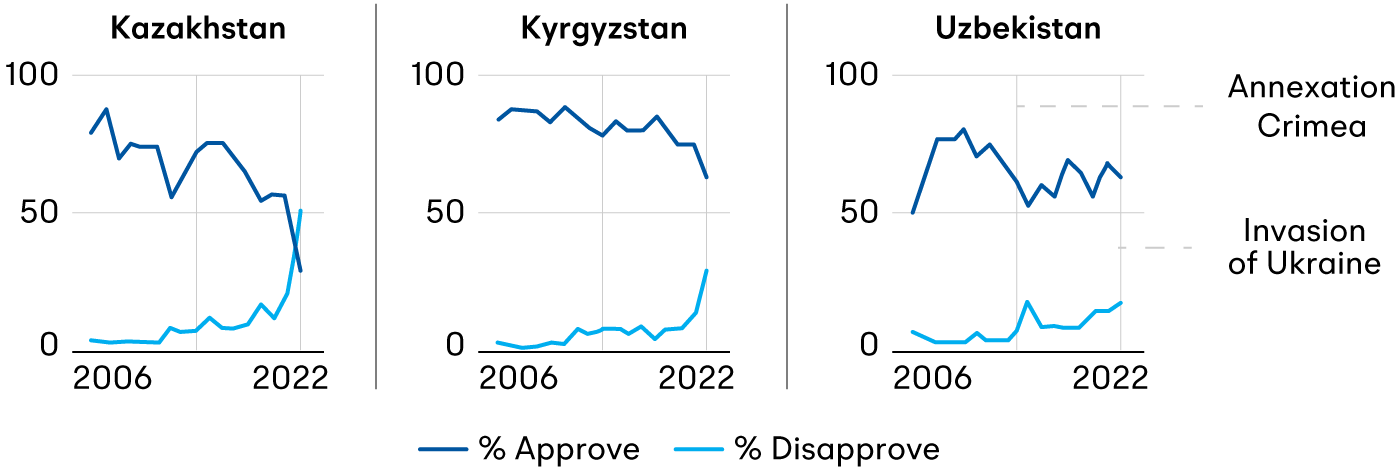
Adolescents are turning their attention to finding a Kazakh identity that had been lost during Soviet times. A similar rhetorical shift is taking place in Uzbekistan and Kyrgyzstan, where there is a growing challenge to the Soviet narrative. These countries begin to recognize and honour the victims of Soviet repression, marking a significant departure from previous historical interpretations.[95] However, these developments are largely confined to the higher political ranks and specific parts of Central Asian societies. The average citizen tends to remain largely unaware of or indifferent to this “decolonization” process.
Circumvention of sanctions
Since Russia’s full-scale invasion of Ukraine, Central Asia has witnessed a rapid proliferation of new businesses. Like mushrooms after a rainstorm, new import-export companies are sprouting across Kazakhstan, Kyrgyzstan, and Uzbekistan. This surge coincides with a dramatic increase in exports from these countries to Russia, while the European Union’s exports to the country fell by over half between 2021 and 2023, as visible in Figure 9.
The numbers are striking: Kyrgyzstan’s exports to Russia soared to a 250% volume increase in 2022. Between 2021 and 2023, Kazakhstan’s exports to its northern neighbour rose by 39%, Kyrgyzstan’s by 90%, and Uzbekistan’s by 77%.[96] Curiously, many of these exported goods are neither produced nor traditionally exported by these Central Asian nations.[97] As both Kazakhstan and Kyrgyzstan are members of the EAEU, these goods can flow to Russia through their integrated markets with Russia.
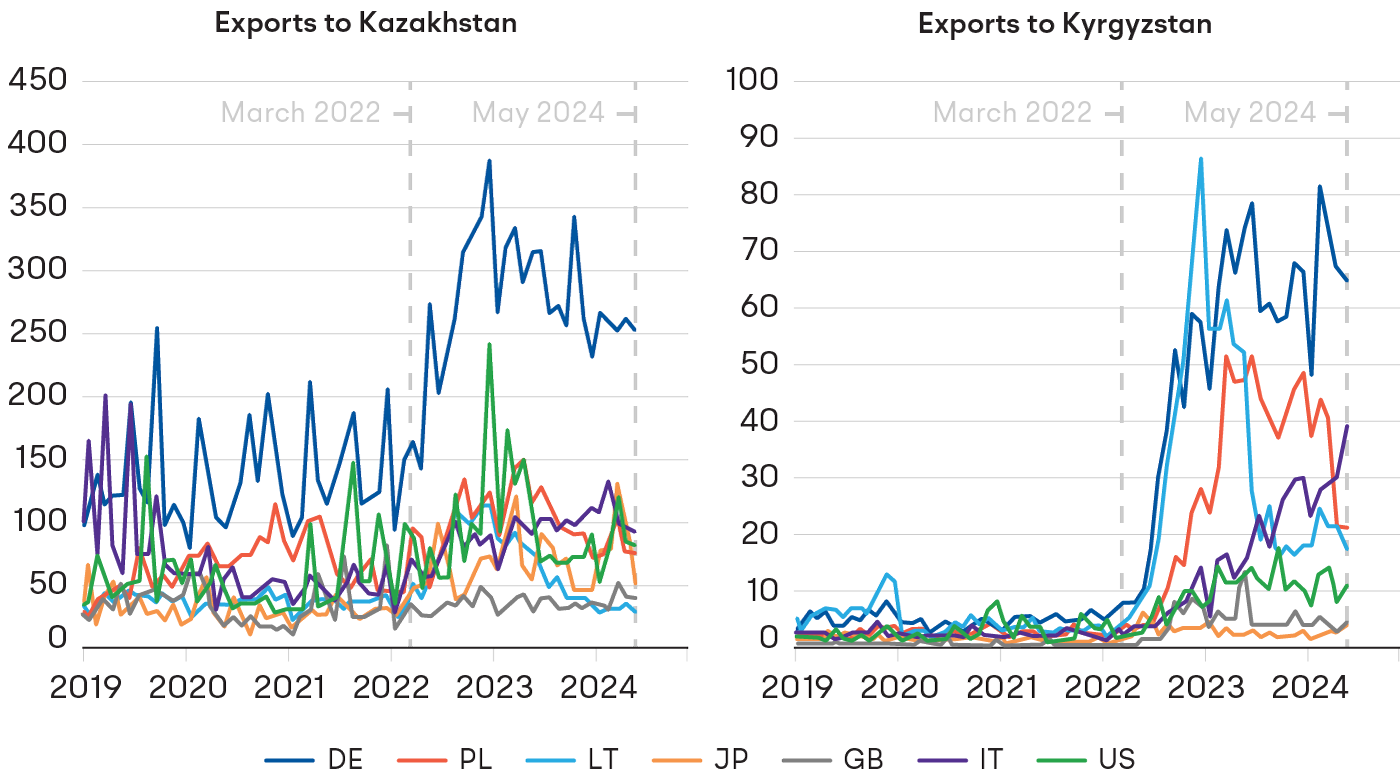
In one instance, The Washington Post revealed a now-halted sanctions evasion scheme in which a Kyrgyz company purchased Chinese drones labelled as heavy-duty crop dusters for agricultural purposes with the aim of reselling them to a Russian company. The drones, which can carry 70 pounds in volume, incited fears among U.S. intelligence officials who were worried that such drones could be weaponized, possibly for chemical warfare against advancing Ukrainian troops. Although these drones were intercepted at the Kazakh-Kyrgyz border due to incorrect export paperwork, officials noted that such products frequently evade interception and successfully reach Russia.[99]