
Open the geopolitical mapping in full-view mode
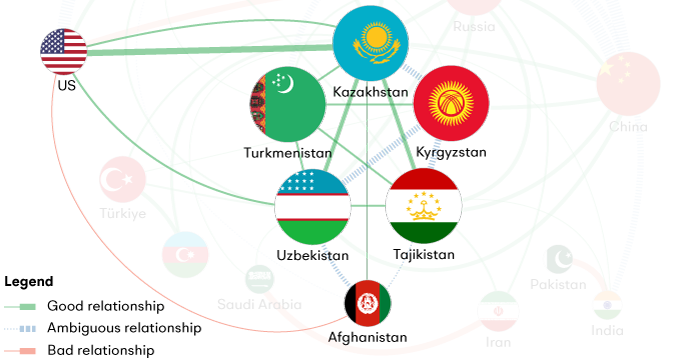
Afghanistan is an ongoing matter for the regional dynamics in Central Asia. Traditionally, Central Asia tends to have good or pragmatic relations with Afghanistan, independent of who is in power. Since the US withdrew from the country and the Taliban took over power, Central Asian states have re-established their relations with the Taliban.
Uzbekistan was the first country to do so.[118] Kazakhstan has officially accepted the diplomatic credentials from Taliban diplomats and removed the Taliban from the list of banned organisations. Turkmenistan continues its policy of neutrality.[119] Kyrgyzstan took the Taliban off the terror list and seeks to normalise ties too, but the ethnic Pamir Kyrgyz in Afghanistan form an issue in the relationship.[120] The Tajik government views Afghanistan as a threat, due to the large Tajik community in Afghanistan, and warns against an infiltration of its borders, drug trafficking, and the radicalisation of Tajik people. But nevertheless, Tajikistan takes a pragmatical approach: electricity to Afghanistan keeps flowing.[121]
A stable and calm Afghanistan is a priority for Central Asian countries, and pragmatically working with the Taliban is part of that policy. In addition, transboundary issues such as water bring Central Asian states and Afghanistan around the table. As Afghanistan is building the Qosh Tepa Canal, which will divert up to 25% of the water of the Amur Darya's water flow to Uzbekistan and Turkmenistan, these countries rather prefer to collaborate with the Taliban to ensure the canal’s efficient construction, rather than enduring a significant reduction in water flows.
Despite the US withdrawal from Afghanistan, the anticipated spillover effects[122] of internal Afghan instability on the broader region have not materialized as strongly as expected. While the absence of US bases and active military engagement in Central Asia, as seen in the 2000s, has reduced its direct presence, the US is still a large power in the region to date. It maintains substantial investments and embassies in all five countries.