
Over the past decades, EU engagement towards Central Asia has slowly but steadily developed from limited engagement to an important partnership. Especially in the fields of trade, energy, investment, and development aid, the EU is now one of the most important partners for Central Asian countries.[129] The EU has made significant steps to get to this point. Whereas in the 1990s Central Asia was not amongst the key priorities of the EU, this relation deepened over time.
This chapter gives a brief overview of this history and explores how the EU and the Netherlands in particular could effectively enhance their relations with Central Asia. Based on the local priorities of Central Asian countries, it discusses specific areas where the interests of the parties are aligned, pointing to challenges and opportunities for greater cooperation.
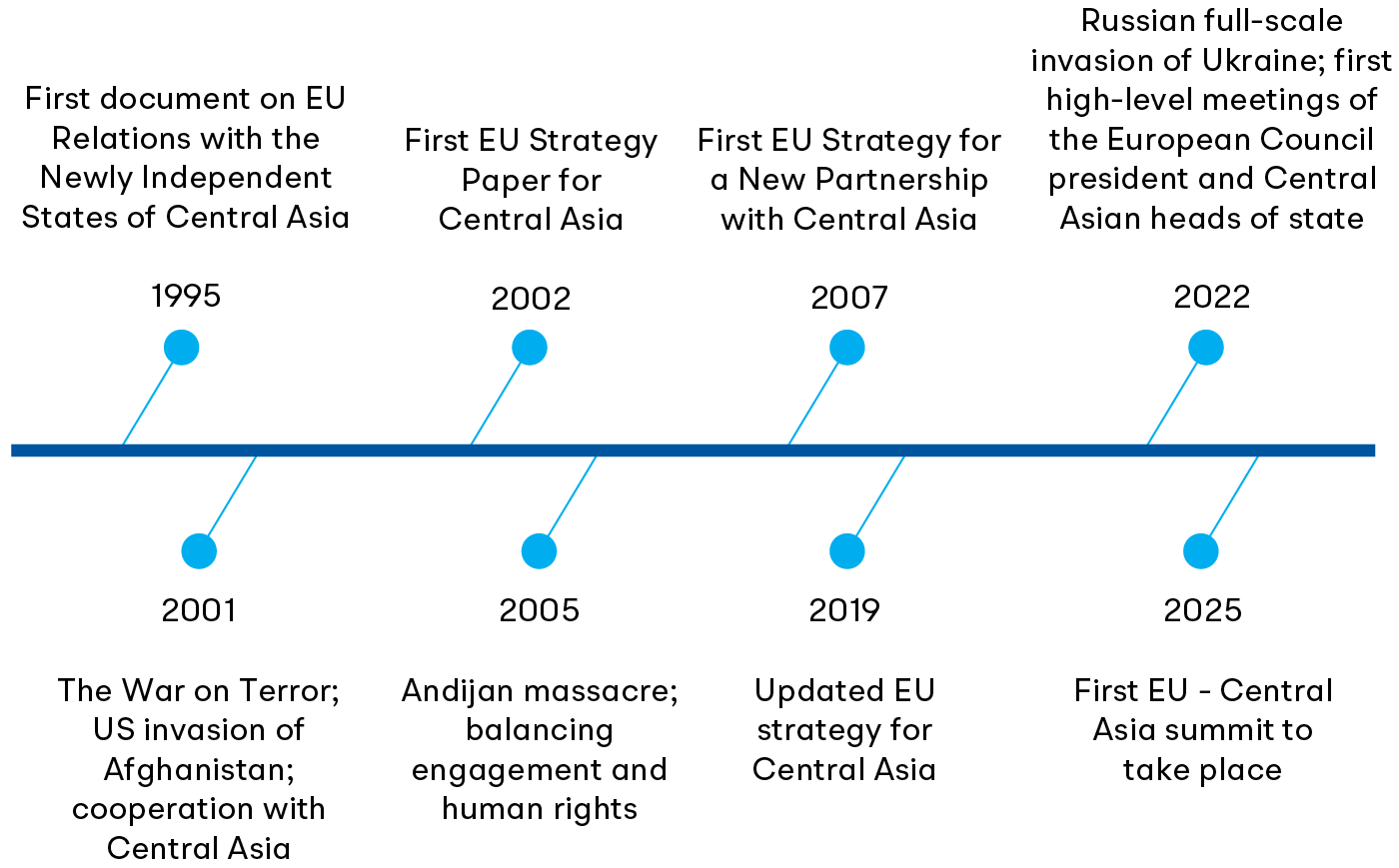
In its 1995 document entitled The EU’s Relations with the Newly Independent States of Central Asia, the EU kickstarted this process by sharing its “geopolitical and economic” interests for the region, in particular towards Central Asia’s energy sector.[130] In a related memo, the EU expressed its “serious political concerns over human rights and democracy throughout the region”, as well as assessing the economic circumstances of the region, the EU interest and investments, as well as the role of Russia, the US, Türkiye, and China as third countries in the region.[131]
The first turning point in EU – Central Asian relations came in 2001 with the US War on Terror and the invasion of Afghanistan.[132] Western military personnel within the NATO coalition were allowed to use the facilities of Kyrgyzstan, Tajikistan, and Uzbekistan to fight the Taliban, while the interest of the Central Asian countries was to secure their borders.[133]
This was also the time when Austria initiated the Border Management Programme in Central Asia (BOMCA), which was later made into an EU programme with the goal of securing the region’s external borders, and the Central Asia Drug Action Programme (CADAP) to assist Central Asia in their fight against the drug demand.[134] A year later, in 2002, the first Strategy Paper for Central Asia was published. The EU focused on the provision of technical assistance, such as humanitarian assistance, macro-financial grants, and loans, by allocating fifty million euros a year for a five-year period.[135] In 2005, the first EU special representative for Central Asia was appointed.[136]
The second key moment in the EU-Central Asian relationship came in 2005, following the Andijan massacre in Uzbekistan. After 23 local businesspeople were accused of extremism, armed men released them from prison, occupied government buildings, and took police officers hostage. The government's assault on the 10,000 protestors that followed ended in a massacre, with 173 people killed according to the Uzbek government and up to 500 according to eyewitnesses. In reaction, the EU and US distanced themselves from Uzbekistan and cut military funding. Former President Karimov likewise turned his back on the West, and ties remained strained until sanctions were lifted step-by-step towards 2009.[137]
This tragedy in Andijan and the subsequent response is indicative of the tensions between human rights and the rule of law on the one hand, and geopolitical and economic interests on the other, of which there are more examples that have played a role in the bilateral relationship over the past decades.
The third and most significant turning point in the relation between Central Asia and the EU came in 2007 when the EU launched its first strategy for the region, entitled The EU and Central Asia: Strategy for a New Partnership.[138] This document presented an “interest in security and stability” and “adherence to human rights” as the most important interests of the EU in the region.[139] From this point onwards, basic EU cooperation turned into a more structured and increased engagement with the countries of the region.[140]
Later on, in 2019 the EU-Central Asia strategy was updated. Although this has been described as “the old EU Central Asia strategy in a fresh PDF” by some, as it regrouped the EU priorities for the region into new categories,[141] it is in fact a different document. While the 2007 strategy was developed under a German initiative, the new strategy is based on EU-wide deliberations among member states, several rounds of talks between the EU and the countries of Central Asia, conversations with civil society in the region, and discussions with academia and think tankers in Europe. And compared to the earlier strategy, it is also more specifically aimed at the realities and requirements of individual Central Asian states.[142]
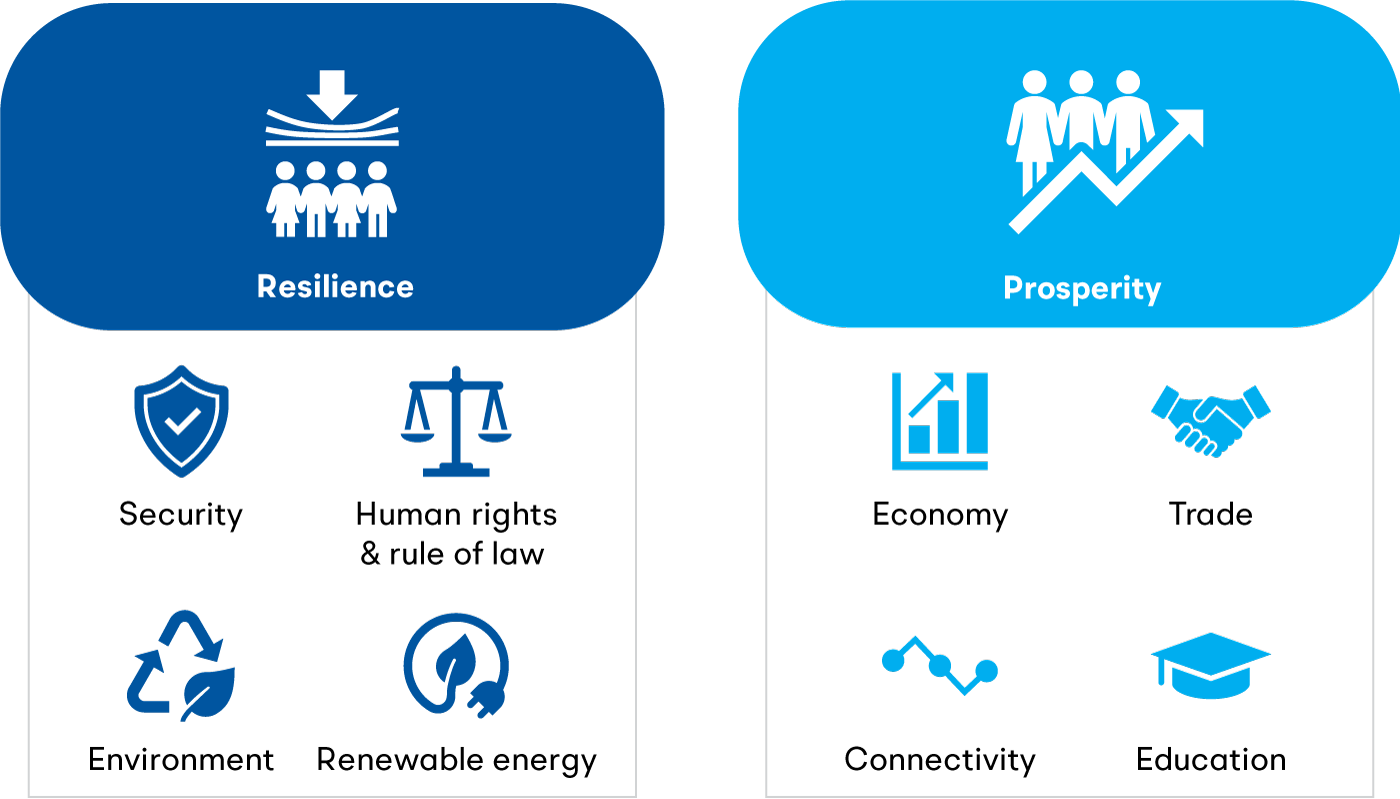
In its latest strategy, the overall aim of the EU in Central Asia is “to forge a stronger and nonexclusive partnership with Central Asian states so that the region develops as a more resilient, prosperous, and closely interconnected economic and political space”. These overarching priorities and underlying themes are visualised in Figure 11.[143] In practice, a third additional and overlapping EU priority for Central Asia is regional cooperation.
After the COVID-19 pandemic and Russian aggression against Ukraine, there have been discussions in Brussels to replace the 2019 strategy. So far the consensus has been that the standing priorities and themes are still valid. The EU did, however, develop a roadmap in 2023 as a sort of annex or to-do list to the strategy.[144] From its strategy the EU picks and chooses, currently stressing the environment and renewable energy in its resilience priority on the left side of Figure 11, and connectivity in the prosperity priority on the right side of the figure.
February 2022 marked the latest turning point in the relationship. Due to the Russian full-scale invasion of Ukraine, Central Asian countries once again came into the EU spotlight as potential alternative energy suppliers instead of Russia, similar to the situation in 2006-2009 when Putin started to threaten gas deliveries to Ukraine and the EU. Since 2022, the EU is also increasingly looking towards Central Asia as an alternative transport route, and as a region where the EU could step up its engagement to help countries decrease their dependence on Russia.
Since then, high-level meetings between the European Council president and Central Asian heads of state have taken place, as well as a steep increase in national European visits to the region. Last year the first EU – Central Asia summit was supposed to take place in Samarkand, Uzbekistan, as icing on the cake, but, as yet, it has not been possible to organise this. At the time of writing, there is still no concrete date in sight.
However, beyond such meetings and renewed attention for energy and transport connectivity with Central Asia, a more fundamental change in EU policy towards the region has not consolidated as overall attention and funding are still modest.[146] And despite the progress made since 1991, EU engagement with Central Asia is not perceived as consistent by the actors in the region. Various interviewees shared a similar sentiment, which can be summarized into the following quote:
After the Cold War ended, the West was suddenly interested in Central Asia. This faded away, but from 2001 onwards, when the US invaded Afghanistan, this interest returned – only to fade away yet again. And now that you have problems with Russia, you are once again interested in Central Asia. Will you leave again afterwards? Others, like Russia, China, and Türkiye, have always been here.[147]
Moreover, during some of our interviews, interviewees argued there is still little awareness among the population in all five Central Asian countries about the EU and its initiatives. Only after the 2007 Central Asia Strategy did the EU start to become more visible in the region.[148] The EU is aware of this and aims to raise its profile in the region through a “more dynamic and better-targeted communication strategy, presenting the rationale behind its engagement and underlining the opportunities, which the EU-Central Asia partnership can bring to the region and to its citizens.”[149]
The foreign policy nature of most Central Asian countries invites working with as many countries as possible – except for Turkmenistan’s neutrality policy. The five Central Asian states are expanding their partnerships with third countries to create better conditions for trade and investment. Both governments and businesses understand the need to diversify their partners, and Europe in particular is an attractive partner as it could offer an alternative path for economic diversification and provide certain technology and know-how which Central Asians cannot receive from Russia and China.[150]
Bilaterally, the EU is developing Enhanced Partnership and Cooperation Agreements (EPCAs) with the countries of Central Asia to replace the older Partnership and Cooperation Agreements (PCAs) that previously defined the relationships. These agreements arrange for cooperation in various fields, ranging from investments to energy, transport, education, and more. The EPCA with Kazakhstan (2020) has been ratified and with Kyrgyzstan (2024) signed. With Uzbekistan an EPCA is currently being prepared for signature, with Tajikistan negotiations are still ongoing, and with Turkmenistan there is only an interim trade agreement.[151]
The EU has argued it wants to become more geopolitical in its dealings worldwide since Ursula von der Leyen became President (elect) of the European Commission in 2019.[152] If the EU wishes to achieve this goal, its policy should be backed up by tangible and deeper engagement that goes beyond energy and trade, for instance by seriously including education, connectivity, and other elements.
To achieve this commitment, the sections below present some of the key sectors where the EU and the Netherlands in particular could have a unique entry point to the region. These areas are based on the national priorities of Central Asian countries, as well as the policy priorities as formulated in the EU strategy for Central Asia. While all issues are important, the ones related to water management and agriculture should be of particular relevance to the Netherlands in doing its bit.