The BRICS and the Emerging Order of Multipolarity
- Expansion of the BRICS, coupled with shifts in US policy, have accelerated the emergence of a multipolar global order.
- This new reality prompts the EU to diversify its strategic and economic partnerships to remain a competitive and effective global actor.
- To do so successfully, the EU will have to engage with BRICS-countries, collectively accounting for some 41 percent of global GDP (PPP).
- Such engagement requires the EU to accept diverse worldviews, prioritise shared utility over shared values, and support (some of) the BRICS’ diversification efforts.
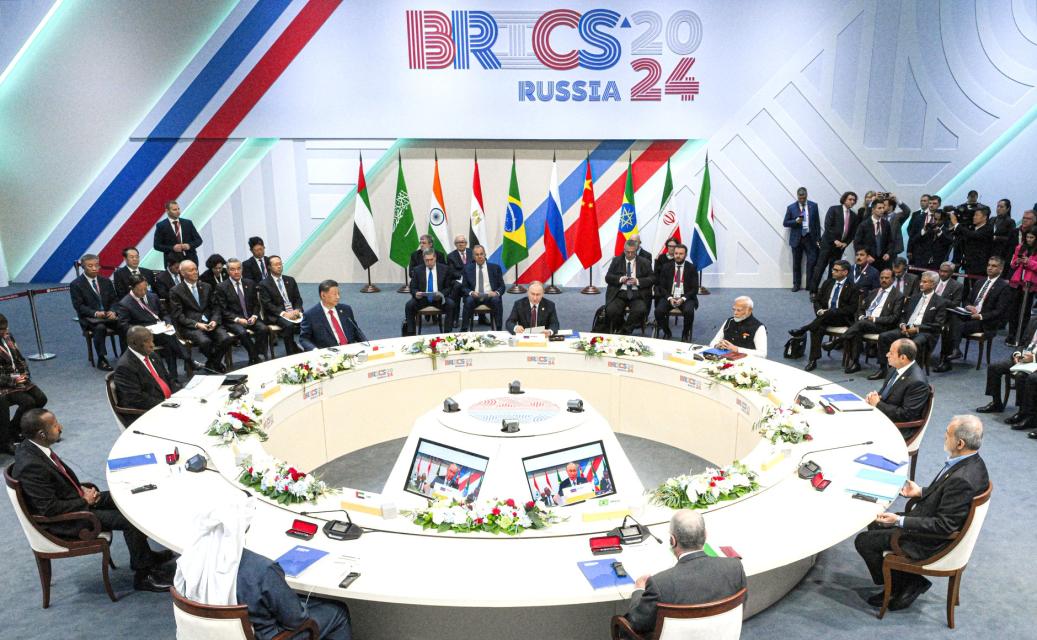
For the BRICS group – originally consisting of Brazil, Russia, India, China, and South Africa – 2024 has been a year of enormous and sudden expansion.
First, the BRICS welcomed four new member countries – Egypt, Ethiopia, Iran, and the United Arab Emirates (UAE) – in its midst on January 1, 2024. Then, the group announced the adding of ten new ‘partner countries’ during its most recent Summit, held in Kazan, Russia in October 2024. According to Russian presidential aide Yury Ushakov, the term ‘partner countries’ is meant to evaluate “how ready [countries] are for full-fledged or any other BRICS membership.” Indonesia then joined as full member on January 6, 2025, bringing the group’s official number of members to ten. Additionally, Saudi Arabia is listed on the website of the BRICS as a full member, but has yet to formally accept the membership. There is yet more potential for expansion, since some 40 more countries have voiced their interest in joining the group. The rapid expansion of BRICS prompts the need to address several key questions.
First, what are the key driving forces behind this relatively sudden BRICS expansion, and how is this reflected in BRICS ambitions and achievements? Second, what are the advantages of BRICS membership? Third, how should one characterise the BRICS grouping vis-à-vis other groupings? Fourth, what are current policy positions of the Netherlands and the EU on the BRICS and fifth, what are the key implications of the BRICS expansion for the Netherlands and the EU, as well as for the future world order? Finally, what are the policy recommendations to successfully relate to BRICS countries?
Methodologically, the report answers the questions above based on a combination of desk research, interviews and conversations with experts and policymakers, and a closed-door scenario workshop in which fifteen experts on the BRICS and individual BRICS countries participated.
This Policy Report is part of the PROGRESS-series 'Global Governance in Flux', with contributions by experts from the Clingendael Institute and The Hague Centre for Strategic Studies (HCSS). The series informs policymakers and stakeholders about developments in global governance that are relevant to the EU, EU member states and partners.