


Hamas “From the Heart of Battle”: Analyzing Abu Obaida’s Discourse
This essay was originally published by The Cairo Review
The frames and focus of the speeches of Hamas spokesperson Abu Obaida reveal the group’s strategic goals and the psychological warfare used to achieve them.
Despite Israel’s vows to decimate Hamas, military analysts in the country and beyond believe the resistance movement is unlikely to be completely uprooted. Israeli military spokesperson Rear Admiral Daniel Hagari himself admitted that Israel “cannot eliminate an ideology”. Indeed, Hamas has been able to continue fighting and inflict losses on one of the world’s most sophisticated, modern, and professional armies for over a year now. The movement continues to conduct limited strikes on Israeli forces in spite of Israel destroying over sixty percent of the strip’s physical infrastructure.
While Israel claims it has killed 15-20,000 Hamas fighters, and caused upwards of 186,000 deaths according to a letter published in The Lancet in July, Hamas continues to inflict casualties on the Israeli military—including killing senior officers—forcing the army to return time and again to areas of Gaza that were presumably free of fighters.
How Hamas has managed to keep standing—shifting from open combat to guerilla tactics in the process—deserves closer scrutiny. This is especially the case as Israeli military operations have partially shifted to Lebanon in the meantime, with the consequence that Gaza risks sliding slowly off the international agenda.
Just as guerilla tactics can frustrate an occupying force—Algeria, Afghanistan, Iraq, and Vietnam come to mind as examples—so can wartime discourse build psychological dominance over the battle space, especially its political framing. This is because language plays a powerful role in shaping our understanding of conflict contexts, participants, and the scope for action. It frames what is happening, defines who we are, and provides options on what can be done. Control of the narrative, particularly during conflict and war, is critical as it helps build support among constituencies and can instill fear among adversaries.
Analysis of how Abu Obaida, spokesperson for Hamas’ armed wing—the Izz al-Din al-Qassam Brigades, or al-Qassam for short—has framed the fight of the brigades against Israel, mobilized support, sowed dissent, and portrayed victory after October 7 offers insights into the group’s goal of psychological dominance in the war theater.
Twenty-six of his speeches, which vary between two-minute voice clips and 20-minute video addresses aired between October 7, 2023 and May 29, 2024, were converted into a textual corpus to allow a quantitative analysis of key terms and structural features which informed a qualitative thematic analysis of the aforementioned issues. A deeper understanding of the sources and prospects of the resilience of Hamas’ military wing—including the organization’s internal cohesion and public support, both of which are influenced by the movement’s discourse—can inform policymakers about its motivation and strategy.
Language as a Weapon
Al-Qassam have been active since the 1990s, attacking civilian and military targets in Israel and the Occupied Palestinian Territories. Named after the anti-Zionist Syrian militant Izz al-Din al-Qassam, killed in Jenin by the British in 1935, their stated goal is to violently resist the occupation of the Palestinian Territories, liberate Palestinian prisoners, and put an end to “Zionist” control of “historic Palestine”. Their militancy is part of a broader “Project of Resistance” spearheaded by the Islamic Resistance Movement, Hamas. This project is different from the Iran-linked “axis of resistance”.
The group spearheaded the October 7 attack on Israel, killing up to 1200 people—combatants as well as non-combatants—and taking over 200 hostages back to Gaza, and broadcast its operation live to audiences all over the world as part of a multimedia campaign that continues until today. It includes battlefield footage, intimidating videos of hostages, real-time updates from the ground, and long-form speeches.
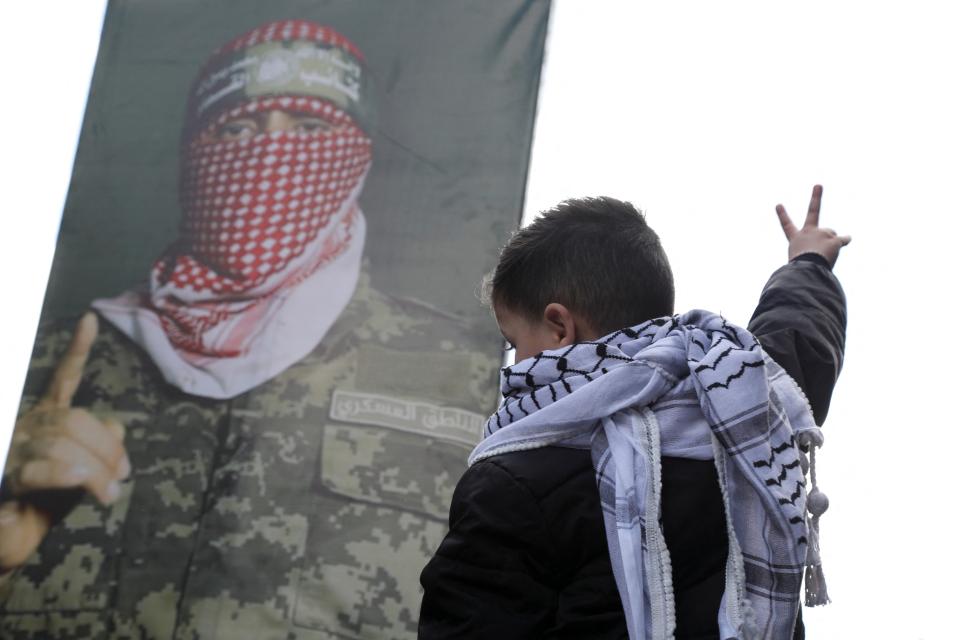
As the central figure of al-Qassam’s media campaign, Abu Obaida has appeared before crowds and cameras since 2006, when the group kidnapped the Israeli soldier Gilad Shalit, to explain the operations and strategy of the Brigades. Always dressed in military fatigues and characterized by his iconic red keffiyeh, he is seen as a symbol of resistance across the region.
Addressing his audience “from the heart of the battle”, as he puts it, Abu Obaida’s speeches include briefings on the battlefield, the hostage situation, statements on negotiations, and details about the performance of resistance fighters in Gaza. Looking into discursive practices like direct address, anecdotes, and moral as well as religious appeals helps understand how al-Qassam—an entity that is part of Hamas, but not identical to it—views its fight against Israeli occupation. The analysis adheres closely to the frames, language, and symbols used by Abu Obaida in a bid to render and interpret these as clearly as possible.
