Humanitarian access and humanitarian negotiations
Over 360 million people are currently in need of humanitarian assistance. However, meeting these needs has proven to be a challenge. Not only because of the substantial shortfall in funding, but also because having assistance reach where it is needed most appears to be a complicated undertaking, fraught with a wide variety of obstacles. In fact, as it turns out, ‘access’ is one of the biggest humanitarian challenges today.
Humanitarian access refers to both the ability of humanitarian organisations to reach crisis-affected populations and simultaneously to the ability of those populations to access humanitarian assistance and services. Access is pivotal for enabling a timely and effective humanitarian response, and facilitating access is an obligation to the parties involved, which is enshrined in various provisions of International Humanitarian Law (IHL).
Key articles include:
1. Geneva Conventions and Additional Protocols:
a. Common Article 3 (applies to non-international armed conflicts) obliges parties to allow humanitarian services for individuals not actively participating in hostilities.
b. Article 23 of the Fourth Geneva Convention mandates the free passage of essential goods, such as medical supplies, to civilians in occupied territories.
c. Articles 59 and 61 of the Fourth Geneva Convention and Articles 69 and 71 of Additional Protocol I (AP I) address the right to relief operations in cases of occupation, requiring the occupying power to permit and facilitate impartial humanitarian activities.
2. Customary IHL Rules:
a. Rules 55 and 56 outline that humanitarian relief must be allowed and facilitated during both international and non-international armed conflicts. Consent for relief efforts cannot be arbitrarily withheld when basic needs are unmet
3. Prohibition of Starvation as Warfare:
a. Article 54 of Additional Protocol I and Article 14 of Additional Protocol II forbid using starvation as a method of warfare, necessitating the provision of essential supplies to affected populations
Although this is enshrined in law, in reality humanitarian access to people in conflict zones is unfortunately not always guaranteed. In fact, there are many obstacles that limit access and therefore the delivery and reception of aid. Some may be situational and occur incidentally or unintentionally, whereas others may be deliberately created and may have strategic or even malicious intentions.
Types of access constraints
Humanitarian needs emerge for different reasons and in different contexts. Both in situations of armed conflict and in natural disaster contexts, humanitarian actors’ ability to reach people in need of assistance as well as the ability of affected populations to have full access to humanitarian aid, can be affected by so called ‘access constraints’. For example, in the case of armed conflict, active fighting and military operations can form serious security risks to both humanitarian personnel and local populations, and therefore humanitarian activities may need to be (temporarily) halted. Although this may have serious consequences, such situations are inherent to conflict zones. In these cases, violence is not necessarily targeted at humanitarian operations as such. There are also mechanisms in place to ‘deconflict’ which is to coordinate the movements of humanitarians in such a way that they are not endangered by any ongoing fighting.
There exist also other constraints that are unintentional and situational, that are not necessarily linked to conflict situations. For example, harsh climates/weather conditions after hurricanes, difficult terrains after earthquakes, and lack of infrastructure may form significant barriers to reach and deliver aid. This can be the status quo of a specific area but can also be the result of a natural disaster, and can happen and affect actors indiscriminately.
On the other hand, there are the obstacles that are intentionally created. For example, (de facto) authorities or armed groups can physically limit access through blockades and checkpoints impose bureaucratic restrictions on humanitarian personnel and supplies, interfere with the delivery of relief and implementation of activities in a way that is contrary to the humanitarian principles to which organisations must adhere. In the worst case scenario, fighting parties attack humanitarian personnel, goods, facilities and people that are seeking to access those services in a targeted way. These obstacles can be created for strategic or malicious reasons, but they can also derive from mistrust towards humanitarian organisations. In many cases, a combination of different factors, rather than a single one, leads to constrained humanitarian access. It is then the people in need of humanitarian assistance such as shelter, basic food, water and health or civil protection that suffer.
Overcoming obstacles to humanitarian access
Overcoming any of the abovementioned obstacles can be challenging for different reasons and requires different approaches. After an earthquake for example, infrastructure may be destroyed, making it physically challenging to reach affected areas and populations. It will take time and logistical efforts to overcome this obstacle and gain access. However, when mistrust or strategic interest are the underlying issues or motivating factors for access obstructions, this presents a very distinct challenge, as, other than for logistical or physical barriers, it entails a relational component. Although complex, (re)establishing and maintaining access and acceptance of humanitarian actors and their work is possible in these cases as well, as it can be advocated for, or negotiated. This process is referred to as humanitarian negotiations.
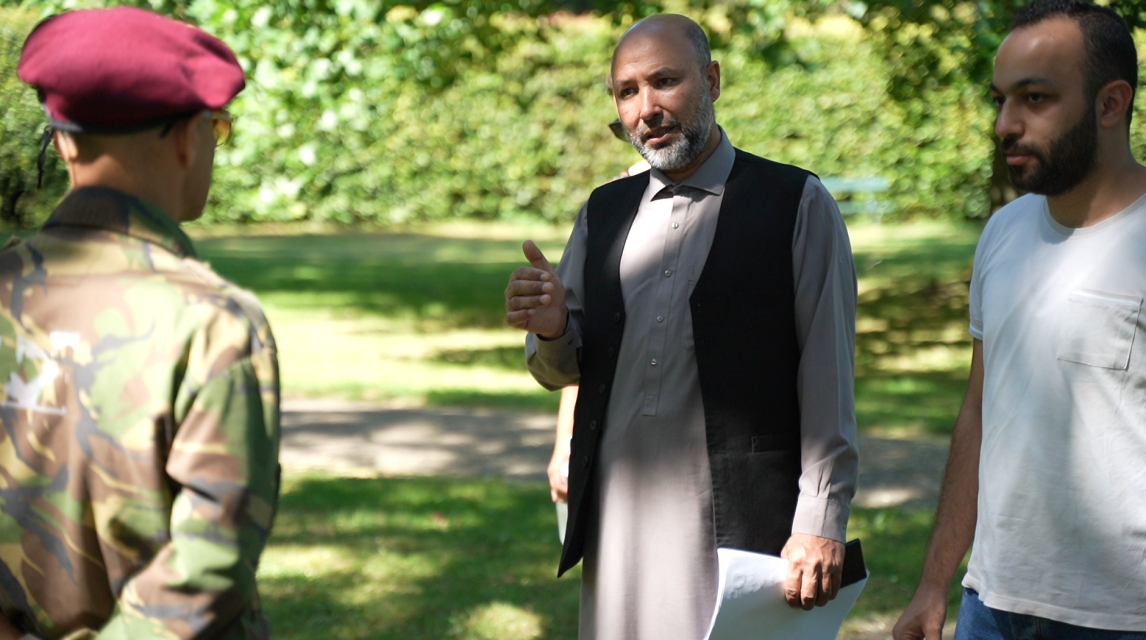
Humanitarian negotiation is a process through which humanitarian actors engage with various stakeholders - including governments, armed groups, local communities, and other organisations - to secure the conditions necessary for safely delivering and receiving humanitarian assistance. This process is usually highly complex, as it requires balancing the humanitarian principles of humanity, neutrality, impartiality, and independence while identifying relevant actors and addressing their diverse and often conflicting interests in tense environments and under time-sensitive conditions. Conducting this process successfully however, is critical for ensuring access to aid in conflict and crisis settings. It requires strong negotiation skills. Luckily, this is a skill that can be trained.
Humanitarian access negotiations training
Training in humanitarian negotiation skills can provide humanitarian aid workers with analytical and behavioral tools to navigate the abovementioned challenges effectively. Our training helps to provide insights to enhance preparations and support them to uncover deeper motivations behind stakeholder demands, which can lead to more informed decision-making and strategic negotiations.
Our training also promotes experience-sharing among humanitarians to address dilemmas collectively. In our training, participants are equipped with tools, insights and knowledge, but they and their organisations stay in the driver’s seat as experts in their field. Ultimately, our collective goal is to overall improve humanitarian action outcomes and alleviate the conditions of those who have been affected by natural or human-made crises.
Clingendael Academy
Would you like to know how the Clingendael Academy could help your organisation? Reach out to [email protected] and have a look at our humanitarian training programme.