Nepotism in the Islamic Republic of Iran
- In many countries, especially of the authoritarian and patrimonial variety, formal governance structures are underpinned by informal social relations that determine access to positions of power and influence. Iran is no exception. Family ties, revolutionary credentials and clerical lineage are major entry tickets into Iran’s governing apparatus and its associated privileges
- Ironically, the Iranian Revolution of 1979 failed to eradicate the practice of nepotism - in contrast to its professed intentions. Instead, the ideological framework of the revolutionary theocracy perpetuated nepotistic relationships, but presents them under a new set of justifications aligned with the regime's values
- Achieving greater economic prosperity and accelerated national development in Iran will require tilting the balance away from nepotist appointments and governance practices towards more merit-, competence- and accountability-based modes of governance
By Mehrzad Boroujerdi
Editor’s introduction
In September 2022, the death of Mahsa Jina Amini marked a major turning point for Iran. The event sparked lengthy nationwide protests across socio-economic classes and population groups whose demands rapidly evolved from discarding controversial hijab regulations to calls for the overthrow the Islamic Republic. The Iranian government responded with repression, killing over 400 protesters in late 2022 and early 2023, according to human rights groups.
The Clingendael blog series ‘Iran in transition‘ explores power dynamics in four critical dimensions that have shaped the country’s transformation since: state-society relations, intra-elite dynamics, the economy, and foreign relations. This blog post examines the three main sources of nepotism in governance in Iran: family ties, revolutionary credentials and clerical lineage. While nepotistic appointments can help create relations of trust in some cases, its overall effects tend to be negative as it prioritizes loyalty over competence, and facilitates corruption.
The social origins of nepotism in Iran
In 1962, Leonard Binder, a perceptive analyst of Middle Eastern politics, observed in his book Iran: Political Development in a Changing Society that "nepotism is a strict family obligation in Iran." More recently, Assef Ashraf characterized the Qajar Iranian state (19th century) as a “familial state,” a term Julia Adams, in The Familial State: Ruling Families and Merchant Capitalism in Early Modern Europe, defines as an organizational structure rooted in “paternal political rule and multiple arrangements among family heads.” During the Pahlavi dynasty (1925-1979), the significant influence of the "thousand families" in Iranian affairs was unmistakable. Although these families lost their power in the post-revolutionary period, the massive social upheaval of 1979 did not fundamentally challenge Binder’s astute observation about nepotism, which continued to persist under the Islamic theocracy that followed. Post-revolutionary Iran's political landscape remains significantly influenced by informal institutions and kinship ties.
Nepotism can be defined as granting advantages, privileges, or positions to relatives or close associates in professional or political contexts. Its widespread presence suggests that power may be exercised through formal mechanisms, but that its origins frequently lie in informal networks just as its dynamics emerge from such networks. In turn, this means that focusing exclusively on formal institutions and public actors risks overlooking critical dimensions of governance and rule in Iran. Hence, tracing informal networks, via for example family and marital ties, can yield insights into how social connections shape power dynamics and governance.
Nepotism can be seen as a mechanism for ensuring continuity in leadership and policies, offering opportunities to groom new talent by seasoned relatives and facilitating smoother transitions of power, particularly in regions prone to political instability. However, it often comes with significant drawbacks, such as fostering political dysfunction like discrimination, financial shenanigans or political corruption. By prioritizing loyalty over expertise, nepotism also undermines meritocracy, encourages rent-seeking behavior, and demotivates individuals who are perceived as outsiders.
With these characteristics and effects of nepotism in mind, it is noteworthy that a longitudinal study of 2,748 members of the political elite in the Islamic Republic by the author, including their family ties, shows that the dynamics of post-revolutionary politics in Iran have been strongly influenced by informal politics. They are at least in part the result of the kinship and marital ties of its officeholders.
Different forms of nepotism
The ideology of the Islamic Republic divides society into "insiders" and "outsiders"—those whom the regime can trust and those it cannot. The insiders are trusted and given privileges over the outsiders. Consequently, coveted positions are reserved for individuals who have demonstrated their loyalty to the "nezam" (system). This philosophy creates an environment conducive to nepotism, albeit under a revolutionary guise.
Examination of the familial ties among the ruling elites of the Islamic Republic provides valuable insights into the "circle of insiders." Their connections often stem from traditional practices such as cousin marriages or intermarriages among political families. Additionally, and more unique to Iran, contemporary familial ties have developed from political prisoners or war veterans marrying the sisters, cousins, or nieces of their former comrades from prison or the battlefield. Finally, being the offsprings of clerics in a theocracy is a resume enhancer. Data on 167 ministers shows that 22% of them have been sons of clerical personalities, for instance. In brief, family ties, revolutionary credentials and clerical lineage represent the major entry tickets into Iran’s governing apparatus and its associated privileges.[i] Let us take a look at each in turn.
Family ties
According to my data bank, at least 15% (400 individuals) of the top elites in the Islamic Republic have at least one familial connection with another person in this group of political elites (2,748), which encompasses ministers, heads of the three branches of government, members of parliament, members of the Guardian Council, the Expediency Discernment Council, the Assembly of Experts, and commanders of the army and the IRGC.
Within this group of 400 individuals, there are approximately 665 distinct family ties. Ancestral connections are the most prevalent, making up 58% (384) of all familial ties, in-law ties account for 37% (246) of family ties, and less than 4% (23) are husband and wife ties. The ancestral ties typically follow patterns such as “father-son,” “two or three brothers,” or “two or more cousins.” These ancestral ties are primarily concentrated in the parliament (Majles), with some also present in the Assembly of Experts and the Guardian Council. They can be categorized as either intergenerational (sons succeeding their fathers) or intragenerational (two brothers or cousins serving concurrently in a political institution).
While elites with ancestral ties are predominantly male (95%), an analysis of the dynamics of female office holders is also revealing. The data shows that at least 22% (20 individuals) of the 93 females who have served as MPs, ministers and Vice Presidents since the 1979 Revolution, were the daughters, wives or nieces of other prominent political personalities. Moreover, at least 10% more were the daughters, wives, sisters and mothers of “martyrs” (mainly of the Iran-Iraq war).
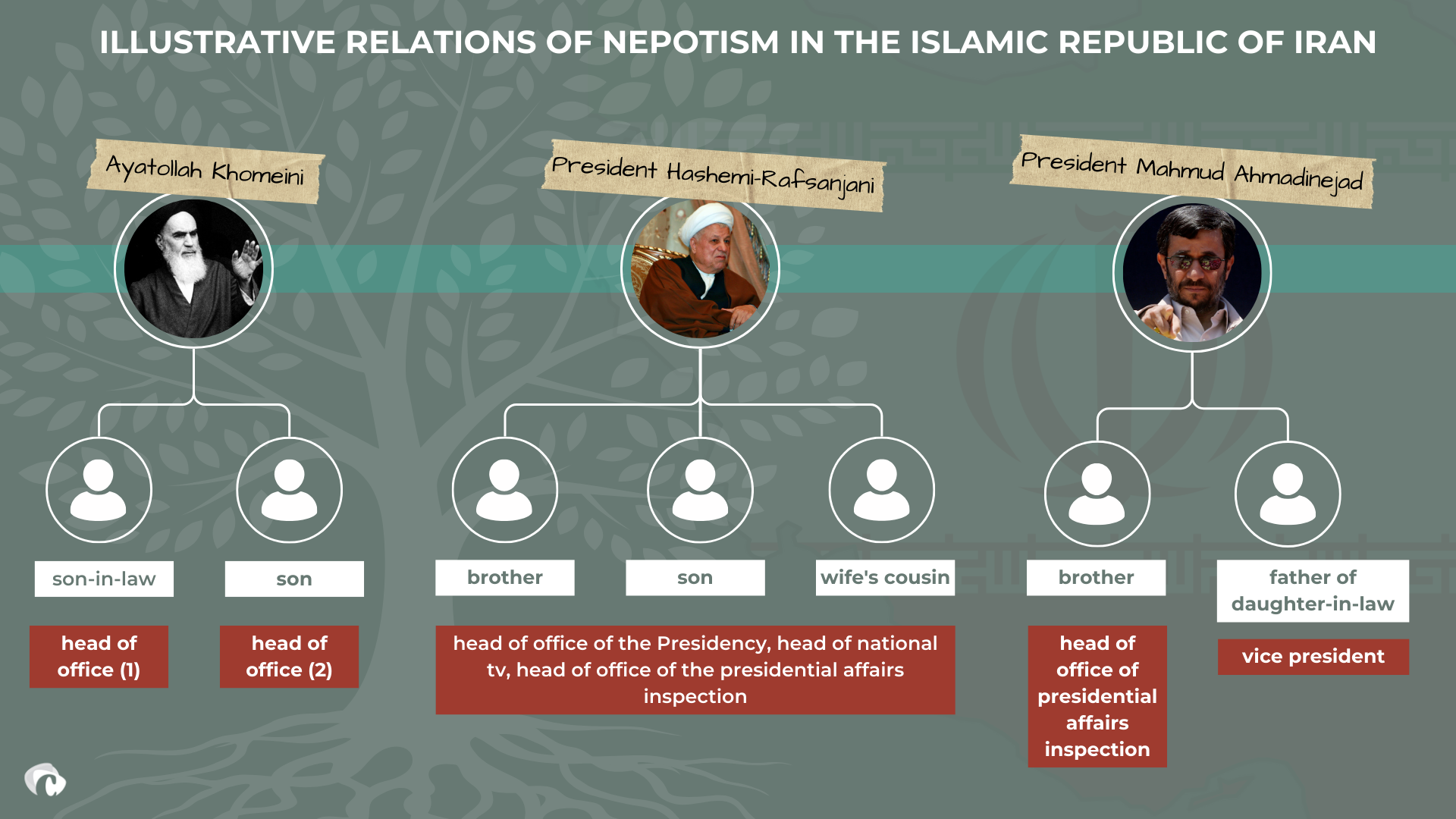
Typically, when a new minister, governor or mayor assumes office, they bring along a group of individuals aligned with them.[ii] These individuals are frequently friends and relatives, and often lack the necessary expertise and knowledge. Officials who are inclined to appoint relatives justify such appointments with the claim that “loyalty” and “trust” are crucial for the proper management of the responsibilities of the office. Prominent examples of this dynamic include:
- Ayatollah Shahaboddin Eshraqi and Ahmad Khomeini, respectively the son-in-law and son of Ayatollah Khomeini served for many years as the heads of his office. Under Khamenei, the position is held by Mohammad-Mehdi Golpayegani, the father of his son-in-law.
- President Hashemi-Rafsanjani appointed his brother, son, and later his wife’s cousin to roles such as acting head of the Office of the Presidency, head of national TV, and head of the Office of Presidential Affairs Inspection.
- President Mahmud Ahmadinejad appointed his brother as head of the Office of Presidential Affairs Inspection, and the father of his daughter-in-law, Esfandiyar Rahim-Mashai, as Vice President and Head of the Cultural Heritage, Handicrafts, and Tourism Organization and First Vice President.
The Mahdavi-Kani clan runs the influential Imam Sadeq University, an institution that develops revolutionary cadres, as a family enterprise. The most important academic administrative offices have been held for ages by the ayatollah, his wife, son, daughter, sons-in-law, brother, and nephews.
Revolutionary nepotism
Revolutionary nepotism differs somewhat from typical nepotism, The latter is often rooted in kinship politics, tribal politics and/or patronage networks that serve the powerful. In revolutionary nepotism, many individuals elected to parliament or appointed to high-level positions are relatives of martyrs, former prisoners of war, or disabled veterans. In particular the sacrifices of fathers and brothers during the Iran-Iraq War boosted the electability of their children and siblings, granting them the status of "favored sons and daughters" and access to coveted state jobs. Nepotistic favoritism also extends to practices such as benefiting from a quota system to attend universities, being awarded state scholarships for overseas study, and even being granted judicial leniency for crimes committed.
The practice of children with "good revolutionary genes" who leverage their parents' or close relatives' influence and power to gain economic or political advantages has become so widespread that the Iranian public has coined the term "aghazadeh" (literally "son of") to describe them. Aghazadehs are often perceived as privileged offspring who attain significant power and wealth with minimal effort, primarily due to their family connections and proximity to influential circles. This phenomenon transcends political factions and includes both male and female offspring.[iii] Raised in political families, these aghazadehs often believe they have "compelling" reasons to occupy high-level political or economic positions and enjoy corresponding privileges, mirroring the careers of their parents. Their perceived greed and sense of entitlement, in turn, generate considerable public resentment.
While some elite offspring use their family name to gain a foothold in politics, many others, wary of Iran's turbulent political landscape, have turned to the business sector as a safer and opaquer alternative. In Iran's crony capitalist system, it is common practice to appoint relatives to managerial positions within the vast bureaucracy of state-owned and (para)statal organizations. Such appointments are particularly attractive in banks, councils, foundations, energy companies, think tanks and universities. It has become routine to offer salaries and the title of "consultant" to relatives and friends. Their insider status allows this revolutionary ‘family’ to exploit lucrative opportunities with minimal public scrutiny. As a result, Islamic revolutionary families accumulate assets, status, and political connections that could influence Iran's politics for years to come.[iv] Dislodging these entrenched families and "sons of power" who have enjoyed political longevity and economic muscle will be no small task.
In Iran, the tradition of intermarriage among clerical families has long reinforced and perpetuated nepotism within the political and clerical elite. As the author has noted elsewhere, many individuals in significant positions are linked by marriage as sons-in-law or brothers-in-law to influential figures, creating a web of familial alliances that consolidates power and influence.[v] A prime example is the prominent Larijani family, which exemplifies the practice of intermarriage among clerical elites. Ali Larijani, former Speaker of the Majles, is the son-in-law of Ayatollah Morteza Motahhari, the former chair of the Revolutionary Council. His brother, Sadeq Larijani, a former Chief Justice and current head of the Expediency Council, is married into the family of Ayatollah Vahid Khorasani, a leading Shiite source of emulation. Another brother, Bagher Larijani, former Chancellor of Tehran University of Medical Sciences, is the son-in-law of Ayatollah Hasan Hasanzadeh-Amoli, a distinguished Islamic philosopher. Additionally, their sister married Ayatollah Mostafa Mohaqqeq-Damad, a former head of the State General Inspectorate Organization.
Such interconnectedness extends into political appointments. While serving as the head of the Judiciary, Ayatollah Sadeq Larijani appointed another brother, Mohammad-Javad Larijani, as the deputy for International Affairs and head of the Human Rights Office, illustrating the centrality of familial ties in career advancement. This pattern is not unique to the Larijanis. Ayatollah Khomeini’s family, for example, has established marital connections with at least eighteen different families, while Ayatollah Khamenei’s family has formed kinship ties with at least nine families. These alliances demonstrate how intermarriage functions both as a tool for maintaining influence and as a mechanism for embedding nepotism within formal governance structures.
Conclusion
Nepotism is a hallmark of authoritarian and patrimonial systems in which rulers often prioritize kinship politics as they view family ties as reliable and stable. Where government positions are perceived as opportunities to benefit one's family, clan, or kinship group—often at the expense of broader societal interests—a crypto-hereditary system can take root.
The 1979 Iranian Revolution formally abolished the monarchy but failed to eradicate the practice of nepotism. Instead, the ideological framework of the revolutionary theocracy adapted and perpetuated nepotistic relationships, presenting them under a new set of justifications aligned with the regime's values.
Read earlier blogs in this series.
[i] In addition, nepotism in Iran often takes the form of ethnic or neighborhood (“mahaleh”) favoritism, i.e. hiring individuals from one’s own region, ethnic group, clan, or locality.
[ii] One blatant example of nepotism is the former minister of interior (2013-2021), Abdolreza Rahmani-Fazli. He appointed his son to the ministry's Resistance Economy Task Force, secured a managerial position within the ministry for his son-in-law, and placed his sister's son-in-law as the head of the Performance Management, Inspection, and Legal Affairs Center. Additionally, he appointed his brother-in-law as an advisor to the ministry.
[iii] Some examples of aghazadeh are the children of such individuals as Mohammad-Reza Aref, Gholam-Ali Haddad-Adel, Akbar Hashemi-Rafsanjani, Safdar Hoseyni, Seyyed Ali Khamenei, Abolqasem Khazali, Ahmad Jannati, Morteza Motahhari, Mohammad-Baqer Qalibaf, and Abbas Va'ez-Tabasi.
[iv] Some of the more well-connected political families of the Islamic Republic are Abbaspur-Tehranifard, Abutorabifard, Dastgheyb, Hashemi-Rafsanjani, Kalantari, Khamenei, Khamushi, Khatami, Khomeini, Larijani, Mottahari, Nateq-Nuri and Saduqi.
[v] The advantage of appointments of sons-in-law or daughters-in-law lies in their anonymity as different last names do not immediately reveal a direct familial relationship unless exposed by the media or knowledgeable individuals. This helps protect high-ranking officials' reputation from being tarnished. Even when nepotistic relationships are uncovered, the official can claim that the appointment was based solely on merit. To further distance themselves from the appointment of their in-laws, officials often ask other power holders to appoint their relatives, frequently in exchange for rendering a similar favor.