Between Hope and Fear: Dutch population united in fear of hybrid threats and war, while strong divisions persist
- Dutch people find common ground in fear of hybrid threats and war
- The vast majority also agrees on how these hybrid threats and the threat of war should be handled. People desire protection of society against hybrid threats and war threat, as well as investments to improve the resilience and self-sufficiency of the Netherlands and Europe
- Threat perception regarding migration, climate as well as democracy and the rule of law remains strongly divided, but the wish to prepare for the consequences of climate change remains widely shared
- More than 20% of Dutch citizens see the political views of other Dutch citizens as the greatest threat: they fear the rise of political parties in various countries who discriminate against people based on their religion or race
- A number of relevant policy changes by the current government have so far failed to stir much enthusiasm among the population. This concerns the use of development cooperation in service of Dutch interests and the reintroduction of Dutch border controls
Between Hope and Fear
Since 2022, the Clingendael Institute annually surveys what international developments the Dutch population perceives as most threatening and as most hope-inspiring. A remarkable finding in the 2025 edition is that the threat of war is bringing Dutch citizens together. Not only do they share a fear of hybrid threats and war, but they are also united in their hope for greater resilience and for the achievement of a lasting ceasefire between Ukraine and Russia. Media coverage of cyberattacks, hybrid and military threats, speeches by political leaders such as NATO secretary general Mark Rutte, and calls to put together an emergency package have made an impression on most Dutch citizens.
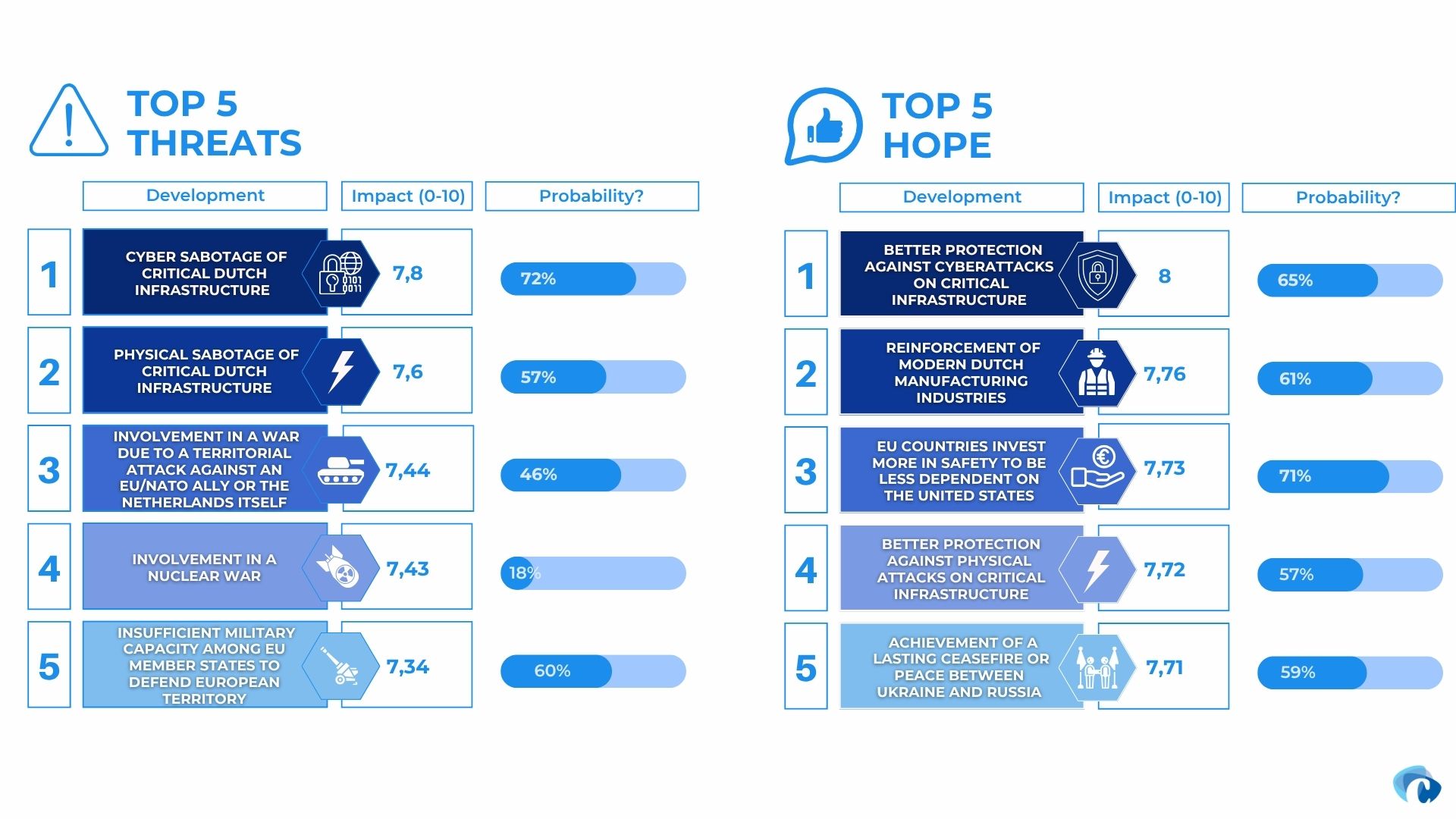
The attitudes of Dutch citizens were measured using two samples of more than 4000 respondents in December 2024. Respondents were asked to rate (on a scale from 0 to 10) the impact that a large number of developments would have on the security and prosperity of the Netherlands, if these were to actually occur. Based on the average impact score that respondents assigned to the various developments, a threat hierarchy and a hierarchy of hope were prepared. Respondents were also asked to indicate whether they consider it likely (with a probability exceeding 75%) that a certain development will indeed occur within the next five years.
As in the past three years, we found that Dutch citizens are deeply divided with regard to international developments. In the Clingendael survey study, we conceptualise this schism as running between people who are strongly attached to borders and national culture, and people who are not; these are respectively referred to as Somewheres and Anywheres.
Heightened fear of war
In 2025, we see a consensus about the threatening nature of several developments, as well as about how these developments should be handled. This consensus concerns hybrid threats and the threat of war. Deemed most threatening by the Dutch population are cyberattacks and physical attacks against critical infrastructure; these are ranked first and second, respectively, in the hierarchy of threats. Positions three, four and five represent various war-related threats: involvement in a war due to an attack on a European member state or NATO ally, involvement in a nuclear war, and concerns about the inadequacy of Europe’s military capacity (see Table 1). The top four of these most threatening developments rank in the top fifteen of both Somewheres (see Table A in the Annex) and Anywheres (see Table C in the Annex). Furthermore, these are threats that majorities of respondents – 54% to 72% – believe likely to occur in the next five years. Nuclear war ranks high because people believe that the consequences would be disastrous; quite remarkably, one in five Dutch citizens also fears that nuclear war will likely break out within five years.