Anette Hoffmann in the Dutch House of Representatives on the situation in Sudan
On 9 December 2025, Sudan researcher Anette Hoffmann spoke before the Foreign Affairs Committee of the Dutch House of Representatives. Read her position paper below. Also available as PDF with links and footnotes. Watch the round-table session here.
Sudan: diplomatic engagement
Introduction
After two and a half years, the war in Sudan between the regular Sudanese Armed Forces (SAF) and the paramilitary Rapid Support Forces (RSF) continues to fuel the world’s largest humanitarian catastrophe, displacement crisis and protection emergency. Sudan’s war and ongoing state fragmentation also poses a serious threat to stability across the wider region including in the Red Sea.
With the RSF’s brutal takeover of El Fasher last October, and the mass atrocities that followed, the war has reached a tragic low point. This manifests itself in both the scale of suffering that this well-planned, systematically orchestrated and ethnically motivated violence caused, as well as the astonishing inaction of the international community despite consistent warnings by independent experts over the past 18 months.
With at least 60,000 estimated to be killed in El Fasher alone, and 400,000 in Sudan since 2023, the immense human cost of this international inaction raises an urgent question: What diplomatic engagement will it take to end the violence and alleviate the suffering of the civilian population? This document offers some lessons from diplomatic engagement on Sudan to date and suggests entry points for more effective action by the Netherlands (NL) and the European Union (EU).
Lessons learned from hitherto diplomatic efforts to end the war in Sudan
As violence rages and famine spreads, international efforts to end the war keep failing: Many diplomatic statements of concern condemning the atrocities have been issued. Half a dozen ceasefire and peace initiatives have been launched. But none of these efforts was able to pressure Sudan’s generals to cease fighting, nor to persuade regional powerbrokers to push for a compromise.
This is not to say that diplomatic engagement has not affected the fighting on the ground. But rather than de-escalating the conflict, mediation efforts have often led to an intensification of conflict, by prompting the parties to the conflict to scale up military efforts with the aim of bolstering their bargaining position at the negotiation table. An example is the RSF’s brutal take-over of El Fasher, which occurred while one of their high-level commanders partook in ceasefire negotiations in Washington.
The main mediation initiative presently ongoing - the Quad - involves the U.S., Saudi Arabia, Egypt and the United Arab Emirates. They issued a joint statement in September 2025, calling for an immediate ceasefire, a three-month humanitarian truce and an inclusive political process of nine months that should lead the country from war to democracy. However, follow-up meetings between the Quad and representatives of the belligerents have failed to translate any of these proposals into action. The main obstacle remains the warring parties’ lack of genuine interest in ending the war. Besides that, international efforts have yielded little results due to the reluctance of Western capitals to increase pressure on the main regional sponsors of the conflict, to systematically include civilians in negotiations and to strategically coordinate the various diplomatic efforts into one coherent and bold negotiation framework. Meanwhile, the situation in Sudan continues to rapidly deteriorate, with arms supplies intensifying on both sides.
To turn the tide of failing diplomatic engagement, some lessons can be drawn from previous initiatives.
Firstly, without escalating and sustaining high-level pressure on the conflict parties and their backers, mediation talks risk doing more harm than good. To date, whether in the Jeddah talks or recent Quad meetings, both parties have shown no restraint in waging war while talking peace. New attacks during talks must have immediate consequences and translate into tangible disadvantages and less negotiation power in the talks. The United Arab Emirates, Saudi Arabia and Egypt have all continued to supply weapons to the belligerents while calling for an end to external interference. Unless they are effectively pressured to walk the talk, their behaviour is unlikely to change.
Secondly, the absence of a civilian voice in ceasefire and peace talks undermines the chance for lasting peace and democratic rule. Sudan’s civilians, and in particular the anti-war bloc among them, must have a say in all diplomatic efforts. This is because the war is not only fought between two armies and their allies. It is also a war fought by these two armies against the civilian population. Those opposing the war and refusing to side with either party are among the primary civilian targets. Yet, ceasefire negotiations and peace mediations primarily involve armed factions and their military sponsors, who repeatedly prioritise their interests over those of the civilians. However, to determine humanitarian and protection priorities, monitor the implementation of an eventual ceasefire and document breeches, Sudanese civilians have a key role to play.
Thirdly, if poorly coordinated, multiple parallel diplomatic initiatives weaken the process overall, enabling forum shopping by military and civilian actors. The lack of strategic coordination applies to both political engagements to negotiate an end to the violence as well as to targeted economic sanctions. The lack of strategic coordination between various negotiation initiatives1 and sanctioning entities has eroded the effectiveness of such measures.
Entry points for more meaningful diplomatic engagement
Drawing on these learnings, a much bolder, high-level diplomatic engagement is required, by the NL and the EU at large.
Firstly, in the absence of direct leverage on the warring parties, the NL can escalate pressure on the external backers of Sudan’s war and encourage the EU to follow suit.
- The NL can help expose and curb arms supplies. For instance, by publicly endorsing the plausibility of evidence revealing the UAE’s ongoing arms supplies to the RSF and by holding the UAE accountable. (Having removed a reference to the UAE’s role in Darfur in the latest EU resolution, the EU enables future mass atrocities by the RSF rather than doing everything possible to prevent them.) The NL/EU should also hold Egypt, Türkiye and KSA to account for their role in militarily backing the SAF. Finally, the NL should reconsider its own arms exports to these intermediary countries. This is especially the case for the UAE, where the link to mass atrocities, which according to the EU likely amount to genocide, has been well documented in a leaked UN report. The NL/EU can further use theirleverage with the AU to critically engage those AU member states that facilitate the external arms supplies to Sudan (incl. key counterparts of the EU and the NL: Kenya, Uganda), hence putting regional stability at risk.
- The NL/EU can escalate economic pressure by demanding tighter controls on Sudan-linked gold flows, demanding enhanced scrutiny of Sudan-linked gold trading via the UAE, and linking trade agreements to compliance with international humanitarian law and human rights. As gold is the main commodity financing this war and with an estimated 90% of Sudan’s gold ending up in the UAE, NL should support sanctions that target UEA entities responsible for trading conflict gold and channeling weapons and mercenaries into Sudan. Such measure are paramount to counterbalance the EU’s problematic decision in July to remove the UAE from the list of high-risk third countries for anti-money laundering. Lastly, the EU must use the ongoing negotiations of a free-trade-agreement with the UAE to address the credible evidence that the UAE’s military and financial support to the RSF is fuelling the war and contributing to mass atrocities in Sudan.
- The NL can use its diplomatic weight in the UN by lobbying for the implementation of existing UNSC resolutions, such as the recently extended sanctions regime and arms embargo 2750 (2024) and the El Fasher Resolution 2736 (2024) calling for the withdrawal of all fighters that threaten the safety and security of civilians. Even if the UNSC is unlikely to endorse drastic measures, the existing tools in the international peace and security architecture ought to be applied.
Secondly, the NL/EU should amplify the voice of civilians in any diplomatic engagement on Sudan. After a decade of supporting pro-democracies forces in Sudan, the NL is uniquely positioned to more consistently use their seat at various diplomatic tables to amplify Sudan’s civilian voice, including the voice of those grassroot movements, youth and women groups and mutual aid groups who lack access to the usual conference halls in the region.
- On the humanitarian file, most diplomatic engagement has been with the conflict parties around humanitarian access, facilitation of visa and travel permits, etc. and the UN Cooperation Framework for Sudan. While necessary, as virtually any humanitarian aid hinges on the goodwill of armed groups, it is also critical to consult, protect and strengthen civilian actors in the humanitarian space: by seeking their advice when negotiating ceasefire arrangements and setting up monitoring mechanisms in which civilians can form part. The NL could also consult civilian coalitions when offering feedback on the UN’s cooperation agreement with the SAF dominated authorities.
- With regard to accountability and justice, it is critical that the NL continues supporting the ICC and the UN fact findings mission. In addition, it is critical to ensure funding for those independent Sudanese news platforms (like Ayin, Atar, Sudan War Monitor, Dabanga, etc.) whose crucial role in documenting crimes and providing context enables future accountability and justice. For instance, the reporting of the independent Amsterdam-based Radio Dabanga was critical in holding former Janjaweed leader Ali Kushayb accountable for his crimes in the earlier Darfur conflict 20 years ago.
- Finally, for achieving lasting peace, the NL and the EU have a keen interest in working towards a realization of the vision Sudan’s pro-democracy forces brought forward in their peaceful December Revolution in 2018. While President Trump’s attention for Sudan may be able to force Sudan’s regional powers to a compromise, the Quad is unlikely to promote lasting peace and a rule-based order. Like in earlier peace deals led by the current U.S. administration, the focus in Sudan is on a ceasefire and power and wealth sharing, rather than on addressing the root causes of the conflict. The NL should advocate within the EU to support the Quad’s efforts to silence the guns, while stressing the need for developing a broader vision for ending the war, one that is driven by the Sudanese civilians. This requires broad popular consultations, involving the country’s diverse grassroot movements, around fundamental issues such as governance, justice and citizenship.
Conclusion
The magnitude of the suffering and destruction in Sudan stands in sharp contrast with the toothless diplomatic engagement by the EU and its member states. This is concerning from an ethical perspective but also with regard to the NL’s own foreign policy priorities, since the war disrupts Red Sea shipping lines, threatens regional security and fuels irregular migration.
Ending the war in Sudan will require a much bolder approach than the quick-fix solution the Quad initiative is likely aiming for. Such an approach would hinge – among others - on the NL’s and the EU’s readiness to (i) escalate pressure on and sanction those Sudanese and non-Sudanese entities that continue to back the warring factions and (ii) to amplify the voice of Sudanese civilians, in any discussion whether around accountability, ceasefire, humanitarian access or the political transition towards democracy.
Sticking to more of the same carries the high risk that the Sudanese state will collapse, with catastrophic consequences for the 47 million Sudanese as well as the entire region. The stakes for the EU and the NL could not be higher.
***
Additional useful resources on Sudan:
- Most recent NOS explainer about the role of the UAE in Sudan: Hoe dit land de Sudan-oorlog voedt
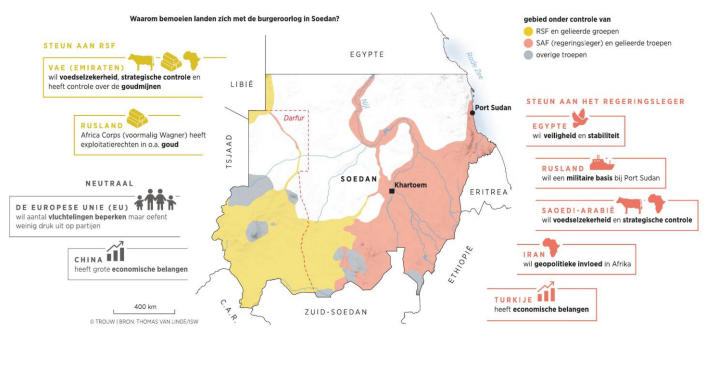
- Overview of foreign influences in Sudan in recent Trouw article: Achter de bloedige strijd in Soedan gaat een geopolitiek spel schuil: wie steunt wie, en waarom? | Trouw
Authors

Related
See all