Iran's geoeconomic positioning since 1979: Across all Azimuts
- Iran’s overall global role is often misunderstood because policy debates focus almost exclusively on geopolitics. To truly understand the country, equal attention must be given to its geoeconomic dynamics, which shape both the region and the wider world
- Since 1979, Iran’s geoeconomic strategy has been largely pragmatic: first, to secure the survival of its political system; second, to position itself within the rise of (Eur-)Asia and an emerging multipolar order
- Looking ahead, Iran’s geoeconomic trajectory will depend on the fate of its current system, amid significant internal and external uncertainties. Over the long term, however, Iran is likely to revert to its historical role as a geoeconomic and cultural crossroads
By Mohammadbagher Forough, Assistant-professor at the Erasmus University of Rotterdam
Editor’s introduction
In September 2022, the death of Mahsa Jina Amini marked a major turning point for Iran. The event sparked lengthy nationwide protests across socio-economic classes and population groups whose demands rapidly evolved from discarding controversial hijab regulations to calls for the overthrow of the Islamic Republic. The Iranian government responded with repression, killing over 400 protesters in late 2022 and early 2023, according to human rights groups. The protests of January 2026 both reflected and reinforced the negative spiral of government underperformance and legitimacy, as well as increasing the external and internal pressures that also characterized the protests of 2022/2023.
The Clingendael blog series ‘Iran in transition‘ explores power dynamics in four critical dimensions that have shaped the country’s transformation since: state-society relations, intra-elite dynamics, the economy, and foreign relations. This blog reviews Iran’s geoeconomic positioning since 1979 and observes the dominance of pragmatic policies that are designed firstly to ensure the survival of the country’s political system and, secondly, to align Iran with the rise of the post-Western multipolar world, ensuring the continuity of the idea of Iran as a geoeconomic and cultural crossroads in the process.
Beyond geopolitics
When we think about Iran on the international stage, many automatically think of nuclear negotiations, regional rivalries, the Axis of Resistance or animosity with Israel. In a word, Iran's place in the geopolitical order. What remains under-discussed is Iran’s geoeconomics, i.e. reconfiguring "the idea of Iran" in economic and geographic terms. The blog focuses on Iran’s infrastructure and trade initiatives since 1979. It examines how these initiatives reflect Iran’s efforts to reconceptualize its position in the context of the reordering of the global political economy. This reordering involves the collapse of the Soviet Union and the relative decline of Western power. At the same time, a range of non-Western actors, such as China, India, Russia, Brazil, Indonesia, South Africa, Saudi Arabia, and Turkey have gained influence in global politics and economics. Iranian elites intend their country to join this emerging group of influential states as soon as possible.
The pre-1979 global and national context
The Pahlavi dynasty's (1925-1979) foreign policy, particularly under Mohammad Reza Shah, was deeply shaped by the Cold War. The Shah envisioned Iran as the closest ally of the US in the region and promoted the country as the "Gendarme of the Persian Gulf," a role meant to be carried out under the tutelage of Western imperial powers. In this capacity, Iran was tasked with containing Soviet imperial influence as well as socialist and communist movements across the region. A case in point is Iran’s military intervention (1972-1975) in Oman, which helped defeat a Marxist-Leninist insurgency that threatened the UK-backed Omani sultanate. Geopolitically, Iran thus positioned itself as the regional enforcer for the Western bloc during the Cold War.
Geoeconomically, Iran was similarly reimagined in a pro-Western framework, as an "island" of modernization in a region assumed to be backward and uncivilized. This image of Iran relied on reductively romanticizing Iran’s long monarchical past and emphasizing its so-called "Aryan" heritage and bloodline. For many Iranians at the time, and for many monarchists still today, this notion implied belonging to the white, civilized Western world. Such civilizational and racial discourse was deployed to present Iranians as culturally and racially superior to other regional peoples. The Shah called himself "Aryamehr", meaning the light of Aryan people. Under the Shah, Iran was thus portrayed as an unapologetically Westernized, "white", "modern" nation, an extension of the "civilized" West in a non-Western region – similar to the way some Israeli elites call Israel "a villa in the jungle". This Pahlavi orientation was hardly surprising, given that Shah's ascension to power was facilitated through a US- and UK-backed coup in 1953.
Iran’s post-1979 geoeconomics
The Pahlavis were dethroned in the 1979 Revolution, which brought the Islamic Republic of Iran (IRI) to power. Rejecting the Shah's West-centric self-orientation, the IRI elites promoted the geopolitical slogan "Neither East, Nor West", rejecting alignment with the Cold War's imperial camps, particularly the West. Tensions with the US led Iran into security arrangements that formed what we call the "Axis of Resistance", an Iranian-led network of state and non-state partners organized around opposing American and Israeli interventions in the region. In recent years, IRI elites have embraced the rise of the "East" (China, India, Russia), reflected in their "Look East" policy and efforts to rebrand the region as "West Asia," emphasizing the country's Asian identity.
Unlike its anti-Western geopolitics, the IRI's geoeconomic policies have consistently sought to reconceptualize Iran as a "crossroads" or "bridge" between civilizations and (geo)economic blocs in both North-South and East-West directions. Iran was a pioneer of the "New Silk Road" (NSR) concept long before China's Belt and Road Initiative (BRI). These geoeconomic policies are partly driven by Western sanctions targeting Iran's economy and energy sector, measures designed, as US policymakers have publicly admitted (time and again), to pressure ordinary Iranians and trigger internal collapse - or at least cause chaos. The IRI's geoeconomic strategy is thus two-pronged: first, it can be called a 'geoeconomics of survival', to create lifelines for the Iranian economy to withstand western sanctions, and second, beyond survival it points to Iran's ambitions to align itself as much as possible with the rise of (Eur)Asian powers. Departing from this insight makes it useful to discuss key initiatives that Iran has been promoting in consequence, and to reflect on their effects.
The Economic Cooperation Organization (ECO)
The collapse of the Soviet Union offered Iran a historic opportunity to reassert its influence in the “inner heartland” of Eurasia. Tehran responded by expanding the Regional Cooperation for Development into the Economic Cooperation Organization (ECO), bringing the newly independent Central Asian republics into a broader regional framework. Although ECO was formally established in 1985 by Iran, Pakistan, and Turkey, its strategic significance increased markedly after 1991. Iran promoted infrastructural and policy connectivity among the founding members as well as—most importantly—between Iran and the landlocked states of Central Asia, which sought access to international waters through the Persian Gulf and the Arabian Sea. This logic has remained a recurring theme in Iran–Central Asia relations.
ECO’s core objective is the creation of a cohesive regional market by prioritizing transport connectivity, energy security, and trade liberalization among its ten member states. The organization’s guiding principle of “corridor-based development” conceptualizes the region as a vital transit bridge linking Europe, China, and the Indian Ocean. This vision took concrete form in large-scale infrastructure initiatives such as the Islamabad–Tehran–Istanbul (ITI) railway and the Kazakhstan–Turkmenistan–Iran corridor. Iranian elites consistently portrayed the country as a natural East–West bridge within this evolving Eurasian architecture and promoted the discourse of New Silk Road, long before the advent of China's BRI.
ECO's overall performance reflects both strategic potential and persistent frustration. Despite the “Vision 2025” roadmap, progress has been constrained by international sanctions on Iran, chronic instability in Afghanistan, and limited investment capital. Intra-regional trade remains modest, and ambitious energy initiatives, such as the Peace pipeline between Iran and Pakistan or a regional electricity market, have remained as (experimental) work in progress. Nonetheless, given the rise of (Eur-)Asian and New Silk Road discourses, ECO is experiencing a cautious revival. Bottom of Form
The International North-South Transport Corridor
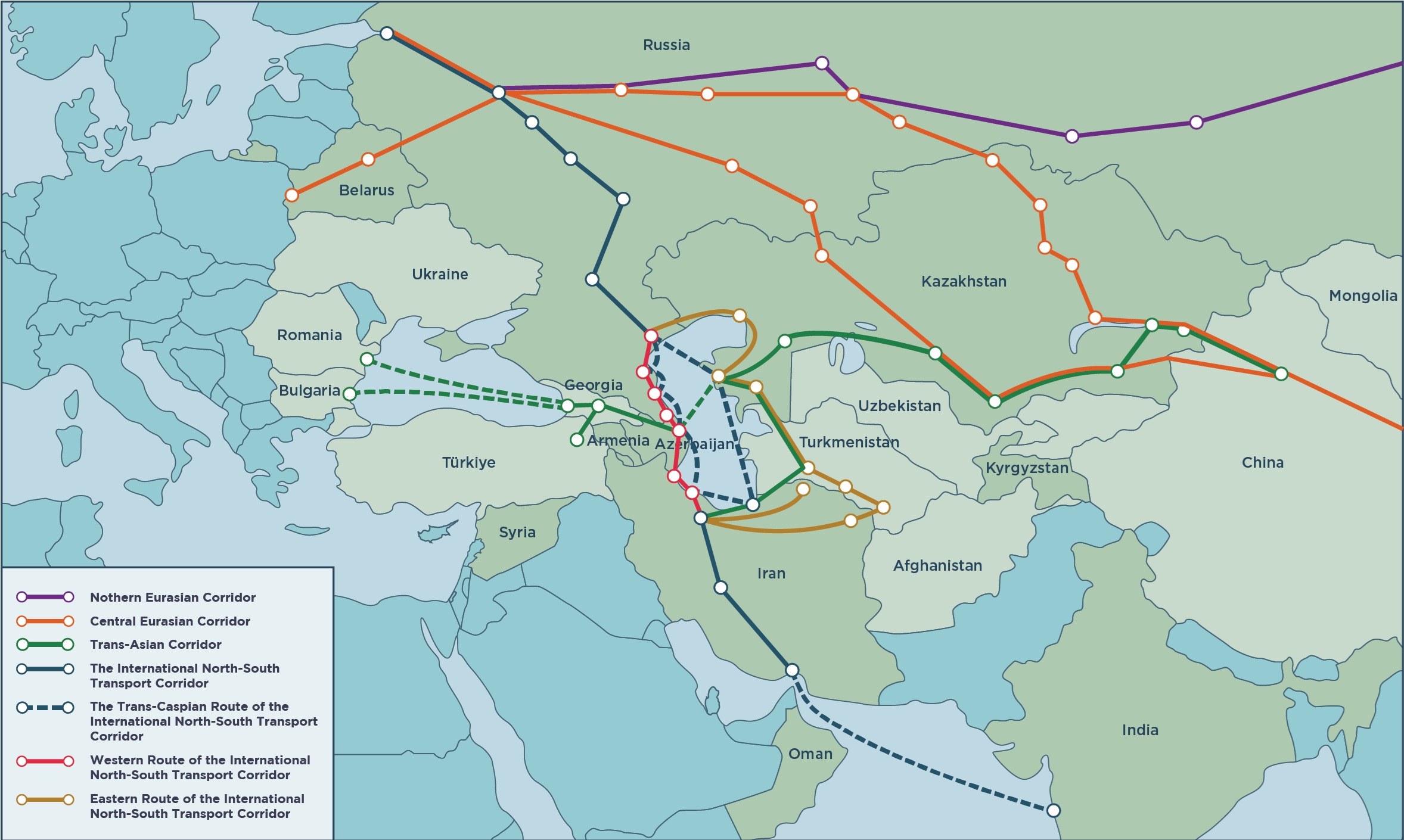
If ECO emphasizes Iran's East-West connectivity, the INSTC represents Iran's most ambitious geoeconomic North-South initiative, one that positions the country as the spine of an emerging Eurasian geography. Conceived by Iran, Russia, and India, INSTC is a 7,200-kilometer multimodal network connecting the Indian Ocean to Northern Europe while bypassing the Suez Canal. Shipping goods from Mumbai to Moscow via Iran takes about half the time of the traditional route. Three INSTC routes cross Iranian territory: the Western route linking Russia and Azerbaijan to Iranian rail networks; the Central Caspian route connecting Russian and Iranian ports; and the Eastern route bringing Central Asian cargo down to the Persian Gulf via the Kazakhstan-Turkmenistan-Iran railway.
Two recent developments have accelerated INSTC's importance. The 2023 agreement with Russia to complete the missing Rasht-Astara rail link signaled serious political commitment. Simultaneously, Iran signed a ten-year strategic contract with India for Chabahar Port development, giving India its long-sought "golden gateway" to Central Asia. Why has INSTC become so critical? The answer lies in Western sanctions. Iran has been under various sanctions regimes since the 2000s, compelling Tehran to seek alternative economic pathways. For Russia, the 2022 invasion of Ukraine triggered unprecedented sanctions. Hence, for both countries INSTC evolved from a theoretical trade route into a project of economic survival. INSTC transforms Iran's central geography into strategic indispensability. Without Iran, neither Russia nor landlocked Central Asia can access international warm-water ports to their south. Nor can India reach the Eurasian landmass.
The Belt and Road Initiative
For Iran's ruling elites, the relationship with China represents a pivotal axis in constructing a multipolar world. The Belt and Road Initiative (BRI) is viewed in Tehran as the materialization of "New Silk Road" discourse that Iran helped pioneer. Two BRI corridors are particularly significant. The China-Central Asia-West Asia (CAWA) Corridor explicitly includes Iran as an integral component, bringing connectivity between China on the one hand, and resource-rich Central Asia, Iran, the Persian Gulf region, and Europe on the other. The China-Pakistan Economic Corridor (CPEC), while not officially including Iran, holds potential for synergy. The geographic logic of connecting Gwadar Port (less than 200 kilometers from Iran's Chabahar) with Iranian networks remains compelling.
The 25-year Comprehensive Strategic Partnership signed in 2021 serves as the institutional roadmap for China–Iran relations. It aims to transform the bilateral relationship from a tactical partnership centered on trade and connectivity into a long-term geoeconomic and civilizational alignment (what the Chinese term a 'comprehensive strategic partnership'). Importantly, however, it presently is a general 'roadmap' or vision rather than a set of bankable commitments.
As with other initiatives that Iran has been promoting, Iran's participation in the BRI has faced setbacks due to direct and secondary sanctions; rampant corruption; poor economic management; high expectation of IRI elites of China as the overnight solution to Iran's problems; the historical pro-western orientation of many Iranian people, including IRI elites (as evidenced by the IRI elites' rush towards Western companies after JCPOA was signed), among other reasons. Despite these setbacks, the IRI has become part of the Asian Infrastructure Investment Bank, Shanghai Cooperation Organization, and BRICS+, as institutions which are solidifying the rise of a multipolar world order.
The Eurasian Economic Union (EAEU)
The most recent addition to Iran's geoeconomic portfolio is deepening integration with the Russia-led EAEU. The 2025 Free Trade Agreement eliminates tariffs on over 90 percent of trade items, securing Iran's position as the "southern gateway" for the EAEU. This creates increasingly close economic cooperation between Iran, Russia, and Central Asia operating largely outside Western-dominated financial systems. For both Russia and Iran, the EAEU complements INSTC: where INSTC focuses on infrastructure, the EAEU focuses on trade liberalization. Both initiatives were conceived before Western sanctions against these two countries. Now, with those sanctions in place, both are being developed with more urgency, with the goal of creating non-Western economic geographies.
Initiatives designed to isolate Iran
Several geoeconomic initiatives were launched over the past few years that are deliberately designed to bypass or isolate Iran, or compete with Iranian initiatives. Some are mostly notional, while others are more substantial. Both influence IRI's decision-making. As for notional ones, the India–Middle East–Europe Economic Corridor (IMEC), announced at the 2023 G20 Summit, aims to link India to Europe via the Arabian Peninsula and Israel. By circumventing Iran and Turkey, IMEC directly challenges China's BRI and Iran’s INSTC. Simultaneously, it promotes Israel’s economic integration in the region. I2U2 (comprised of India, Israel, UAE, and US) is another more notional project that aims to bypass Iran and integrate Israel in the region. Iraq’s $17 billion Development Road Project is yet another, as it seeks to transform Iraq into a transit hub linking the Persian Gulf to Europe via Turkey, explicitly bypassing Iranian ports and railways and reducing Baghdad’s dependence on Tehran in the process as well.
In terms of substantial initiatives, the most prominent is Turkey's the Middle Corridor, which links China to Europe across Central Asia and the Caucasus, bypassing both Russia and Iran. Since 2022, traffic has surged due to sanctions on Russia. In the South Caucasus, the proposed Zangezur Corridor would connect the heartlands of Azerbaijan with its Nakhchivan exclave through Armenia, eliminating Azerbaijan’s need to transit Iran. Tehran views this as a major threat to its regional leverage and has labeled it a strategic red line, countering with the proposed Aras Corridor to preserve Iran’s intermediary role.
Looking Ahead
The slogan that launched the IRI, "Neither East, Nor West", promised revolutionary independence. Four decades later, Iran’s actual trajectory tells a more complex story. Geopolitically, the IRI slogan has become “East is good (hence the Look East policy), the West is unreliable and imperialistic”. Geoeconomically, IRI's slogan has effectively become "Both East and West, and North and South as well".
What emerges is a picture of Iranian geoeconomics as simultaneously reactive and proactive. On the one hand, Iran has demonstrated remarkable agency, actively reconstituting itself as a crossroads through ECO, INSTC, BRI participation, and integration into the EAEU. On the other hand, several initiatives have been designed by other actors to bypass Iranian territory and marginalize the country geoeconomically.
The future of all these initiatives, their perils and promises, depends on the future of the IRI itself and how it deals with domestic and international challenges. Recent military confrontations (e.g. Israeli American aggression against Iran in 2025) and internal political unrest in the country (which produced a very violent crackdown) are shaking the foundations of the IRI’s political system. The 2026 American-Israeli military aggression against the country (including their assassination of Ayatollah Khamanei, Iran's leader) has produced an existential war not only for the IRI but for Iran as a sovereign entity due to the danger of civil war and separatism instigated by the US and Israel.
Uncertainty is the name of the game. However, what is certain, as argued above, is that the geoeconomic vision that IRI elites have pursued for four decades, namely that of Iran as a crossroads or bridge, will outlast any political system. Such is the insight that paying attention to Iran's geoeconomics can give us. Paying analytical attention to Iran only in security terms gives a very shallow understanding of the country and its role in the world. Assuming Iran's current borders remain intact, the material and cultural geography of Iran is such that it can never function like an "Island" or a "villa in the jungle". It is too vast a country with too deep a history to be able to keep barricading itself in, or to be excluded from, the region. The cultural history and geography of the country dictate the crossroads logic to whoever oversees policymaking in the post-war Iran.