
Zooming out from the core countries it becomes clear that the war in Ukraine has had a similar effect – of crystallising positions and pushing certain geopolitical choices - on the larger dynamics and relationships in Europe. This section will discuss several interesting developments illustrating this.
Open the geopolitical mapping in full-view mode
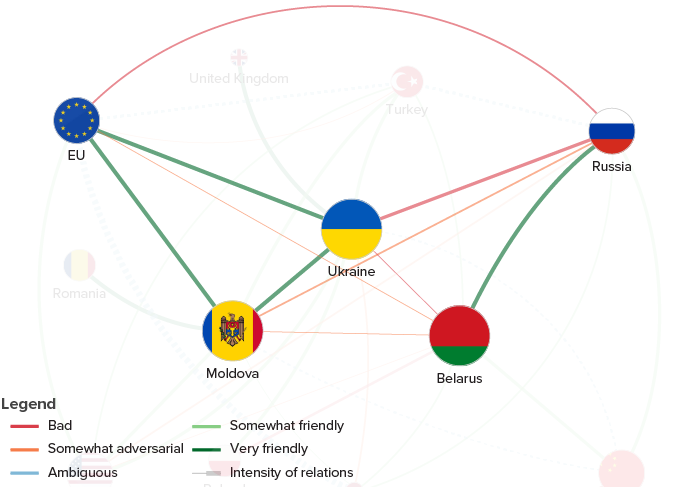
The EU-Russia rift
The clearest example of the war’s consequences can be seen in the positioning of the EU and Russia vis-á-vis each other and the core countries (see figure 3). The EU’s relationship with Ukraine, Moldova and Belarus, is an inversion of that of Russia. The Russia-Belarus alliance stands squarely opposite Ukraine and Moldova, both EU candidate-countries and backed by the bloc politically, diplomatically, financially and in terms of security.
The relationship between Russia and the EU has always had its complexities. Russia increasingly viewed the bloc as a political rival - though not necessarily a threat - as the 00’s and 10’s progressed, while the EU remained passively divided on its stance vis-á-vis Russia: the countries on its eastern flanks periodically warned of a potential Russian threat, while Western Europe largely preferred to continue engaging with Moscow. Following the February 2022 invasion, however, perceptions in EU’s Western member states shifted to align more with the pre-existing perceptions in the Baltics, Poland and other Eastern and Central European member-states: Russia came to be seen as a dangerous adversary, the threat of which warranted a rearmament push across the EU.
Russian gas
Another way this shift can be demonstrated relates to the transit and consumption of Russian gas (fig. 4 and 5). In 2020, Ukraine was an important transit country for Russian pipeline-gas on to its consumers in the EU, even though it had stopped consuming the gas itself by 2015. The share of Russian gas in EU’s gas imports has since dropped from 45% to roughly 19%, with Hungary and Slovakia still importing Russian gas via pipelines, and Spain, Belgium, the Netherlands and France being the biggest importers of Russian liquefied natural gas (LNG).[12],[13] In June 2025, the European Commission proposed a plan to ban EU imports of Russian gas completely by 2028.[14] In September 2025, following apparent pressure from the Trump administration, the Commission decided to speed things up, bringing the ban on Russian LNG forward to 2027.[15] Slovakia, Hungary and Austria have opposed it, with France and Belgium resisting the LNG ban.[16],[17]
Open the geopolitical mapping in full-view mode
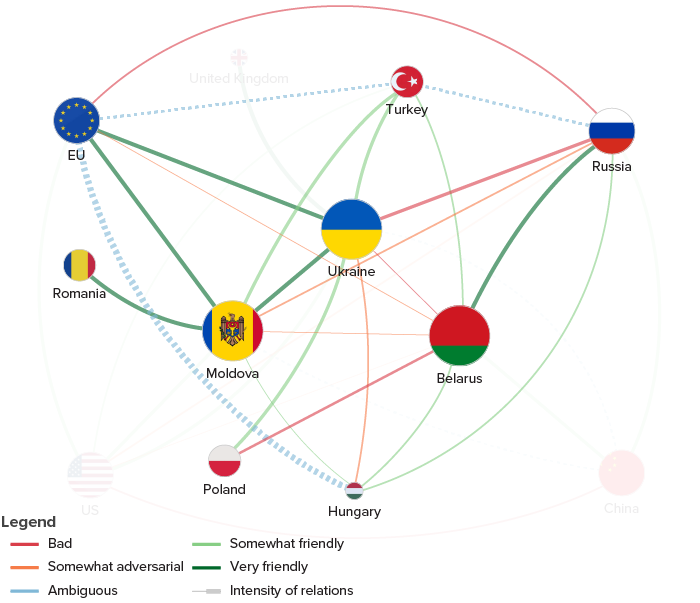
Open the geopolitical mapping in full-view mode
Black Sea dynamics
Despite the new realities in Europe, there are still instances where cooperation, or at least communication, across the wartime divide is difficult to avoid. One such example is the Black Sea (see figure 6), which constituted a key theatre, especially during the early stages of the Russo-Ukrainian war after the full-scale invasion of 2022. Questions of dominance in the Black Sea basin hung in the balance, in terms of military superiority as part of the war effort, but also control over transit routes for trade vessels, especially when it comes to Ukraine’s grain exports and the related issue of global food security.[18] Mainly using unmanned drones, Ukraine managed to push back Russia’s Black Sea Fleet after a number of successful attacks in 2023-2024, ushering in a somewhat calmer period. Nevertheless, the changed dynamic of relationships and general tension around the Black Sea still holds.[19],[20]
Open the geopolitical mapping in full-view mode
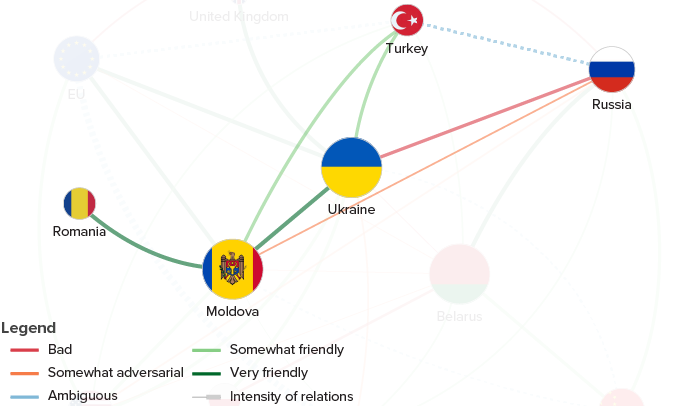
The divisions and rifts resulting from the war in Ukraine have provided an opportunity for Türkiye to obtain a strategic diplomatic position, as an actor that is able to balance its relationships with all others involved. While Ankara’s balancing skills will be discussed in more detail later, suffice to say that considering its position as the only major Black Sea country that has managed to retain a working relationship with every other Black Sea power, its ability to take on the role of facilitator of negotiations, especially during the more acute stages of the maritime conflict, are unsurprising.
Hungary’s attempt at balancing
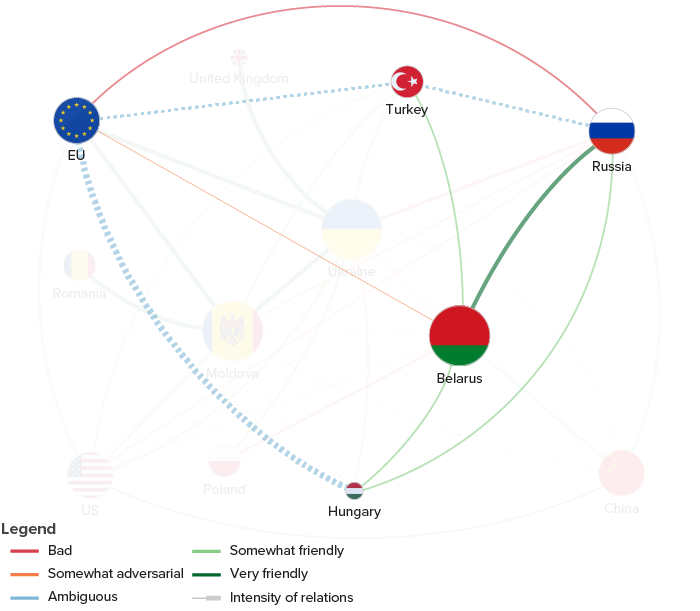
Another actor that attempts a balancing act is Hungary (see figure 7). As a member of the EU, the country is tied into the bloc’s rules and procedures, but at the same time continues to entertain a relatively positive relationship with Russia despite the adversarial nature of the current EU-Russia dynamic.[21] Hungary’s prime minister, Viktor Orbán, has regularly blocked support for Ukraine and its EU candidacy bid, and his willingness to visit and meet with president Putin undercuts the EU’s policy of isolating the Russian president on the world stage.[22]
Open the geopolitical mapping in full-view mode
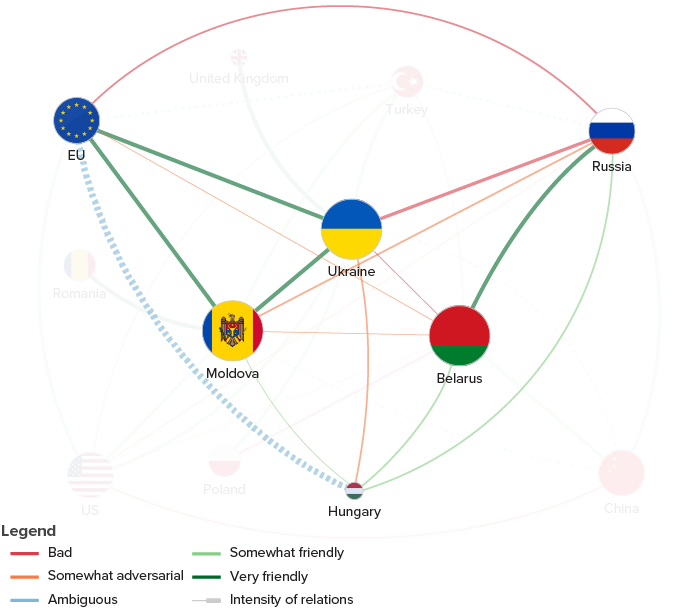
At the same time, while this may provide Orbán with some leverage in his dealings with the EU, the success of this balancing act is questionable. While its relationship with Russia provides Hungary with certain perks and benefits – notably in cheap energy - it is less significant than Hungary’s EU membership, and it has cost the country much goodwill with leading EU member states and institutions. This questionable trade-off is illustrated in our mapping with Hungary’s ambiguous relationship with the EU, which is quite striking – and arguably problematic - considering the country’s membership in the bloc.[23]