
Over the past decade, the global standardisation landscape has undergone a significant transformation, with China evolving from merely adopting global standards to actively shaping them. As a key player in developing cutting-edge technology and dominating areas like solar energy and EV chips, China’s growing technological leadership has elevated its role in global standardisation efforts. Recognising the strategic value of standardisation in enhancing competitiveness, China has made standardisation one of its comprehensive industrial policy’s central elements. China has now established a distinctive standardisation system, characterised by strong government involvement, while also increasingly engaging the private sector to drive innovation and disseminating it abroad.
‘Third tier companies make products; second tier companies make technology; first tier companies make standards’. This mantra effectively encapsulates China’s standardisation approach,[36] which has been strategically promoted and planned since the 18th National Congress of the CCP in 2012. The internationalisation of standards gained momentum with the launch of China’s Belt and Road Initiative in 2013. The promulgation of the ‘Made in China 2025’ technological upgrading strategy in 2015 further accelerated this process, laying the groundwork for the ‘China Standards 2035’ (CS2035) initiative, which was introduced in 2018. Alongside the development of the CS2035 strategy, China actively began executing plans to shape global standards for emerging technologies such as 5G, the Internet of Things and artificial intelligence (AI).[37] These diverse strategies and policies highlight China’s coordinated use of standards to stimulate industrial growth and align with broader economic goals. National and international standards are to be developed closely together, bringing about a shift from a nationally oriented approach to a so-called ‘national–international mutual transformation’. By 2035, the Chinese standardisation system should become internationally compatible, fitting a ‘standardisation management system with Chinese characteristics’.[38]
The active role of the government in China’s standardisation approach is evident in the multitude of state bodies involved in the process. The Standardisation Administration of China (SAC), operating under the State Administration for Market Regulation (SAMR) and the State Council, primarily sets overall strategies and oversees China’s standardisation efforts. SAC is responsible for strategic coordination, project approval and represents China in the ISO and IEC. In the ITU, China is represented by the Ministry of Industry and Information Technology (MIIT). National and sector standards are developed by Technical Committees (TCs), composed of experts from both the public and private sectors. TCs report to their corresponding ministries, on a sector basis.
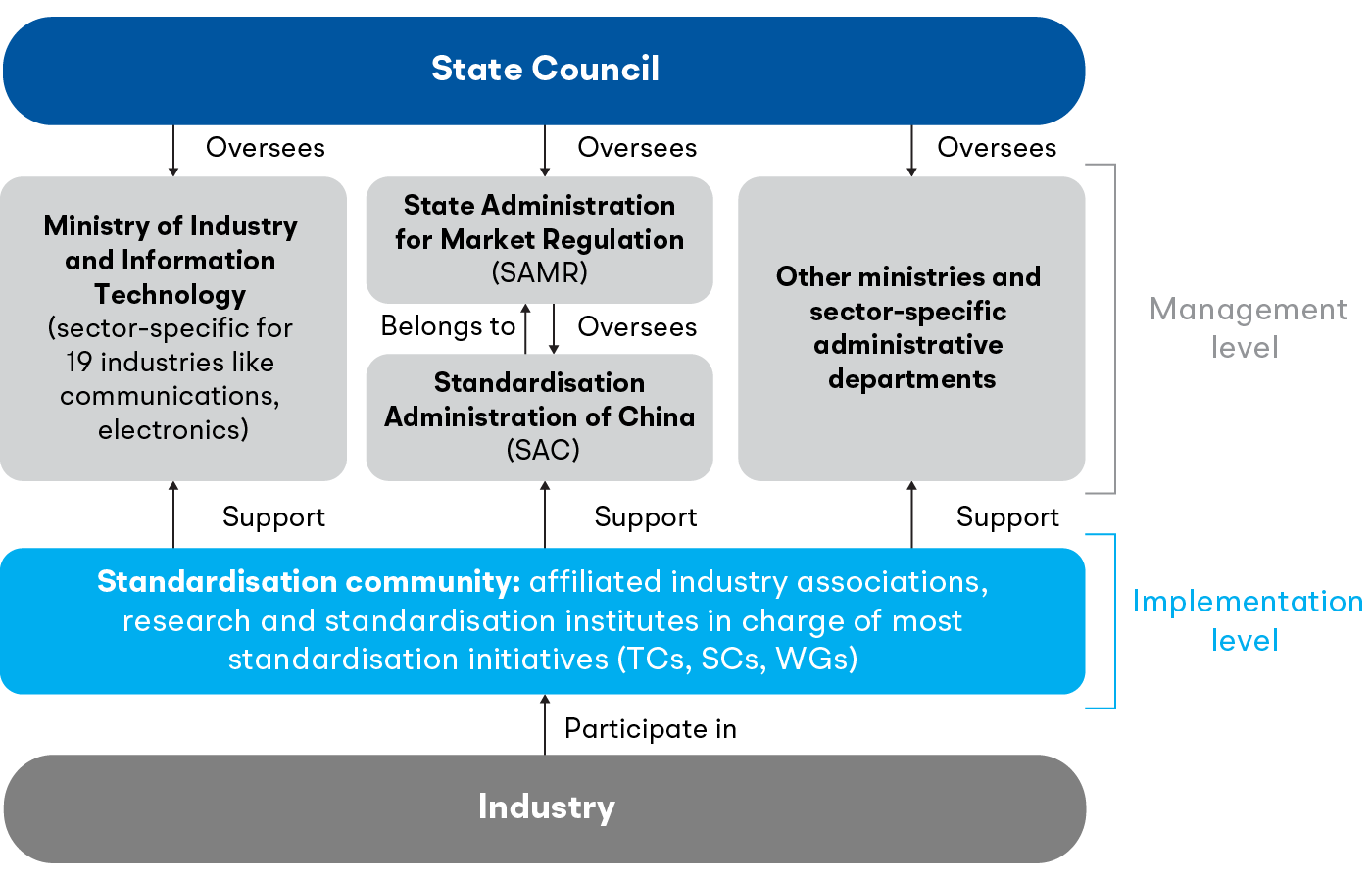
Note: TCs stands for Technical Committees; SCs stands for Sub-Committees; and WGs stands for Working Groups.
Source: Susann Lüdtke’s compilation, adapted from Seconded European Standardization Expert in China (SESEC), 2024.
This structure marks a significant contrast to the United States and the European Union, where industry-driven and non-governmental organisations typically guide the development of standards. Additionally, it highlights the political priority that standardisation holds in China, positioning it as a key national priority rather than simply a technical or business concern. SAC is also the Chinese representative in the international formal SDOs.
The SAC is responsible for coordinating national strategies and policies related to standardisation, while specific technical standards are developed by research institutes affiliated with various Chinese government ministries. For example, the Ministry of Industry and Information Technology (MIIT) plays a pivotal role, with specialised institutes such as the China Electronics Standardisation Institute (CESI), which focuses on AI standards, and the National Technical Committee of Automotive Standardisation (NTCAS), which handles, among others, EV standards. This high level of state involvement not only ensures a cohesive and coordinated strategy for the development of standards, but also allows for the strategic allocation of state subsidies to standardisation bodies and rewards companies for working on patents and standards.[39]
China is also intensifying its efforts to encourage greater industry involvement in standards-setting. With the 2018 amendment to China’s Standardisation Law and the introduction of the National Standardisation Development (NSD) Outline in 2021, the Chinese government granted legal status to ‘association standards’ developed by industry associations. While national and sector standards are developed within technical committees, much of the work is now reportedly driven by experts from the private sector, with state institutions retaining formal overall leadership.[40] The new law has also abolished mandatory industry and local standards, which were previously overseen by ministries and local authorities, leaving only mandatory national standards under SAC’s control.[41] The new system reflects a clearer governance model of orchestration, combining state-led initiatives with market-driven participation, where the government acts as a facilitator and coordinator rather than the sole decision-maker. Figure 5 illustrates the changes brought about by the 2018 standardisation law amendment.
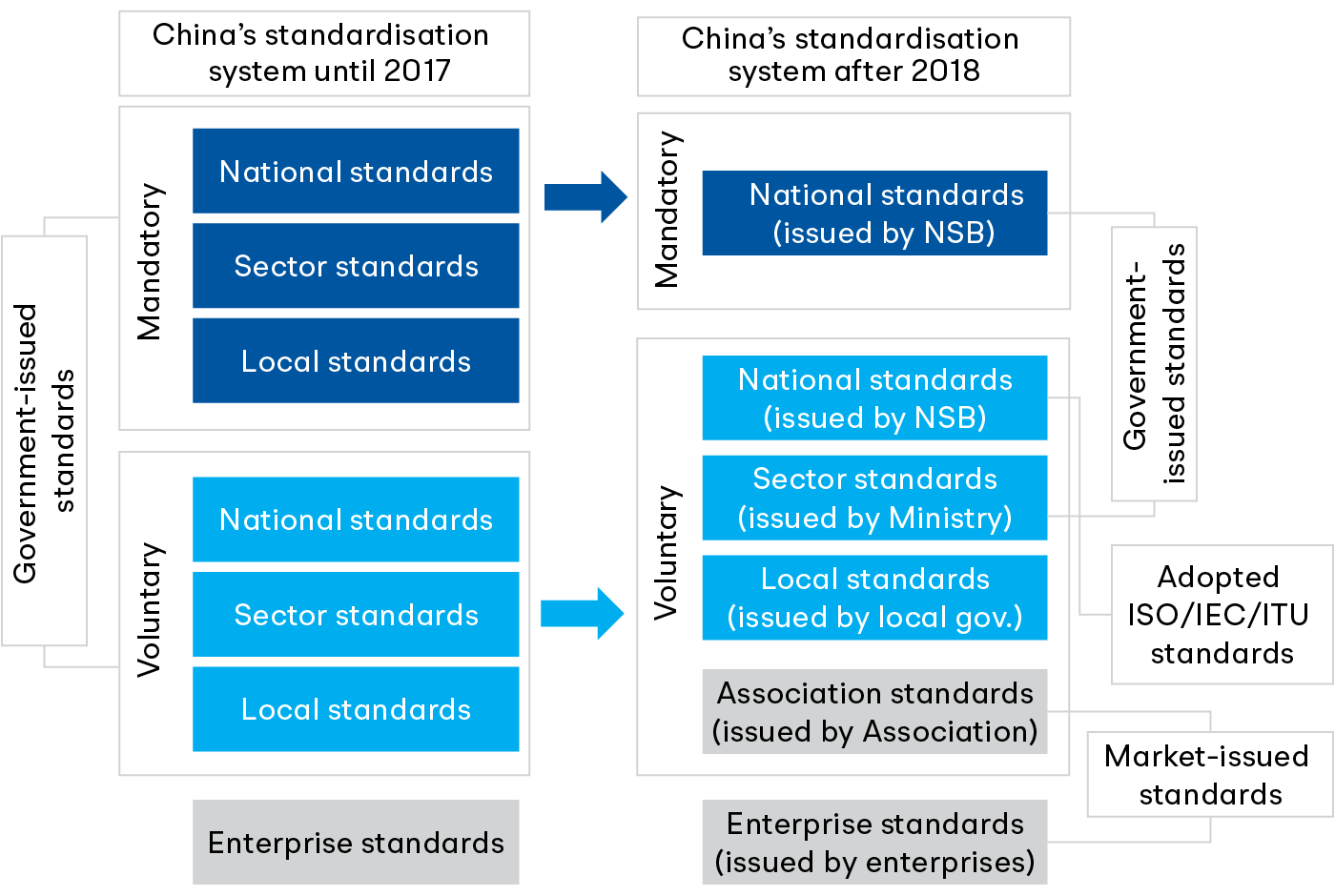
Source: Adapted from John Seaman, China and the New Geopolitics of Technical Standardisation, January 2020; and authors’ compilation.
This shift towards more private-sector involvement was deemed necessary to improve the quality and competitiveness of Chinese standards, as it is the industry that brings the technical expertise needed for the development and standardisation of modern technologies. Therefore, the governance shift that occurred in 2018 should not be viewed as a move away from state control, but rather as a strategy to strengthen the capabilities of the state-centred standards system.[42] The Chinese government will continue to oversee national mandatory standards in critical areas related to national security, the technologies of the future like AI and quantum, environmental protection and economic and social governance – thus ensuring that standardisation serves broader competitiveness and geopolitical objectives.
3.1 From Domestic Control to Regional Dominance
The Belt and Road Initiative (BRI) marked China’s ambition to expand its global presence, and with that its global role and influence.[43] This ambition was also extended to standardisation. In 2015 and 2018, China’s State Council and SAC released two action plans promoting China’s standardisation cooperation with BRI countries. These plans enabled China to promote bilateral recognition of standards in manufacturing industries and the adoption of Chinese telecommunications standards by BRI partner countries.[44] As part of the initiative, China started translating its domestic technical standards into foreign languages to support their adoption in other countries. By September 2019, China had entered into 90 bilateral agreements on technical standardisation cooperation with 52 nations and regions.[45]
These agreements show that China promotes its standards through a bilateral, sector-specific approach rather than attempting to build a unified regional standards regime. This suggests that China is not aiming to replace existing international standardisation frameworks, but rather to reshape them incrementally from within. Bilateral agreements with partner countries create long-term interoperability and dependencies, particularly in developing countries that lack the capacity to develop their own standards. As these countries adopt Chinese technical norms, it increases the likelihood that such standards will be proposed – and accepted – in international SDOs. In this way, China leverages bilateral engagement under the BRI to strengthen its collective voting power and influence in global standardisation forums.
3.2 From Regional Dominance to Global Influence
Over the past fifteen years, China has made significant strides in its engagement with formal SDOs, making this a central element of its standardisation strategy. This effort has yielded significant results, of which the rise of Chinese official Houlin Zhao to become ITU Secretary-General from 2015 to 2022 is a prime example.[46] Key strategies to achieve this include: submitting more proposals for international standards; increasing the volume and quality of technical input from Chinese stakeholders; and expanding the presence of Chinese experts in technical committees – particularly by securing leadership and secretariat roles within those bodies.[47]
From 2020, SAC prioritised increasing its active participation in the three formal international SDOs: the ITU, ISO and IEC. A key way to do so was to enhance China’s presence in formal SDOs’ Technical Committees (TCs), which play a critical role in shaping the content and direction of international standards. These committees are where technical specifications are drafted, reviewed and negotiated, which makes them the backbone of the standardisation process.[48] Taking the example of the ISO, China is currently involved in 778 ISO TCs, ranking as the country with the largest number of TCs in which it participates (see Table 1).
| Country |
TC Participation |
TC Secretariat |
|---|---|---|
| China (SAC) |
778 |
90 |
| France (AFNOR) |
651 |
82 |
| Germany (DIN) |
721 |
134 |
| Japan (JISC) |
665 |
84 |
| Netherlands (NEN) |
454 |
10 |
| United Kingdom (BSI) |
702 |
76 |
| United States (ANSI) |
562 |
92 |
Source:
Authors’ compilation based on ISO Technical Committee data.
See: ISO, ISO Technical Committees Metadata, May 2025.
However, mere participation in committees does not guarantee influence over standards-setting outcomes. Securing a secretariat position is a key factor in determining a country’s influence, as it often reflects a member’s dedication to deeper involvement and the commitment of additional resources to standardisation efforts, as well as to setting the agenda. In this regard, China holds the second largest number of secretariat positions (90), following Germany (134). While Table 1 shows that EU Member States are still far more represented than China in the ISO, Figure 6 illustrates the trend in ISO leadership positions among selected countries between 2013 and 2023.[49]
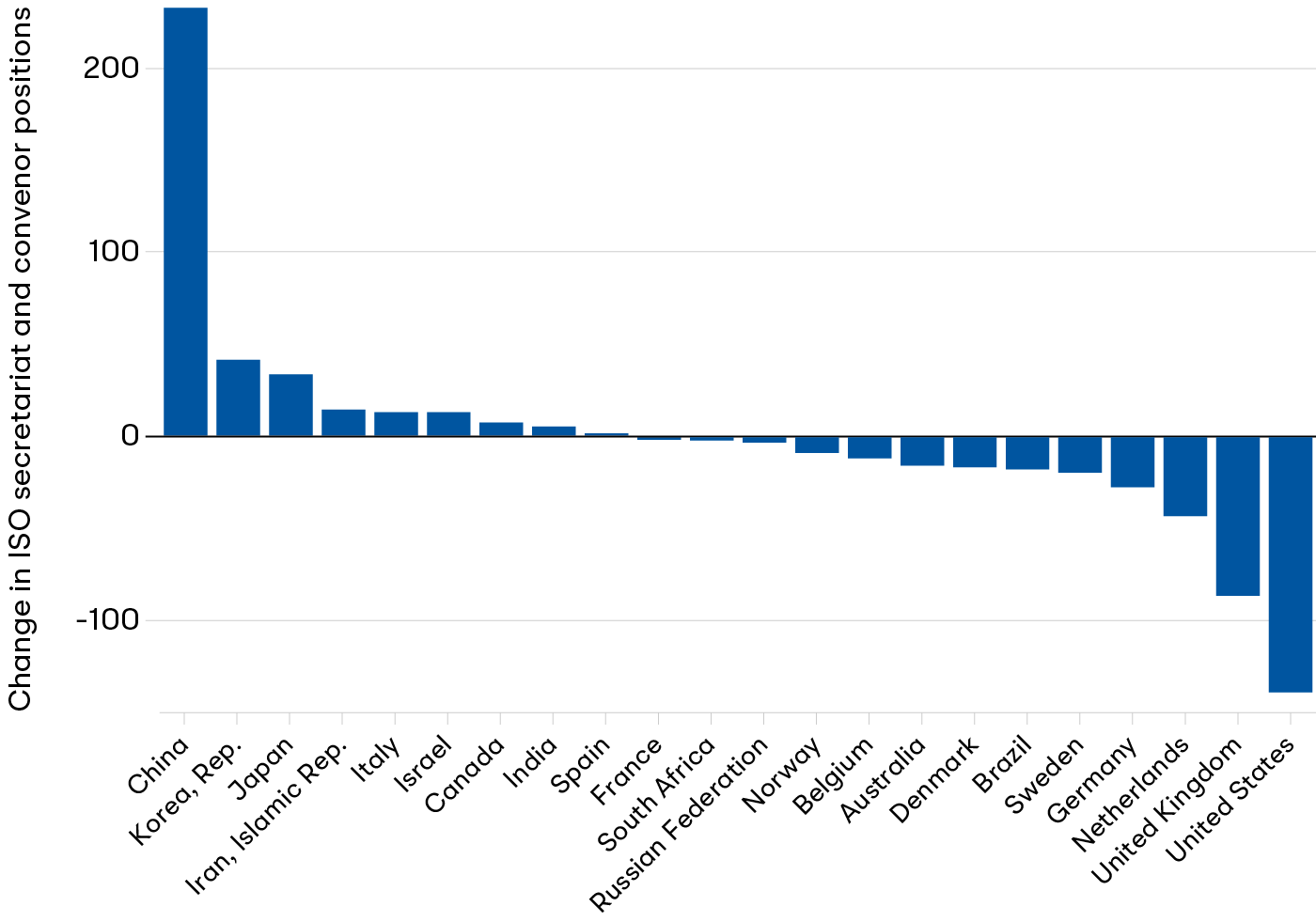
Source: United States Studies Centre, Standards Development Organisations in an Era of Strategic Competition, 16 December 2024.
In 2019, Chinese companies submitted 830 technical specifications for wired communications in the context of the ITU. This is more than the combined total of the three next-largest contributors: Japan, the US and South Korea.[50] Since 2020, China has consistently boosted its ISO and IEC proposals by 20 per cent each year.[51] While the ITU does not play a leading technical role in developing mobile telecommunications standards – where the 3rd Generation Partnership Project (3GPP) is the primary arena – it remains influential in legitimising technologies through official adoption processes. In September 2024, the ITU approved three Chinese proposals related to 6G mobile technologies as candidate frameworks for further study, underscoring China’s ambition to shape benchmarks. This trend is expected to continue across several sectors, as the Chinese government’s goal is to lead over 100 international standardisation projects by 2030.[52]
China’s increased involvement in international SDOs is strongly supported from Beijing. Both China’s central and regional governments are reported to allocate annual financial incentives to companies leading the development of standards, through an incentive and reward mechanism to compensate their efforts.[53] However, this incentive scheme is not without drawbacks. Practitioners have noted that an emphasis on the quantity of contributions does not always translate into technical quality, and that the large volume of submissions from Chinese stakeholders can at times slow down the work of international SDOs or overwhelm committee processes. Another approach involves replicating ISO and IEC TCs at the national level, a strategy also adopted by the US and the EU. This practice is known as mirroring, or twinning. Mirror committees review drafts issued by international TCs, gather input from domestic experts, and align stakeholders on national voting positions and contributions. This process ensures that a country’s voice is coherent, technically sound and strategically positioned in global standardisation efforts. China has approximately 870 mirror committees for ISO/IEC TCs and their subcommittees (SCs) that closely follow international standardisation developments.[54] In contrast, the European mirror committee system reflects the diversity of national standardisation bodies and stakeholder processes across EU Member States. This leads not only to slower consensus building but also often to a heterogenous vote, while China is sometimes able to use a ‘bandwagon’ strategy to convince others to vote with them.[55]
Overall, China’s approach demonstrates strategic planning, with standardisation seen as a key component of its industrial and innovation policy. Driven by strong government involvement and capabilities, China is increasingly positioning itself as a leading player in shaping international standards. In contrast, standardisation in Europe still appears to lack priority, putting the European Union at risk of falling behind in establishing the standards that will drive the next wave of technological innovation.