
As global competition in emerging technologies intensifies, standardisation becomes a powerful tool of strategic influence. To illustrate the nature of standardisation bodies and the shift that has occurred in the power balance over recent decades, two domains are analysed: (1) telecommunications and the internet; and (2) electric vehicle (EV) chips. Telecommunications underpin global connectivity but also national security, while EV chips are critical to the next generation of mobility and smart infrastructure. By examining these two domains, this section highlights how standardisation not only buttresses technological progress, but also reflects China’s incorporation of standardisation into its strategic priorities, with the aim to assert its leadership in global markets.
4.1 Telecommunications and the Internet
Telecommunications and the internet are foundational to the functioning of modern economies, public services and national security systems. As illustrated in Figure 7, most of the standardisation work on telecommunications and the internet occurs at the quasi-formal level, in the context of organisations like the IEEE or IETF; or standards consortia such as 3GPP.[56] The internet is, in fact, a prime example of how standardisation is increasingly left to private actors. As the internet developed, standardisation increasingly shifted towards private-led bodies, while the ITU remained more central to traditional telecommunications’ infrastructure and coordination. Initially, the internet operated under a loose governance model that emerged in the 1980s, primarily driven by American entities.[57] Notably, the establishment of a private multistakeholder internet governance regime resulted in the industry-led Internet Engineering Task Force (IETF) in 1986, which spearheaded the technical standardisation of the internet.[58]
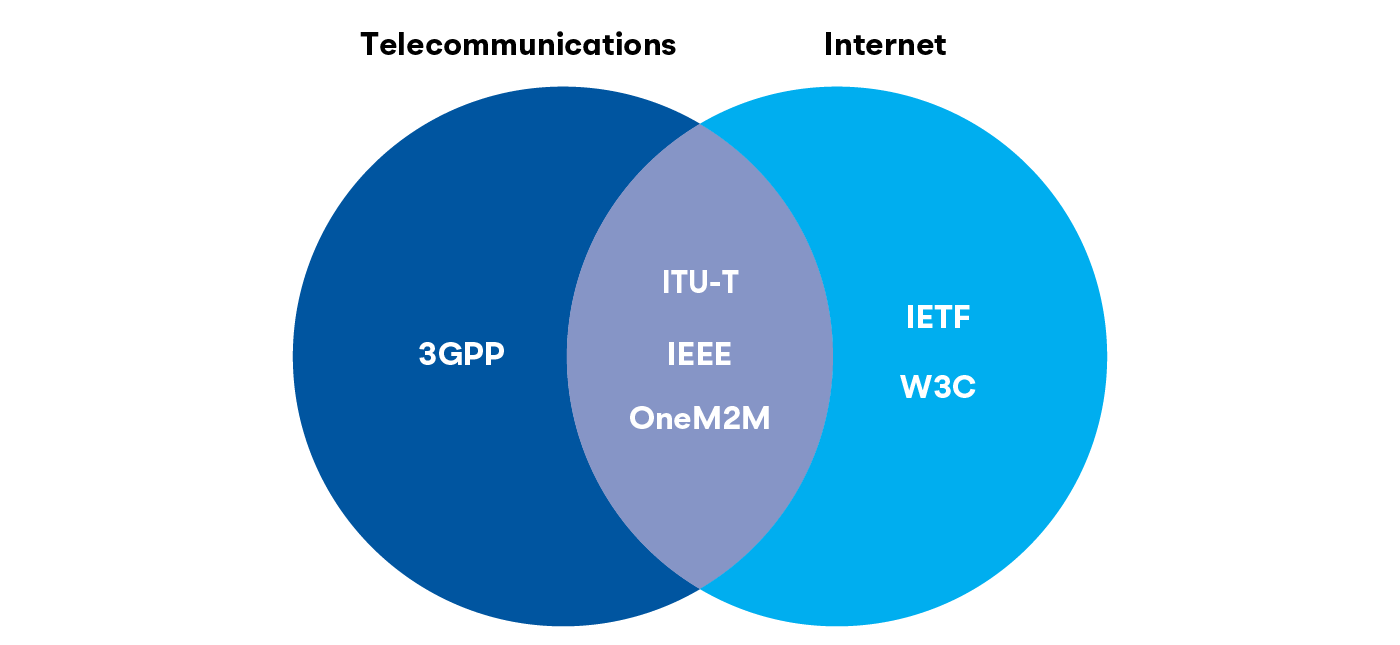
Note 1: The ITU is the only international formal body responsible for technical standardisation in the fields of telecommunications and the internet.
Note 2: While ICANN is not a standardisation body, it plays a crucial coordination role in internet governance by managing the global Domain Name System (DNS), IP address allocation and protocol parameter assignments, all of which rely on standards developed by other organisations like the IETF.
Source: Authors’ compilation.
The history of mobile networks’ development, from 2G to 5G, also showcases the complexity of the interaction between formal and quasi-formal SDOs. In practice, the ITU’s role has been to define the requirements and approve standards that meet these requirements, rather than developing the standards themselves.
Europe has historically played a significant role in these forums, particularly through bodies like the European Telecommunications Standards Institute (ETSI), which contributed to key mobile technology standards like the Global System for Mobile Communications (GSM). However, part of the momentum has shifted. Today, influence over standards in telecommunications and the internet increasingly reflects wider geopolitical trends – with China’s rising prominence and the United States’ continued dominance pressing Europe to rethink its strategic positioning.
Since the late 1990s, China’s role in telecommunications has changed rapidly from follower to innovator. China entered the telecommunications standardisation game by developing the domestic 3G standard TD-SCDMA, with the intention to foster internal industry growth and protect its domestic market from foreign competition.[59] The initiative was partly successful: in spite of not having gained global traction, TD-SCDMA ‘was approved by ITU as one of the candidate standards for 3G mobile communications in May 2000 and accepted by 3GPP in March 2001’.[60] This initiative allowed China to develop knowledge about the processes around standardisation, both at home and abroad. In parallel, the Chinese government stimulated the sector by giving subsidies to national champions like Huawei, ZTE and China Unicom, showcasing its ability to integrate and embed different strategies working towards the same goal.[61]
A high-profile example of these dynamics is the (ultimately unsuccessful) attempt by China to promote a ‘New Internet Protocol’ (New IP) at the ITU in 2019, led by Huawei. Although presented as a next-generation internet architecture, the proposal raised red flags over risks to openness, decentralisation and net neutrality. Ultimately, the lack of technical details and political resistance stalled the proposal. Interviews with internet routing specialists indicate that no technical disruptions or routing anomalies have been observed in relation to internet traffic to and from China.[62] While this might suggest a successful defence of the open internet model by Western and multistakeholder actors, this case also highlights China’s growing coordination across telecommunications firms (like Huawei and ZTE), state-linked institutes, and research entities and experts within SDOs like the ITU and 3GPP. This should be regarded as a wake-up call for others, as China continues to shape how future standards are drafted, for instance in areas like 6G or smart cities.
From Europe’s and the Netherlands’ perspective, China’s growing influence poses both a challenge and an opportunity. The challenge lies in the risk of losing normative influence over global internet and telecom standards. But there is also an opportunity: by leveraging its strong digital infrastructure, technical expertise and multistakeholder governance tradition, the Netherlands could play a much more active role in shaping the future of standardisation.
As noted above, one of the key governance features in telecom and internet standardisation is that while the ITU plays a convening and high-level coordination role, the actual technical drafting of standards often takes place in quasi-formal bodies such as 3GPP and the IETF. These working groups are largely dominated by industry actors, with limited formal mechanisms for public-interest oversight. This structure can undermine Europe’s normative priorities – including transparency, human rights protections and digital sovereignty – as these values may not always be embedded in technically driven, industry-led processes. For the private sector, this should also serve as a wake-up call. If European companies remain underrepresented or disengaged from these technical bodies, they risk losing influence over the standards that will define their markets, shape global compliance environments and determine long-term competitiveness.
Summing up, China’s approach to telecom standardisation strategy today has distinctive elements: it involves the proactive allocation of Chinese state resources to companies participating in SDOs; there is clear alignment between industrial policy and standards’ diplomacy, reflected in broader initiatives such as ‘Made in China 2025’ and ‘China Standards 2035’; and by building leadership in technical committees, hosting key meetings and conferences, and developing full technical proposals ahead of the curve, China maximises its influence while remaining formally compliant with multilateral procedures.
Actionable Steps for Europe and the Netherlands:
4.2 Electric Vehicle Chips
The importance of the automobile sector to Europe’s economy makes the standardisation of electric vehicle (EV) chips a matter of long-term strategic significance. The automotive industries of Germany and France, in particular, have been major drivers of economic growth, exports and employment – not only within their own borders, but also across their extended value chains throughout the EU. This includes the Netherlands, which is home to several key semiconductor firms that supply the increasingly digitalised automotive sector. As mobility systems become more software-defined and chip-reliant, aligning industrial capabilities with standardisation priorities becomes a critical task for Europe’s competitiveness and resilience.
Against this backdrop, various types of chips are increasingly important to automotive systems, a trend that is expected to continue as the market for EVs, new energy vehicles (NEVs), intelligent connected vehicles (ICVs) and autonomous driving vehicles grows. As EVs become increasingly embedded in global mobility and infrastructure systems, EV chips – the semiconductors powering these vehicles – are emerging as critical chokepoints. The case of EV chips is particularly interesting, as EVs use legacy chips (also known as mature nodes) alongside advanced chips to support basic functions and ensure compatibility with existing systems. They are essential not only for propulsion, but also for safety, communication, power electronics, battery management and autonomous functionality.
The international EV chip standardisation ecosystem is notably fragmented. Formal SDOs such as the ISO (with its ISO 26262 standard on functional safety) and the IEC (notably TC 22 for power electronics) play central roles. In parallel, quasi-formal and industry-led bodies – like the IEEE, Society of Automotive Engineers (SAE International), Joint Electro Device Engineering Council (JEDEC), Automotive Open System Architecture (AUTOSAR) and the International Automotive Task Force (IATF) – contribute standards on reliability, communications, safety and software architecture. Regulatory frameworks from the United Nations Economic Commission for Europe (UNECE), such as WP.29 (the world forum concerning motor vehicles and their equipment), complement this architecture.
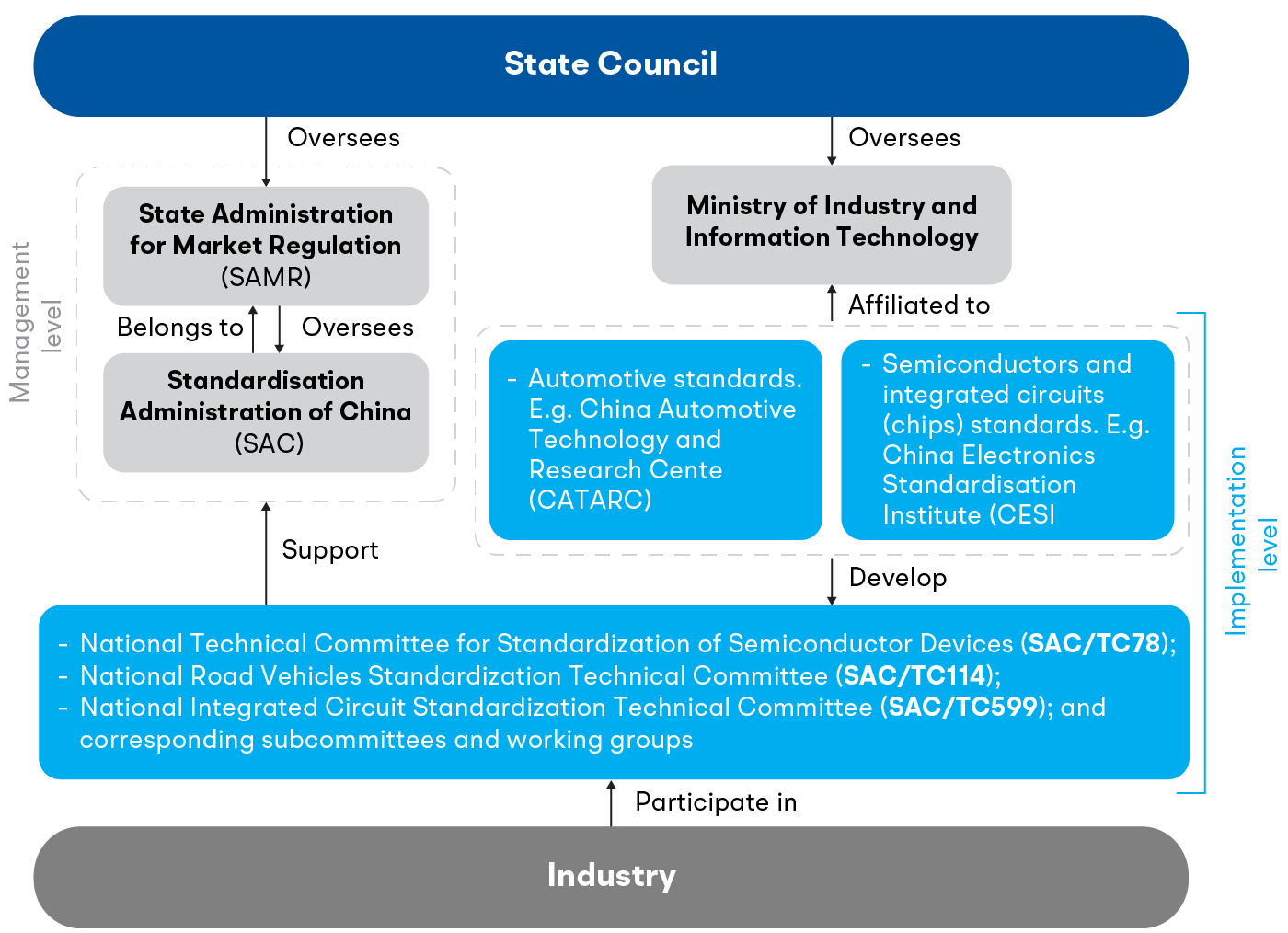
Chinese stakeholders not only seek to influence international EV chip standards, particularly in areas such as battery safety, chip reliability (such as with the EU’s Trusted Chips Initiative) and data protection, but are also very active in national EV chip standardisation. China’s EV chip standardisation system is characterised by strong central government leadership, primarily through China’s Ministry of Industry and Information Technology (MIIT), which coordinates the development and implementation of both national and industry standards covering reliability, safety, cybersecurity and testing protocols. Recent years have seen the introduction of a formal automotive-grade chip[63] certification system and accelerated timelines for mandatory standards, reflecting China’s strategic ambition to enhance domestic chip quality and reduce reliance on foreign chip technology.[64] As with other areas, EV chip standardisation involves collaboration among government agencies, industry associations, large Chinese firms and research institutes. Besides, it increasingly aligns with – or seeks to influence – international standards. The standardisation of EV chips in China is roughly split between automotive standards and integrated circuits (chips) standards. For instance, automotive standards are orchestrated by China’s National Technical Committee of Automotive Standardisation (NTCAS) and via its TC 144 ‘Road Vehicles’. Moreover, integrated circuits (i.e. chips) standards are developed by China’s National Integrated Circuit Standardization Technical Committee (NICSTC) and via its TC 78 ‘Semiconductor Devices’ and the new TC 599 ‘Integrated Circuits’. The latter was established as a response to international restrictions and export controls. Both committees are part of China’s comprehensive strategy for technological independence and leadership in the global automotive chips’ standards landscape. While regulatory responsibility is divided among different departments within MIIT, the related standardization work for automotive and EV chips standards is organized and implemented by specific research institutes like the China Automotive Technology and Research Cente (CATARC) and associations like the China Electronics Standardisation Institute (CESI), among others. Figure 8 presents a visual representation of the main actors involved in China’s EV and automotive chips standardisation landscape.
In theory, foreign enterprises and Chinese companies can participate in equal terms in the various EV chip-related working groups and TCs. Since 2024, this pattern has seemed to diminish as China’s MIIT established the China Automotive Chip Alliance (CACA), composed of Chinese original equipment manufacturers (OEMs, such as BYD and SAIC), automotive electronics and software vendors (like CATL), chipmakers (such as SMIC and Black Sesame) and state-affiliated research bodies. CACA’s main intent is to reduce China’s high import dependency on foreign chips and bring China towards autonomy in automotive chips through the entire automotive chip value chain – but this purely Chinese consortium also likely enables strategic coordination on EV chip standardisation, serving as a model for how technical coordination can be leveraged for geopolitical influence.
In this context, Europe – including the Netherlands – faces twin challenges. First, despite the EU Chips Act, strategic focus remains skewed towards advanced chips for data centres or AI, while legacy and application-specific chips, which are essential to the EV ecosystem, receive limited attention. Second, the EU’s engagement on standards remains reactive and fragmented, resulting in diminished leverage in settings where China coordinates large voting blocs and places state-supported experts in leadership roles across committees.
The Netherlands, although relatively underrepresented in EV chip standardisation, holds a strong position in the broader semiconductor value chain. Global leaders like NXP – headquartered in Eindhoven and with deep automotive integration – are central to both design and production. In addition, Dutch academic institutions and innovation hubs such as Brainport Eindhoven form a key node in Europe’s chip research and development infrastructure. These assets offer a strategic opportunity to deepen Dutch influence on standardisation – both directly and via EU coordination.
Actionable Steps for Europe and the Netherlands:
Lessons and Implications for Other Sectors
Our analysis of telecommunications and the internet, and EV chips, illustrates how China leverages technical standardisation as a tool of industrial strategy and geopolitical influence. For Europe, this dual use of standardisation poses both a strategic challenge and a window of opportunity. This goes in particular for innovation-driven countries like the Netherlands.
While the two industry snapshots on telecommunications and the internet, and EV chips, focus on high-profile technologies, it is important to recognise that much of the standardisation work – especially within NSBs – takes place in far more specific domains. This includes areas such as steel quality, fire safety protocols and food safety procedures. Although often overlooked, such standards can shape industrial processes, regulatory compliance and cross-border market access just as much as frontline technologies.
The current development of a Digital Product Passport (DPP) is such an example. The DPP is being designed as a digital record containing standardised information about a product’s characteristics, lifecycle and environmental performance, in line with the implementation of the Ecodesign for Sustainable Products Regulation (ESPR). Within the EU, a joint technical committee under CEN and CENELEC is tasked with creating a standard for DPPs. In parallel, the IEEE also launched a similar initiative in September 2024, also aimed at shaping a global framework. While CEN frequently integrates IEEE standards, the output of this dual-track approach will be a test of influence – as to whether CEN as a European SDO, or the IEEE as a quasi-formal organisation, ultimately sets the benchmark.
Building on the preceding analysis, section 5 sets out a series of recommendations and action pointers designed to address both high-profile technology areas – like those covered in the industry snapshots above – and the less visible, more operational dimensions of standardisation that shape day-to-day technical and regulatory outcomes.