Armenia and Azerbaijan: Peace or Pause?
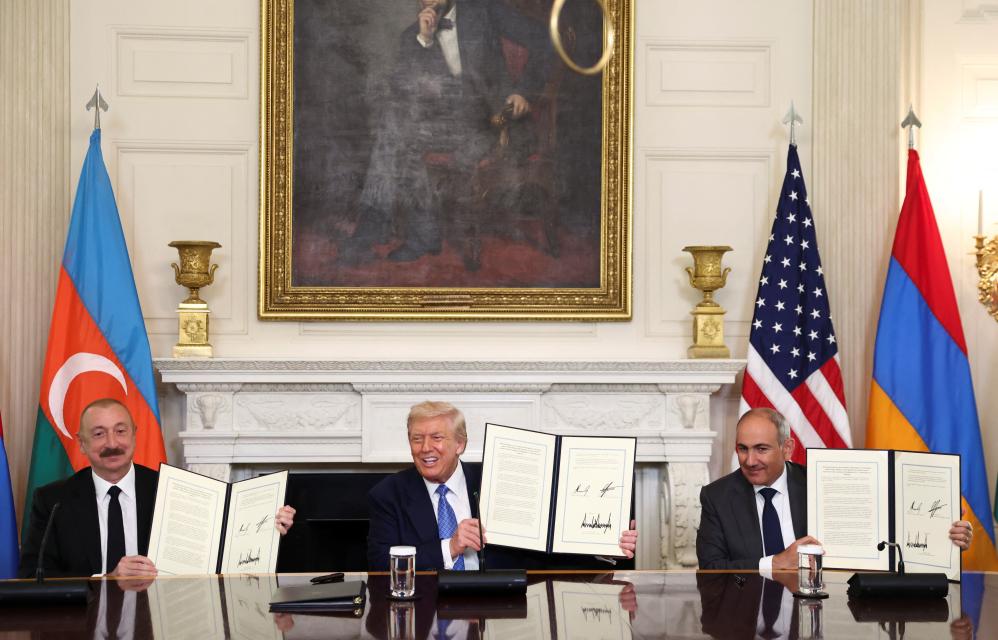
- Leaders of Armenia, Azerbaijan, and US President Trump announced peace and connectivity agreements in the South Caucasus, declaring an end to the 30-year Armenian-Azerbaijani conflict.
- This signal is powerful, but implementation remains uncertain amid divergent interpretations and political obstacles.
- Without guarantors or mechanisms in place, the durability of US engagement is the only - but highly uncertain - factor in ensuring implementation of the agreements.
- Russia is sidelined, Iran uneasy, Türkiye gains a route to Central Asia, and the EU loses ground but could re-engage if US focus wanes.
At the White House in Washington, on August 8th, Armenia and Azerbaijan initialled a peace deal and signed an agreement on the establishment of the Trump Route for Peace and Prosperity (TRIPP): a transport link connecting Azerbaijan-proper with its exclave Nakhchivan through Armenian territory, which had been a contentious issue in the peace negotiations. While the imagery and potential positive consequences of this should not be underestimated, much is still unclear about what the agreements actually mean, including certain formulations and their interpretation as well as the question of how long the US commitment to the region will last. At the same time, the Washington summit represents an opening and a positive momentum for further development of not only the Armenian-Azerbaijani peace process, but larger connectivity in South-Caucasus, and several capitals will have been watching the proceedings keenly. This paper first briefly discusses the agreements reached and some of the remaining questions surrounding them, and then analyses the attitudes and/or reactions of the US, Russia, Iran, Türkiye and the EU, which in some cases, will be crucial to the success or failure of the initiative.
Authors

Related
See all
Armenia’s Changing Relationship With Russia