Inspiration for AI Diplomacy
A Glance at the AI Strategies of the United Kingdom, Denmark, France, and Singapore

- The United Kingdom, Denmark, France, and Singapore all stand out as frontrunners in specific domains of AI strategy and governance
- UK focuses on investment attraction, Denmark on promotion of value-based AI adoption, France in fostering innovation hubs, and Singapore on strategic AI niches
- Ahead of launching its own international AI strategy, having insight into other countries’ AI strategies, governance structures, and mandates enables the Netherlands to learn from its peers as it pursues its own policy goals
- The Netherlands would do well to chart its path forward based on its own specific interests, priorities, and niches for AI development in a way that balances AI investments with privacy standards and safety risks
In preparing to launch its forthcoming international Artificial Intelligence (AI) strategy, the Dutch government would benefit from a better understanding of leading peers' (international) strategies and AI governance structures. This Clingendael Report contributes to this objective by offering an exploratory analysis of key initiatives and governance structures of the United Kingdom, Denmark, France, and Singapore.
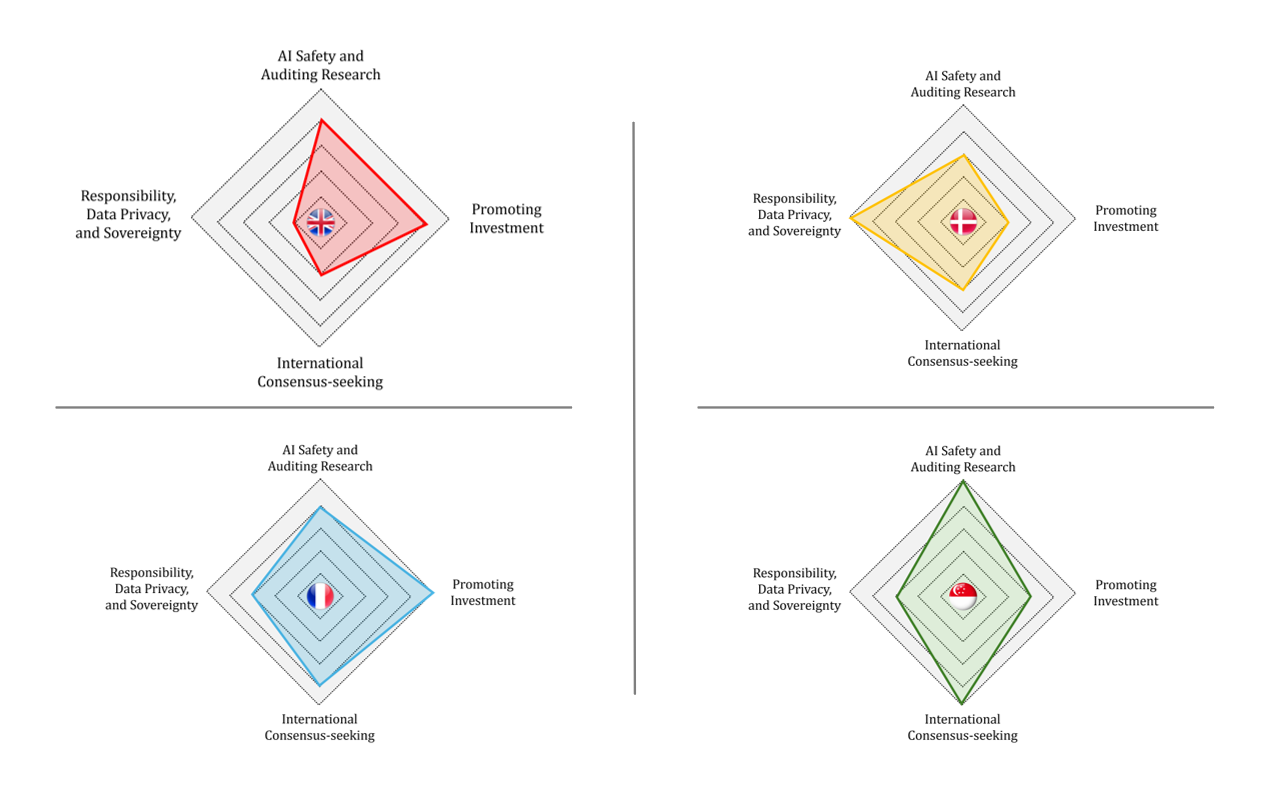
The United Kingdom has adopted a laissez-faire attitude towards AI, aligning with the United States and focusing on attracting foreign investors. While this comes with development gains, it also poses risks to data sovereignty. The UK does have a notable ‘AI Security Centre’ focused on research around emerging AI risks and AI auditing, but it has recently withdrawn from international consensus-building efforts.
Denmark’s approach consists of cultivating AI use across society in accordance with Danish values, with a particular focus on AI in the public sector and not so much in the private sector. Despite its focus on domestic sovereignty and risk management, it has made limited efforts internationally.
France’s strategy somewhat resembles the underpinnings of the US’s DARPA program, focusing on funding a wide range of potentially good ideas instead of funnelling all investment into one project. This has led to the emergence of competitive startups, research hubs, and a pronounced international presence. However, this wide-scope approach means that France lacks centralised AI governance structures and has spread mandates across existing bodies.
Singapore has a strong emphasis on safety, standards, and guidelines, and enables bottom–up development and testing of (open-source) models. It designates specific strategic niches in which it can carve out and sustain an edge and where it focuses its efforts. Its international presence is characterised both by its consensus-seeking efforts, and through providing a model for developing a well-rounded AI strategy using limited resources.
While these four countries are frontrunners in specific domains, AI strategy and governance is an emerging field. The Netherlands would do well, first and foremost, to chart its path forward based on its own interests, priorities, and niches for AI development and not simply seek to replicate existing strategies.
Authors


External authors
Related
See all
AI Diplomacy for a Multipolar World