Kush in Sierra Leone: West-Africa's growing synthetic drugs challenge and Europe’s and China’s part in it
- Kush, a deadly drug, has likely killed thousands in West Africa, with Sierra Leone at its epicenter
- Some of the substances are imported from China, the Netherlands and most likely the UK
- Chemical testing finds that nearly 50% of sample contains nitazenes, a very addictive and deadly opioid
- The market is increasingly fragmented, with smaller actors setting up their own operations
- Better monitoring, testing, disrupting of the supply chains and mitigating the harms of consumption is needed
Since 2022, a synthetic drug known as ‘kush’ is likely to have killed thousands of people in West Africa. Kush emerged in Sierra Leone but quickly spread across countries in the subregion, including Liberia, Guinea, the Gambia, Guinea-Bissau and Senegal, with devastating effects. By April 2024, the health impacts of kush, which contains nitazenes (opioids that can be even more powerful than fentanyl) and synthetic cannabinoids, were so acute that the presidents of Sierra Leone and Liberia declared national emergencies over drug use – an unprecedented step.
Yet, amid widespread speculation, a number of critical questions remained unanswered about the drug. What is kush? Where does it come from? Who is producing and trafficking it? And what can be done to reduce the harm posed by this drug?
These questions are addressed in a new report by the Global Initiative Against Transnational Organized Crime (GI-TOC) and the Clingendael Institute, titled ‘Kush in Sierra Leone: West Africa’s growing synthetic drugs challenge’, by Lucia Bird Ruiz Benitez de Lugo and Dr. Kars de Bruijne.
‘Through our work in West Africa, we kept hearing about kush, but there was a lot of hearsay and myth with very little evidence,’ explained Lucia Bird, director of the GI-TOC’s Observatory of Illicit Economies in West Africa. ‘Without this data, it was impossible to build an effective response,’ she noted.
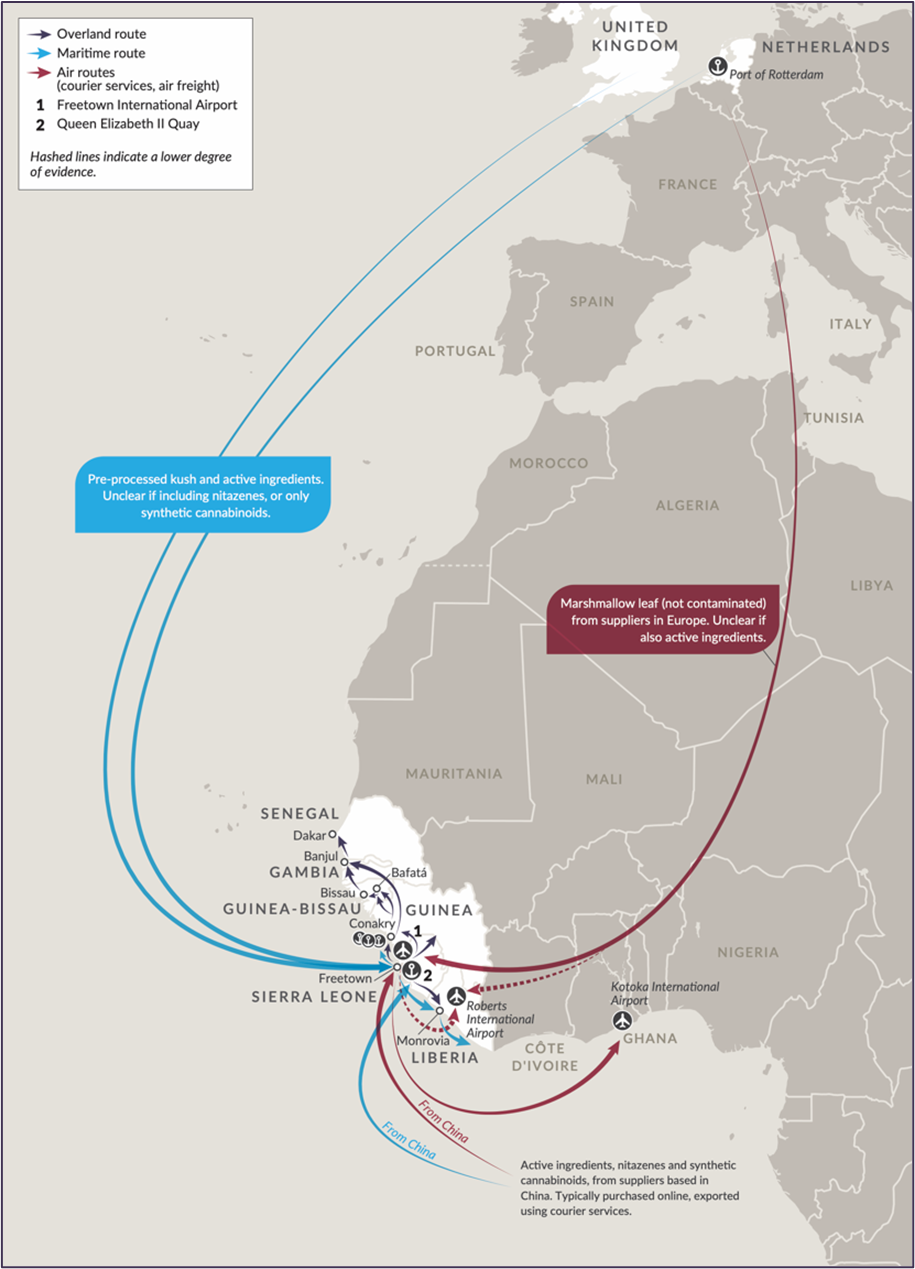
As part of the research, chemical testing of kush, carried out in cooperation with national authorities in Sierra Leone and Guinea-Bissau, detected nitazenes – potent and often deadly synthetic opioids linked to overdoses across Europe and the US – and synthetic cannabinoids. Research into supply chains and trafficking routes revealed that some of these substances are being imported through maritime routes and postal courier services from China, the Netherlands and most likely the United Kingdom. ‘All three countries own part of the responsibility for the kush crisis and the harm to people in Sierre Leone, and West Africa more broadly,’ said Kars de Bruijne, head of the West Africa and Sahel programme at the Clingendael Institute.
The report details how the main actors in the kush market expanded their business since 2019. Today, the market is increasingly decentralized, with increasing numbers of owners, ‘locks’ (intermediaries between owners and the rest of the market), importers, ‘cooks’ (who mix the components of kush to create the retail-ready drug), distributors and retailers. They all play distinct roles and have profit margins respective to their status in the market. Both large and small networks rely on a strongly localized protection system, but some appear to have also infiltrated state-embedded actors.
Kush presents a pivotal milestone in the evolution of the drugs threat facing West Africa. The current scale of the kush market, the speed at which the market expanded in Sierra Leone and beyond, and its public health impacts are unparalleled. The research findings point to a wider problem of synthetic drugs in West Africa. ‘The influx of cheap, addictive and very harmful synthetic drugs in a region with poorly prepared health systems and a very young population is a clear sign of lasting emerging drugs problem in the region,’ warned Bird.
To counteract this dangerous trend, the report calls for urgent coordinated action across the supply chain and makes recommendations across three areas. Firstly, it advocates for building an evidence-based response by strengthening monitoring, early warning, testing and information-sharing across West Africa. Secondly, it calls for disrupting supply chains in source countries (particularly China, the Netherlands and the UK), as well as tightening scrutiny of entry points such as maritime ports, international airports and the postal service. Thirdly, the report underlines the need for mitigating the harms of kush consumption, including prevention and public education, and greater access to treatment and support programmes as well as medication that can reverse overdoses from opioids.
The government of Sierra Leone requested research on Kush in 2023 and was briefed on the results of the research during 2024 and 2025.