


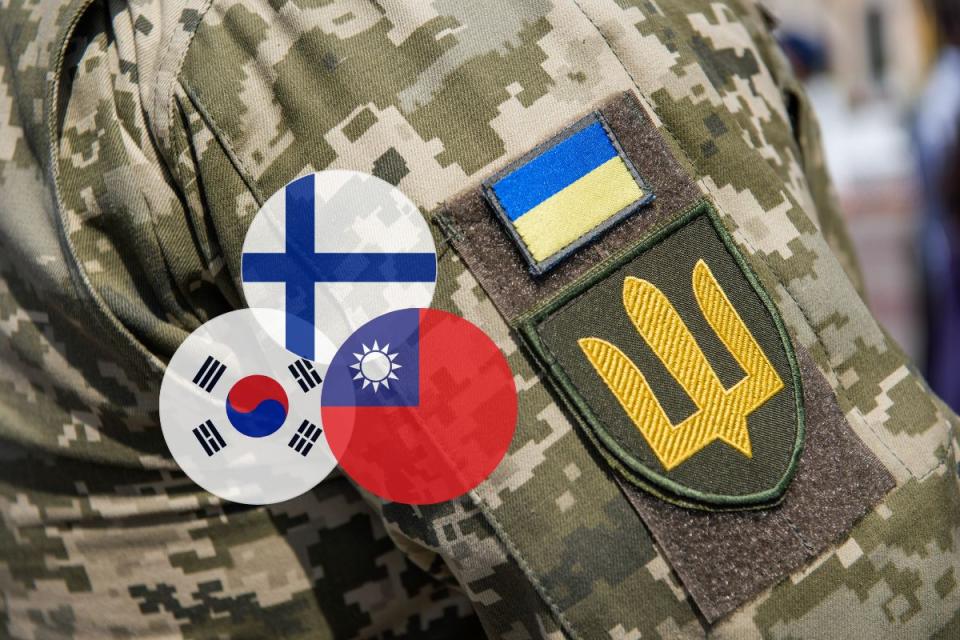
Post-war security sector reform in Ukraine: Insights from Finland, South Korea and Taiwan
This report was originally published by the Geneva Centre for Security Sector Governance.
Four years into the Russian full-scale invasion and a decade after the annexation of Crimea and the onset of hostilities in Donbas, Ukraine, though still reliant on external weapon supplies, has already made significant progress in reforming its military-industrial complex to become more self-sufficient. Initial optimism arose from the supportive response of its Western partners and the granting of EU candidacy status, which suggested promising prospects for NATO integration.
However, four years later, the outlook for external military alliances is less bright. The United States’ foreign policy decisions and reluctance to provide timely military and political support to Ukraine are influenced by upcoming elections, while the European Union faces the necessity of reshaping its European security architecture. The enormous destruction that Russia continues to inflict on Ukraine’s cities, combined with the immense loss of life, places significant pressure on society and government institutions. This exacerbates societal divisions and adds strain to institutional stability.
Despite these challenges, Ukraine is striving to maintain strong civil-military oversight, transform its defence industry, attract foreign investment for economic recovery, and use diplomatic efforts to build bilateral and multilateral military alliances.
Examples from other countries that have experienced similar asymmetrical security threats or active aggression from neighbouring states may be useful to Ukraine in navigating its options and determining its next steps. This paper attempts to distil relevant lessons for Ukraine from the cases of South Korea, Taiwan, and Finland, while fully acknowledging the differences in historical, regional, and political contexts.
The comparative analysis is based on three papers: Wei-chin Lee, Post-War Security Sector Reform in Taiwan (Geneva: DCAF, 2024); Ilmari Käihkö, Post-War Security Sector Reform in Finland (Geneva: DCAF, 2024); and Insoo Kim, Post-War Security Sector Reform in South Korea (Geneva: DCAF, 2024).
The discussion is divided into four parts. The first chapter provides an overview of Ukraine’s international military cooperation over recent decades and discusses relevant lessons from Taiwan, South Korea, and Finland. Chapter Two focuses on Ukraine’s defence sector, specifically its domestic defence industry and the capabilities of its armed forces, drawing parallels with the three cases. The third chapter examines democratic control over the armed forces and civil-military oversight, concluding with lessons from the three countries. The final chapter summarises the discussion and highlights examples that could be useful for Ukraine.
Authors

External authors
Related
See all
Black Sea Security as the White Knight for peace?
