The recovery and resilience facility: success model or democratic deficiency?
Lessons learned on the parliamentary involvement in the RRF in the Netherlands and Italy
- The Recovery and Resilience Facility (RRF) has emerged as a cornerstone of the EU’s post-COVID economic response
- It has been praised for its scope and the speed with which it was adopted
- Yet, it seems that the urgency and haste in its establishment and implementation have come at the expense of democratic scrutiny by national parliaments
- It is essential that future financial instruments are designed with stronger provisions for parliamentary involvement
- This is relevant as the EU risks reinforcing a governance model where efficiency is prioritised before democratic accountability
This report is published on RED-SPINEL on 21 May, 2025.
The Recovery and Resilience Facility (RRF) has emerged as a cornerstone of the EU’s post-COVID economic response. As part of the broader Next Generation EU (NGEU) package, the RRF is designed to provide Member States with access to substantial financial support – in the form of grants and loans – based on the submission of National Recovery and Resilience Plans (NRRPs). These plans must align with the EU’s green and digital transitions and adhere to specific macroeconomic and rule of law conditions.
The RRF is seen as an unprecedented step in the EU integration process, as it allowed the European Commission to borrow the largest bulk of its total worth of 750 billion euro on the capital market in addition to the EU’s Multiannual Financial Framework (MFF). While the RRF has been praised for its scope and the speed with which it was adopted, the urgency and haste in its establishment and implementation seem to have come at the expense of democratic accountability and transparency, thereby weakening democratic scrutiny.
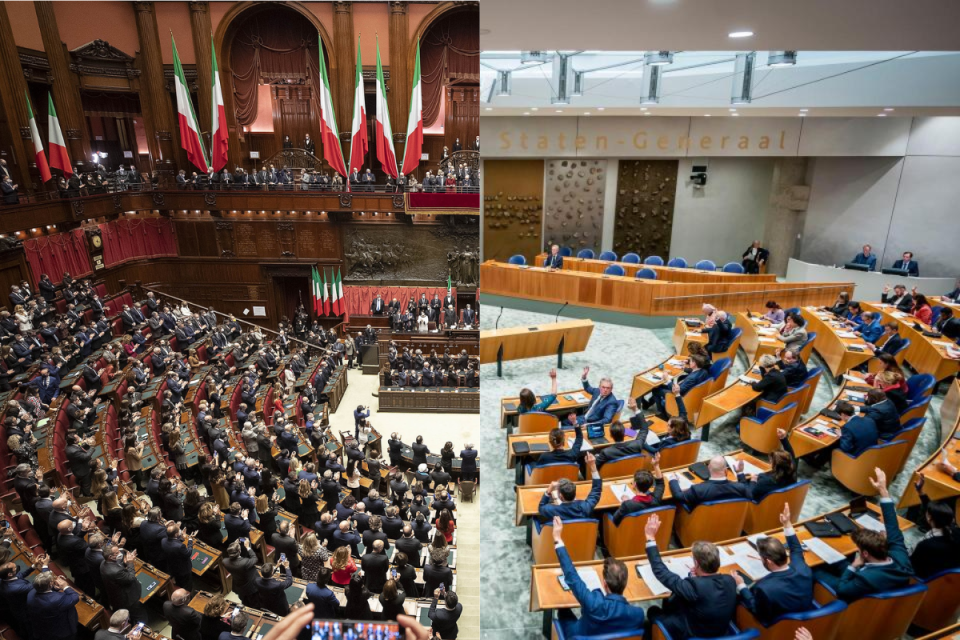
The aim of this paper is to shed light on the democratic legitimacy of NGEU – the RRF particularly. To do so, the paper explores how the RRF has been discussed and handled in the Dutch and Italian parliaments. It analyses the debates held and examines the ways in which they scrutinised the adoption of its various legal acts, as well as the drafting of the NRRPs. The Netherlands and Italy portray two Member States with distinct traditions in executive legislative relations, economic conditions, financial worth of the NRRPs, and recovery and reform priorities. We hypothesise that structural features of executive-legislative relations, combined with crisis-induced time constraints, led to limited parliamentary involvement in both cases, albeit in different forms.
Parliaments and the adoption of the RRF: significant involvement, limited control
The paper explores the roles that both the European Parliament (EP) and the national parliaments played in the adoption of the NGEU framework. In the adoption of most of NGEUs legal acts, including the RRF itself, national parliaments only exercised indirect influence through their ability to hold their executives in the Council accountable. National parliaments had, instead, direct influence on the adoption of the Council decision that authorised the Commission to issuing common EU debt, which, unlike the other acts, required ratification by all Member States. Yet, by that time, the NGEU framework, including the RRF, was largely set in stone, thereby presenting parliaments with a fait accompli. Importantly, the weak national parliamentary control over the NGEU has not been fully compensated by the EP. While the EP acted as co-legislator in the adoption of the RRF, its role in co-shaping the design and governance of the RRF remained limited compared to that of the European Council (EUCO), the Council and the Commission.
The analysis of debates held in the Dutch and Italian parliaments underscore these conclusions. Both parliaments were significantly involved in the adoption of the RRF (albeit with different reasons and focus) as shown by the numerous debates held over the course of 2020 and 2021. Yet, their ability to influence and co-shape the RRF was limited, since this was in the hands of government representatives. In the end, most parties (especially those holding a government position) prioritised a quick adoption of the RRF and therefore supported their executives in the negotiations. Hence, they were not able to influence and co-shape the RRF beyond regular opposition-government dynamics. Moreover, because the adoption of the RRF was linked to the adoption of the MFF, there was significant pressure on the decision-making, which meant that both parliaments did not actively perform their scrutiny role. In the end, neither parliament had a clear voice on the adoption of the RRF, and the final compromise was one that both parliaments simply had to accept.
Parliaments and the drafting of the NRRPs: weak involvement and control
Also when it comes to the implementation of the RRF, the chains for democratic scrutiny are limited. Neither the national parliaments nor the EP exercised control over the adoption the NRRPs and payments, which detracted from their role as budgetary authorities. Both the Dutch and the Italian parliament felt insufficiently included in the drafting of the NRRPs. Moreover, in both countries, the drafting and implementation of NRRP portrays a concentration of decision making authority within the executive at the expense of parliament and, hence, public scrutiny. In the Netherlands, the relatively mild economic impact of the pandemic reduced the urgency for action, and debates on the NRRP (worth 5.4 billion euro) were minimal. The outgoing Rutte government delayed the submission of the plan. When discussions did occur, they focused on the lack of transparency and parliamentary engagement, rather than the substance of the plan itself. In Italy the swift submission of the NRRP (worth 195 billion euro) was more immediate and politically significant. However, the approach remained highly technocratic and executive led. Parliament’s limited role sparked criticism, even contributing to the fall of the Conte government. Nonetheless, subsequent governments continued to marginalise the legislature in the implementation phase.
Implications and Future Outlook
Although the RRF is hailed as a successful response to an extraordinary crisis, the rush and urgency that the pandemic demanded, implied that democratic legitimacy has been weakened. The intergovernmental nature of the decision-making on NGEU, and the limited role for both national parliaments and the EP in its governance, point to a democratic deficit in the EU’s economic governance.
This conclusion is especially relevant in light of comparable future EU policy initiatives. As the EU plans major defence investments under the Readiness 2030 program and prepares the next MFF from 2028 onwards, similar mechanisms of common borrowing and conditional funding may be employed. Given the precedents set by the RRF, it is important that future financial instruments are designed with stronger provisions for parliamentary involvement and democratic scrutiny. This could be guaranteed by granting national parliaments earlier access to information, creating stronger connections with other parliaments and with the EP, and ensuring that national parliaments can send governments executives to the Council with stronger mandates and hold them accountable for decisions taken. This is essential as the EU risks reinforcing a governance model where efficiency is prioritised at the cost of democratic accountability – potentially weakening public trust in European integration at a time when solidarity and shared responsibility are more necessary than ever.
Authors

External authors


Related
See all

The Multiannual Financial Framework