Indonesia’s Parallel Engagement with BRICS, the OECD and the EU
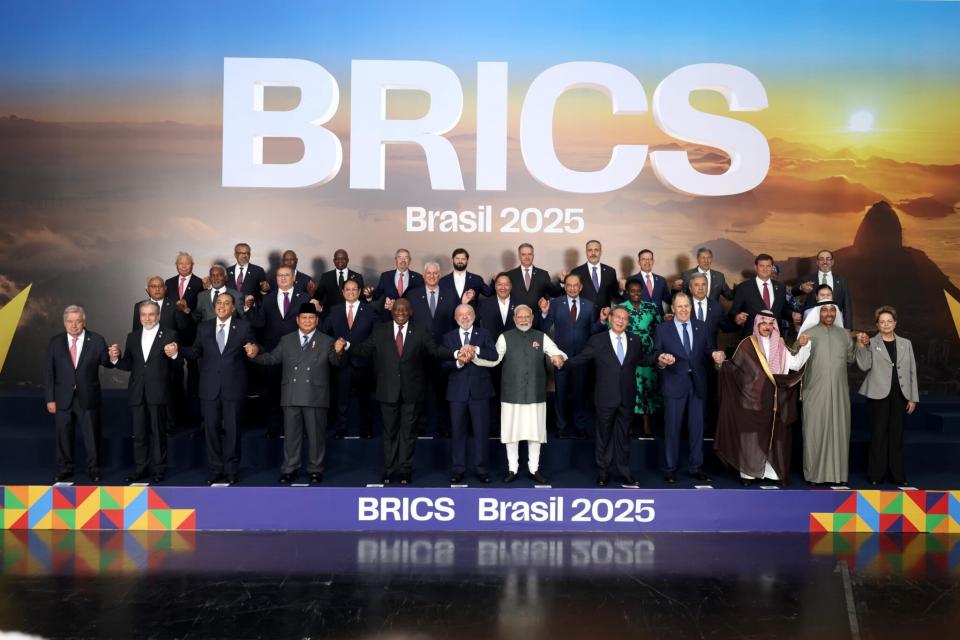
- Indonesia’s simultaneous engagement with BRICS and its accession process to the OECD reflects a strategy of institutional diversification rather than geopolitical alignment.
- OECD accession is structurally more consequential, as it anchors Indonesia’s regulatory reforms, enhances investor confidence and signals commitment to high-standard economic governance.
- BRICS membership offers Indonesia flexibility, additional financing options and political visibility but lacks the institutional depth for long-term economic transformation.
- Indonesia’s expanding multilateral footprint risks stretching limited diplomatic and bureaucratic capacity, potentially diluting ASEAN centrality and its regional leadership role.
- For the EU, Indonesia’s multi-engagement creates opportunities to deepen cooperation through the Global Gateway, provided delivery is tangible and aligned with local needs.
Indonesia is simultaneously engaging with BRICS and acceding to the OECD as part of its broader strategy to navigate an increasingly fragmented global economic order. This joint Clingendael Institute and Centre for Strategic and International Studies (CSIS) Indonesia Policy Brief analyses both the motivations for and consequences of Indonesia’s two-pronged approach. How does this approach fit into Indonesia’s foreign policy culture more broadly? What are the political economic goals Indonesia seeks to achieve, and how? Moreover, what would be apt ways of responding to Indonesia’s grand strategy for the Netherlands and the EU, for instance, through its Global Gateway instrument? The aim is to identify lessons for EU-Indonesia relations from both European and Indonesian perspectives.
The policy brief does not assume the existence of a consolidated Indonesian grand strategy guiding participation across these platforms. Rather, it approaches Indonesia’s BRICS accession as a high-level political decision taken in a context of increasing global uncertainty, whose economic and institutional implications remain uneven and contested. The paper therefore combines explanatory analysis with a critical assessment of the potential consequences of BRICS membership – particularly considering Indonesia’s simultaneous engagement with ASEAN, the OECD, and the EU, and its bilateral engagements with the United States (US) and China.
The policy brief starts with an analysis of Indonesia’s decision to join the BRICS grouping as well as the motivations for and consequences of doing so. Second, it discusses how Indonesia’s parallel strategy to join the OECD fits in the larger picture of Indonesian foreign policy. Building on this, the policy brief outlines policy options and recommendations for the EU and the Netherlands and, finally, concludes.
This Policy Brief is part of the PROGRESS-series 'Global Governance in Flux', with contributions by experts from the Clingendael Institute and The Hague Centre for Strategic Studies (HCSS). The series informs policymakers and stakeholders about developments in global governance that are relevant to the EU, EU member states and partners.
Authors


External authors



Related
See all

The BRICS and the Emerging Order of Multipolarity