
Opposite to the United States in the emerging global geopolitical fault lines is China. Beijing’s main interest in the Western Balkans (Figure 9) is to develop the Land–Sea Express Corridor, a component of its Belt and Road Initiative that serves to improve China–EU connectivity. Second, China seeks to exploit economic opportunities in the region itself, as well as to gain a political foothold through its economic engagements.[24]
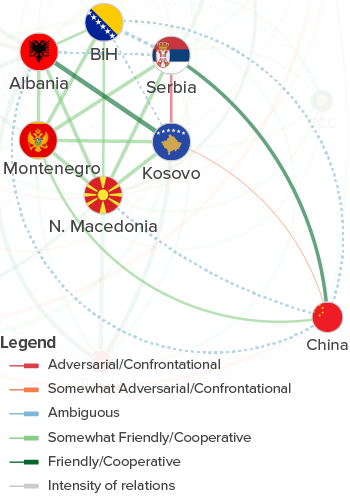
China’s relation with Serbia is most encompassing, spanning political declarations, arms trade, police cooperation and tourism facilitation besides trade and investments. China also supports Serbia in its dispute with Kosovo, which it has not recognised over its strict approach to territorial integrity related to its own dealings with Taiwan, Tibet and Xinjiang.[25] Serbia has displayed a considerable demand for increasing cooperation between the countries in the past years to make use of China’s leverage in amongst others the UNSC.
Chinese investments span the entire region and include infrastructure, industry, the telecom sector, energy plants and more. Unlike Russia, China does not deliberately aim to provide a systemic alternative to EU integration. Rather, Beijing opportunistically steps in where the EU is either unwilling or unable to engage, such as in the construction of the Bar-Boljare highway in Montenegro.
Given the divergences in its environmental, public procurement, cyber and other standards, Chinese engagement regularly subverts EU integration efforts. Beijing’s preference for investing through direct government-to-government contracts undermines democratic accountability, allowing for corruption to persist.[26] As such, while many still see China as an ‘economic miracle’ that can drive development, Chinese projects have also divided public and political opinion, sparking debates about the dangers of foreign loans, construction delays and debt traps. Montenegro’s Bar-Boljare highway is a case in point; upon its signing, the project’s costs represented a quarter of the country’s GDP.[27] All in all, Chinese investments that are incongruent with EU norms will hinder countries like Montenegro as they move closer to EU membership.[28]