
Various determinants shape regional dynamics and bilateral relationships in the Western Balkans (Figure 2): shared (formal) aspirations for EU integration, statehood challenges, ethnic fault lines, similarities in governance styles, and divergent foreign policy orientations.
Many analysts and Southeastern European politicians view the term ‘Western Balkans’ as an EU-imposed analytical construct.[4] Still, the WB6 display clear elements of a coherent political region. The countries remain formally united in their aspiration to join the EU, which facilitates their political cooperation and ability to overcome bilateral frictions. For example, the EU’s push to improve neighbourly relations has helped Kosovo and Montenegro to resolve a dispute over the demarcation of their joint border.[5]
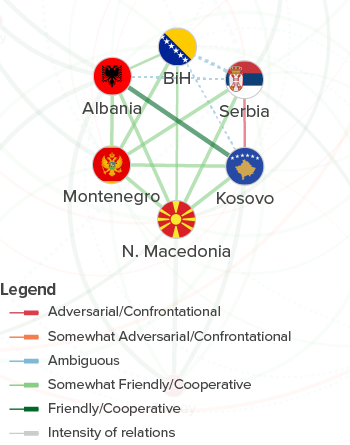
The WB6 joint EU integration objective has also given rise to enhanced institutional and economic cooperation. The WB6 have set up the Regional Cooperation Council (RCC) which promotes steps towards regional economic integration (through the Central European Free Trade Agreement (CEFTA)) and initiatives towards the mutual recognition of passports and professional qualifications.[6] Facilitated by such interaction, economic ties between the WB6 countries are generally expanding. Nonetheless, trade with and investments from outside powers like the EU or China have much more significance, owing to the opportunities offered by their investment capacities and market size.[7]
A notable exception to constructive inter-state relations in the region remain those between Serbia and Kosovo (Figure 3). Serbia does not recognise Kosovo’s independence, and despite years of EU-facilitated dialogue, tensions remain high. In the past few years, several episodes of violence were reported in Kosovo’s North, prompting an intervention from NATO’s KFOR military mission in 2023. Serbian influence over Kosovo’s Serb minority remains considerable, while Kosovo maintains a firm stance on its territorial integrity, combating informal Serb parallel political structures.[8] As normalisation remains elusive, future incidents and broader instability cannot be ruled out.[9]
Open the geopolitical mapping in full-view mode
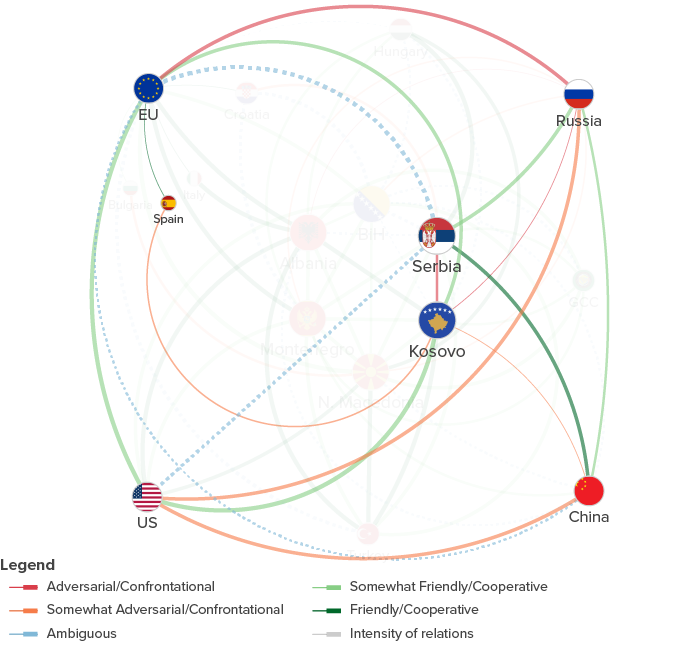
The Kosovo-Serbia rift also negatively affects Kosovo’s relations with Bosnia and Herzegovina. Bosnia has not recognised Kosovo due to resistance from the Bosnian Serb Republika Srpska (RS) sub-state entity, a close ally of Serbia. BiH's foreign policy is complicated by internal ethnic divisions and a complex constitutional structure, with parts of the leadership prioritising relations with Croatia, Brussels, Türkiye, Serbia or Russia, depending on political and ethnic affiliations. In foreign policy terms, BiH and Serbia pursue a more multi-faceted approach than the other four, which are firmly committed to Euro-Atlantic integration and aligned with the EU’s Common Foreign Security Policy (CFSP).
On the substate level, ethnic affiliations significantly shape regional dynamics. Serbia maintains close ties with Serb communities and politicians in BiH, Kosovo, and Montenegro. For instance, the Serbian government maintains a close influence over the Srpska Lista (Serb List) in Kosovo, the country’s main Serbian minority party, and has warm relations with the ZBCG bloc, a pro-Serb party in Montenegro.[10] Similar dynamics are prevalent in BiH, where Serbia and Croatia seek to bolster their respective ethnic groups, often to the detriment of BiH’s unity and territorial integrity. Croatia’s governing party, HDZ, maintains an intimate connection with its BiH counterpart, while Serbian President Aleksandar Vučić has tacitly supported RS President Milorad Dodik in his secessionist ambitions. Cross-border ethnic ties also shape Albania’s neighbourly relations. The country wields influence among the Albanian minorities in Montenegro and North Macedonia, and maintains an especially strong bond with Kosovo, grounded in ethnic, cultural, and linguistic connections.
Despite their differences, the six Balkan countries share a similar governance style. All are classified as “transitional or hybrid regimes” according to the Freedom House Nations in Transit ranking.[11] Strongmen politics, clientelism, ethno-nationalism and incomplete democratic consolidation shape much of the region’s politics, thereby affecting mutual cooperation in various ways. For instance, while Serbia-Albania relations are historically characterised by rivalry, their leaders, longtime ‘stabilocrats’ Aleksandar Vučić and Edi Rama, find common ground on shared economic projects.[12] A case in point is the Open Balkan initiative for a regional common market between Serbia, Albania and North Macedonia which both leaders used to rally around.[13]
Overall, the WB6 countries maintain cooperative state-level relations, though tensions persist between Serbia and Kosovo and over Bosnia and Herzegovina’s statehood. Joint EU integration aspirations, statehood challenges, ethnic fault lines, similarities in governance styles and diverging foreign policy outlooks more broadly determine regional dynamics and bilateral bonds.