
Global geopolitical fault lines are also shaped by the NATO-Russia standoff, which also affects the Western Balkans. Objectively, NATO has the upper hand in the region (Figure 7). Seeking military advancement and protection from Russian influence, 3 out of the 6 Western Balkan countries managed to become full NATO allies in the past decades: Albania (2009), Montenegro (2017), and North Macedonia (2020). The same holds true for EU members like Croatia (2009) and Slovenia (2004). This is a notable achievement for especially Montenegro, where significant opposition favoured closer ties with Serbia or Russia instead.
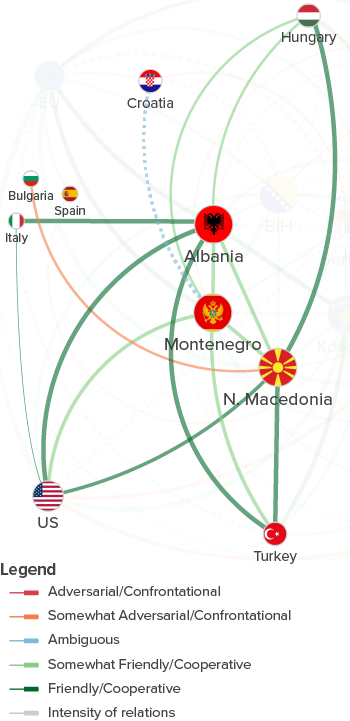
The Alliance also cooperates with the three non-member countries in the region: Kosovo, BiH, and Serbia. It has adopted a Partnership for Peace programme and individually tailored Partnership Programmes with the latter two. Since 2010, Bosnia and Herzegovina has a Membership Action Plan that would prepare the country for NATO membership. In practice, Bosnian Serb resistance has undermined decisive steps in that direction. Due to Bosnia’s fragile stability, NATO continues to offer support to the EU’s military EUFOR Althea mission in the country.
NATO-Serbia relations remain contentious due to the 1999 NATO intervention to end the Kosovo war. Such historical sensitivities and Serbia’s multi-vector foreign policy mean that the country does not aspire to join the Alliance. Negative NATO sentiments in Serbian society continue to provide an opening for local leaders and outside powers like Russia to discredit the country’s Euro-Atlantic integration.
While in the long run Kosovo hopes to join the Alliance, NATO has remained unwilling to put an offer on the table due to the non-recognition by four of its members. NATO does maintain relations with Kosovo, amongst other things through capacity-building support to the Kosovo Security Force, an initially light-armed volunteer force. However, Kosovo’s 2018 decision to transform the KSF into a fully armed force was met with scepticism from former NATO SG Stoltenberg, even if the US welcomed the move.[19] The fact remains that Kosovo, for the time being, is mostly a security consumer due to its tensions with Serbia. Instability risks continue to require military presence through the NATO KFOR mission, which has increased in strength over the past few years due to episodes of heightened unrest.