The wartime economic takeover of the Iranian state
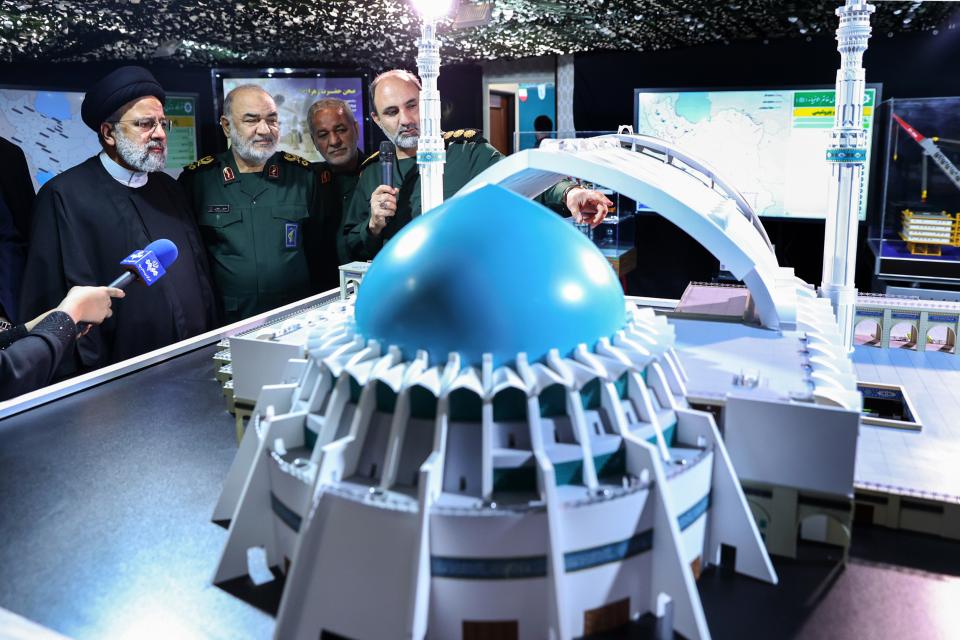
- The Islamic Revolutionary Guards Corps has been critical to Iran’s national defence and wartime governance against Israel and the US, which elevated its political position
- The war is also expanding the IRGC’s economic power base by positioning it to dominate reconstruction, elevate the importance of its sanctions-evasion networks, and potentially allow it to capture new fee-based revenues in the Strait of Hormuz
- This will likely further increase political and economic dependency on the Guards inside of Iran, worsen growth prospects for many Iranians and make re-engagement with the West more difficult
By David Jalilvand, Managing Director of Orient Matters and Associate Fellow with the German Council on Foreign Relations (DGAP)
Editor’s introduction
In September 2022, the death of Mahsa Jina Amini marked a major turning point for Iran. The event sparked lengthy nationwide protests across socio-economic classes and population groups whose demands rapidly evolved from discarding controversial hijab regulations to calls for the overthrow of the Islamic Republic. The Iranian government responded with repression, killing over 400 protesters in late 2022 and early 2023, according to human rights groups. The protests of January 2026 reflected the same public discontent and reinforced the negative spiral of government underperformance and popular legitimacy. They also increased the external and internal pressures on Iran’s government compared with the protests of 2022/2023.
The Clingendael blog series ‘Iran in transition‘ explores power dynamics in four critical dimensions that have shaped the country’s transformation since 2022: state-society relations, intra-elite dynamics, the economy, and foreign relations. This blog examines how the Israeli-US assault on Iran is likely to end up strengthening the economic heft of the Islamic Revolutionary Guard Corps (IRGC). It also discusses whether such a shift sets Iran on a trajectory towards greater international isolation, brain drain and potentially renewed protest – barring major economic reforms that benefit the average Iranian citizen.
Never let a good crisis go to waste
In Iran, the war with Israel and the United States caused widespread damage not only to military assets but also to the country’s economic infrastructure. Energy facilities, industrial sites, and transportation networks have been severely hit. Preliminary assessments suggest that the damage could run into several hundred billion dollars with some projections exceeding half of Iran’s annual pre-war GDP. For an economy already weakened by decades of mismanagement, inflation, underinvestment, and sanctions, this translates into enormous reconstruction needs. While this represents a challenge for Iran as a whole, it also creates a major opportunity for one actor in particular: the Islamic Revolutionary Guards Corps (IRGC) and its ever-expanding economic conglomerate.
Even before the war, the Guards and their networks were deeply embedded in the Iranian economy although a percentage of GDP is hard to provide due to data reliability issues. Within a broader ecosystem of parastatal businesses, the Guards had increasingly emerged as the focal point and assumed control over Iran’s economic commanding heights. Their footprint is especially strong in construction and engineering, defense, the oil and petrochemical industries, ports and logistics, telecommunications, and, increasingly, banking.
The war has positioned the Guards to further deepen their hold over the economy. To begin with, the Guards’ key role in national defense and wartime governance combined with the elimination of significant leadership figures from Iran’s political class, such as Supreme Leader Khamenei and Ali Larijani, has elevated the organization’s political position. That influence can be used post-war to shape the reconstruction process and channel contracts and funds toward the organization’s business networks.
Specifically, three economic effects of the war are creating new opportunities for the Guards that will expand their economic power base in addition to their greater political heft:
The destruction has created acute needs in sectors where the Guards are particularly strong, above all construction and engineering. This gives the Guards an advantageous starting point from which to benefit from post-conflict reconstruction. In fact, the capabilities of the Guards’ engineering corps constituted their initial entry point into the Iranian economy after the end of the Iran-Iraq War in 1988.
- The US blockade of the Strait of Hormuz has forced Iran to further restructure its trade, including by concealing maritime traffic and relying more heavily on alternative land-based routes. This increases the importance of the sanctions-busting expertise and networks controlled by the Guards. Ultimately, the war is further cementing the role of clandestine networks designed to shield financial flows from US sanctions enforcement. Yet, their very clandestine nature also shields such networks from control by Iran’s state institutions.
- The Guards are also central to Tehran’s ambition to collect fees in the Strait of Hormuz. In early May, Iran established the Persian Gulf Strait Authority as the focal point of its attempt to normalize and institutionalize control over the Strait of Hormuz, including the collection of fees. In practical terms, the Authority largely functions as an administrative front for the Guards-led effort to exercise control over the strait. The IRGC effectively controls the framework that makes such fees enforceable and, presumably, the revenue flows themselves. Rough estimates at the upper end suggest potential revenue of several dozen billion dollars per year. At this stage, however, it remains uncertain to what extent, if at all, Iran will succeed in charging for passage at Hormuz.
Taken together, these developments point to a broader shift that the war reinforces. The Guards are no longer merely politically positioned to benefit from preferential access to state funds and projects, or from the manipulation of Iran’s multi-tier exchange-rate system. As a result of sanctions and now the war, they are increasingly able to directly collect hard-currency revenue that nominally belongs to the state. In important ways, it is now the Iranian state that has come to rely on revenue effectively collected by the Guards, rather than the other way around.
It’s the Guards, stupid!
In an economy suffering from a severe hard-currency liquidity crisis, this has major ramifications. As a result of sanctions and now war, the Guards are increasingly able to collect hard-currency revenue directly that nominally belongs to the state. In important ways, it is now the Iranian state that has come to rely on revenue effectively collected by the Guards, rather than the other way around. This blurs the line between the state as such and the Guards as a powerful institution within it, and in fact shifts the balance of power towards the latter.
This shift is compounded by the Iranian state’s failure to meaningfully compensate for lost oil revenue. The state has increased taxation and cut public spending, including welfare. Yet these measures have worsened the socioeconomic crisis facing many Iranian households without generating enough revenue to ease the state’s budget problems. Now, with the war having damaged economic infrastructure and disrupted economic activity, the Iranian state is likely to collect significantly less tax revenue, at least in the short- to mid-term. This further increases the importance of oil revenue collected through IRGC-controlled channels.
In historical comparison, such a dominant role of the Guards in Iran’s post-war reconstruction represents a fundamental shift. After the Iran-Iraq War ended in 1988, then-President Ali Akbar Hashemi Rafsanjani sought to harness the Guards’ capabilities to advance his reconstruction agenda. At the same time, he also sought to steer the Guards, whose political influence had risen during that war as well, away from the political arena. This was also, in no small part, intended to prevent them from sabotaging Rafsanjani’s efforts at reconciliation with the West. At the time, the Guards’ entry into the Iranian economy resulted from a deliberate decision by another power center, namely Iran’s president. Today, the Guards need no such authorization as they already occupy a major political position of their own.
The result of Rafsanjani’s decision was the gradual penetration of Iran’s economy by the Guards who subsequently became the pivotal element in a broader network of parastatal institutions, including nominally religious foundations (bonyads) and influential regime insiders. Over time, this allowed the Guards to assume control over key parts of the economy: first through political patronage under the government of Mahmoud Ahmadinejad and later by taking over projects abandoned by international companies because of sanctions.
Consolidation solidifies
Overall, the current war has not fundamentally altered the structure of Iran’s political economy. The growing role of the Guards and their networks long preceded the conflict and has, by and large, been the defining trend of the past two decades. What is remarkable, however, is that the war has failed to weaken the Guards in any strategic sense, either politically or economically. Instead, the war has consolidated and further expanded their power base. This carries significant consequences for Iran’s economic trajectory and the country’s political outlook.
Most immediately, the consolidation and expansion of the Guards’ economic profile will further sideline the formal state companies and the private sector. As the IRGC’s business networks become the main beneficiaries of reconstruction, more companies may, out of sheer economic necessity, be forced to work with the Guards as subcontractors or suppliers. They may carry out much of the actual work, while the Guards and their networks capture the bulk of the profits. By extension, this also affects the labor market, where the war has triggered layoffs and caused rising unemployment. Whether directly or through subcontractors and suppliers, larger segments of the Iranian workforce are likely to become dependent on the Guards.
Internationally, this will make meaningful engagement with the global economy even more difficult for Iran. As more of Iran’s economy is exposed to the Guards and their networks, the more complicated sanctions relief becomes in practice. Even in the past, due diligence on Iranian entities was extremely difficult. The result was widespread over-compliance by international banks, which often abandoned ties with Iranian entities altogether. That phenomenon is likely to become even stronger, as the Guards’ footprint in the economy grows, even if sanctions are lifted. In this context, the EU’s designation of the IRGC as a terrorist organization in February, and the earlier US designation in 2019, only add another layer of constraint.
Domestically, the further expansion of the IRGC’s role in the Iranian economy also enlarges the segment of Iran’s political class with vested interests in preserving the status quo. For commercial, or rather kleptocratic and nepotist, reasons, those positioned at the helm of Iranian politics and the economy can be expected to act as barriers to any meaningful change. This reduces the prospects for genuine economic liberalization supported by adequate social welfare measures even further. It will also make meaningful economic reforms less likely, such as reducing red tape and clientelism, reducing general subsidies while protecting low-income households, or bringing Iranian legislation into line with international standards. Iran is therefore set to fall short of securing the kind of legal and institutional predictability needed to attract much-needed foreign investment.
Crucially, it will also complicate any attempt at normalization with the West. The Guards would struggle to retain their dominant position in the Iranian economy if the country were to open meaningfully to international business and competition. Notably, this applies not only to Western companies. The same dynamic may also hinder engagement with China: the deeper the Guards penetrate the Iranian economy, the harder it becomes for promised Chinese investment to materialize at scale, especially for larger projects that would require the involvement of Chinese banks with exposure to the US dollar and, therefore, to US sanctions.
Dealing with the US and the future of Iran
Ultimately, the recovery of Iran’s economy and a return to meaningful growth requires sanctions to be lifted, and in turn this necessitates dealing with the United States (and possibly even Israel). For those controlling the commanding heights of Iranian politics and the economy, a limited deal with Washington could still bring substantial economic benefits, including expanded oil exports, greater foreign trade and the release of frozen funds. But this logic arguably does not extend to a far-reaching agreement that would allow Iran to integrate more fully into the global economy, since such a deal would create a more substantial economic opening, which would undermine the IRGC’s economic interests. Combined with Tehran’s belief that it now has greater leverage vis-à-vis the United States, this makes the concessions Washington may seek from Tehran even less attractive in the eyes of the IRGC-linked elite.
For the Iranian economy as such, and especially for the Iranian population, all of this points to a grim outlook. Amid severe pressure on the cost of living, employment and basic public goods such as power and water supply, the strengthening of the Guards further diminishes the already marginal prospects for reform. What remains is a system in which the Guards and their networks stand to profit considerably, while offering no answer to the existential economic needs and demands of the Iranian people. In this sense, the war is also widening the gap between those who control Iran’s coercive and economic infrastructures and the country’s population that is forced to bear the costs.