Hurtling towards irrelevance: Iran-EU relations in 2024
- In relational terms, the EU has become nearly irrelevant to Iran due to its (perceived) unwillingness to chart a foreign policy towards Tehran that is independent from the US.
- A series of tipping points – the EU’s failure to meaningfully implement the nuclear deal, Iranian military support for Russia in Ukraine and military as well as political support of several European countries for Israel – have turned a pragmatic Iran-EU relation that was focused on mutual benefits into an incipient geopolitical confrontation.
- This situation leaves the EU without leverage and with little choice but to follow US policy towards Iran, which is a risky prospect for Brussels should war result under a Trump Presidency. However, it also leaves Iran with one option less for diplomatic manoeuvre and prevents it from mitigating US policy impact via European politicians and policymakers.
By Hamidreza Azizi and Erwin van Veen
Editor’s introduction
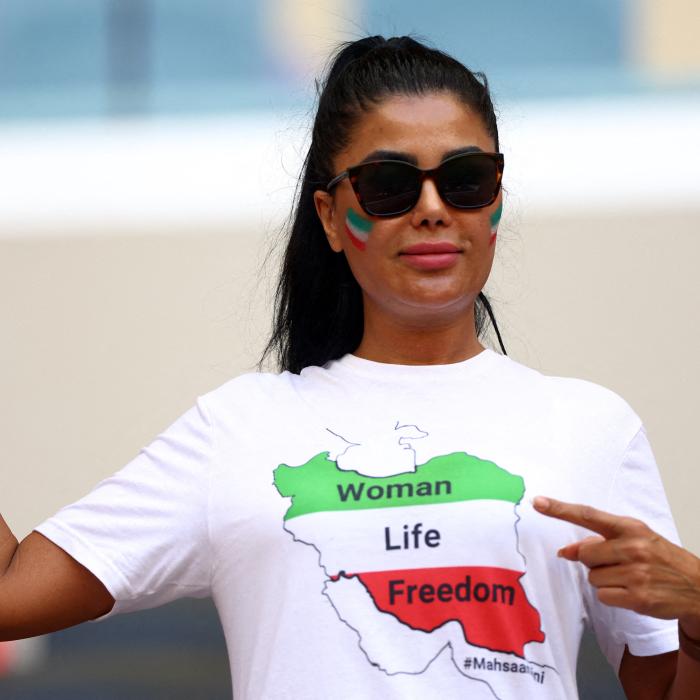
In September 2022, the death of Mahsa Jina Amini marked a major turning point for Iran. The event sparked lengthy nationwide protests across socio-economic classes and population groups whose demands rapidly evolved from discarding controversial hijab regulations to calls for the overthrow the Islamic Republic. The Iranian government responded with repression, killing over 400 protesters in late 2022 and early 2023, according to human rights groups.
The Clingendael blog series ‘Iran in transition‘ explores power dynamics in four critical dimensions that have shaped the country’s transformation since: state-society relations, intra-elite dynamics, the economy, and foreign relations. This blog post analyses how the evolution of Iran - European Union (EU) relations influence Tehran’s foreign policy and, indirectly, both its economy and intra-elite dynamics.
A surprising amount of pragmatism
The European Union (EU) is an economic and political partnership between 27 countries that facilitates its members in overcoming collective action problems. The rule of law, democracy, a market economy, as well as a broad set of shared social values serve as key parameters in which negotiations about such problems unfold. The scope of the EU’s foreign policy has widened with time without, arguably, a commensurate maturation of its geopolitical mindset or toolkit. In contrast, Iran is a state with a long history of imperial conquest as well as subjugation to other empires. Its post-1979 revolutionary regime introduced a form of political Islam as guiding principle for governance and re-established the country’s clerical and military elites that were forged during the Iran-Iraq war of the 1980s. Initial promises of social justice, national development and redistribution gradually gave way to elite appropriation of the commanding heights of the economy. Moreover, a mix of ethno-centric, state-led nationalism and an assertive foreign policy is slowly undermining the notion of an Iranian nation, which has traditionally connected different ethnic groups on the Iranian plateau.
Despite these differences, the EU (by means of the E3, i.e. France, Germany and the United Kingdom – the latter was an EU Member State until 1 February 2020) and Iran have dealt with each other with a surprising degree of pragmatism over the past decades, until recently. On the part of the EU, this was largely due to a lack of proximity, the absence of direct conflict and Brussel’s perception that Iran operates as a rational-pragmatic actor. In contrast, the US developed a more pathological policy view of Iran due to the 1979 hostage crisis, a major loss of geopolitical influence after the dethronement of the Shah and the belief that a ‘theocracy’ must be irrational and/or a threat to regional order. The US also lies closer to Iran because of its network of military bases throughout the Middle East that facilitates its domination of the regional security order.
For its part, Iran has typically viewed Europe as a counterbalance to the more hostile policies of the United States. Its cautious pragmatism towards Brussels stems from Iran's recognition of the EU as a distinct diplomatic identity that is characterized by multilateralism, dialogue and an economic focus. However, Iran's relationship with the EU has also been marked by scepticism due to the colonial track record of several of its Member States, (perceived) European alignment with US policies at critical junctures and dissatisfaction with Europe's inability to mitigate American pressure.
Nuclear ‘partners’
Mutual pragmatism helped the E3 and Iran to play a leading role in putting the Joint Comprehensive Plan of Action (JCPOA) together in 2015, despite normative differences. The EU/E3 focused on the risk of global nuclear proliferation without requiring inclusion of other aspects of Iran’s security posture since it viewed Tehran as less of a threat than the US, and vice versa. Europe played a dual role in JCPOA-process by acting both as negotiating party and as host/facilitator of a number of pivotal discussions. The choice of Vienna and Lausanne as negotiation venues underscored the EU’s position as bridge-builder between Iran and the US.
It helped that the EU was unburdened by recent events like the invasion of Iraq by the US in 2003 that pitted Iran-sponsored armed formations against US military forces resulting in thousands of casualties. When the Syrian civil war ignited in 2011, neither the E3 nor the US allowed the conflict to interfere with the nuclear negotiations either. Considered naïve by both Israel and some of the Arab states on the Persian Gulf, which gave rise to scathing public criticism from Israeli Prime Minister Benjamin Netanyahu and behind-the-scenes-lobbying of Riyadh, the JCPOA nevertheless saw the light of the day in 2015 as hallmark of patient diplomacy, tough negotiations and a selective use of sanctions mixed with inducements.
The period during which the nuclear deal was active - 2015 to 2018 - arguably represents the heyday of contemporary relations between Iran and the EU. It did not last. US withdrawal from the JCPOA in May 2018 marked the start of President Trump’s “maximum pressure” campaign as well as the turning point in EU-Iran relations. The main reason for the rapid slide into irrelevance of the EU from an Iranian perspective ever since has been Brussel’s near-total unwillingness to chart an independent foreign policy in support of the nuclear deal after Trump’s withdrawal. As Washington slapped an unprecedented sanctions package on Iran starting in 2019, EU efforts to mitigate their impact, such as the Instrument in Support of Trade Exchanges (INSTEX) to facilitate non-dollar trade with Iran, proved too little, too late and too symbolic. Ongoing Iranian compliance with the nuclear deal between 2018 and 2019 was meant to convince the EU that Iran meant business. Tehran expected the EU to reciprocate its acceptance of nuclear constraints by supporting its reintegration into the world economy. The opposite happened. As Iran’s former foreign minister Mohammad Javad Zarif lamented in 2019, “Unfortunately, Europe took no effective step to fulfil its [JCPOA] commitments which proves their inability. Iran’s strategic patience ended and the country reduced its commitments.”
Relational tipping points
A consequence of the EU/E3’s unwillingness to support the nuclear deal to an extent that was meaningful to Tehran was that the revival of nuclear diplomacy under President Biden’s after 2021 centred nearly exclusively on Iran and the United States. The E3 tagged along. For example, Enrique Mora and Josep Borrell of the European External Action Service (EEAS) visited Tehran regularly, but they had little leverage and less to offer. Their role was reduced to passing messages and none of their visits resulted in meaningful substantive actions. The result was that the EU/E3 has been relegated to the geopolitical margins concerning Iran, which became a real problem after the start of the war on Gaza in late 2023.
After the JCPOA, another tipping point in the relation between Iran and the EU occurred in late 2022 when it became clear that Iran was supplying Russia with several types of drones in support of Moscow’s invasion of Ukraine. This brought the EU and Iran into a proxy fight of sorts given the former’s support for the Ukrainian army and the latter’s support for Russia’s forces. It also narrowed the distance between Iran and the EU by bringing Iranian weapons to the European continent. For all practical purposes, the move negated earlier Iranian promises not to develop missiles with a range longer than 2,000 kilometres. Brussels perceived a shift in Iran's military posture and EU officials like Josep Borrell warned of escalation. Given that the EU had been unable to deliver on the nuclear deal after 2018, it is likely that Iran discounted the diplomatic cost of supporting Russia. This proved to be a mistake as the EU reacted furiously to finding itself indirectly confronted with some of the weaponry that Iran habitually supplies to its axis of resistance partners, which the EU had so far not considered a threat either. However, the EU’s immediate response options were limited. That said, the alacrity with which the EU has imposed yet more sanctions on Iran based on unconfirmed reports about Tehran having supplied Russia with missiles – targeting Iran Air, Iranian shipping and some Iranian ports – is indicative of the EU’s altered threat perception.
A third tipping point in Iran-EU relations took place in late 2023 when Israel counterattacked Hamas in Gaza after Iran’s partners in the axis of resistance had also started to attack Israel from multiple fronts. Several EU countries provided near-unconditional support to Israel in the form of diplomatic coverage, political support, arms sales and direct or indirect military assistance. This in spite of mass killings and the forced displacement of Gaza’s residents. Iran sees ongoing arms sales to Israel by the US, Germany and the Netherlands; French assistance in intercepting Iranian missiles; as well as UK and Dutch contributions to naval missions against the Houthi in Yemen as part of the same campaign to confront and damage Iran across the region. Tehran views all such actions as (in)direct threats to its own interest, not dissimilar from how the EU views Tehran supplying Russia’s forces in Ukraine. Iranian officials have in fact repeatedly drawn this parallel, accusing Europe of double standards in handling regional conflicts.
Factors driving the relationship
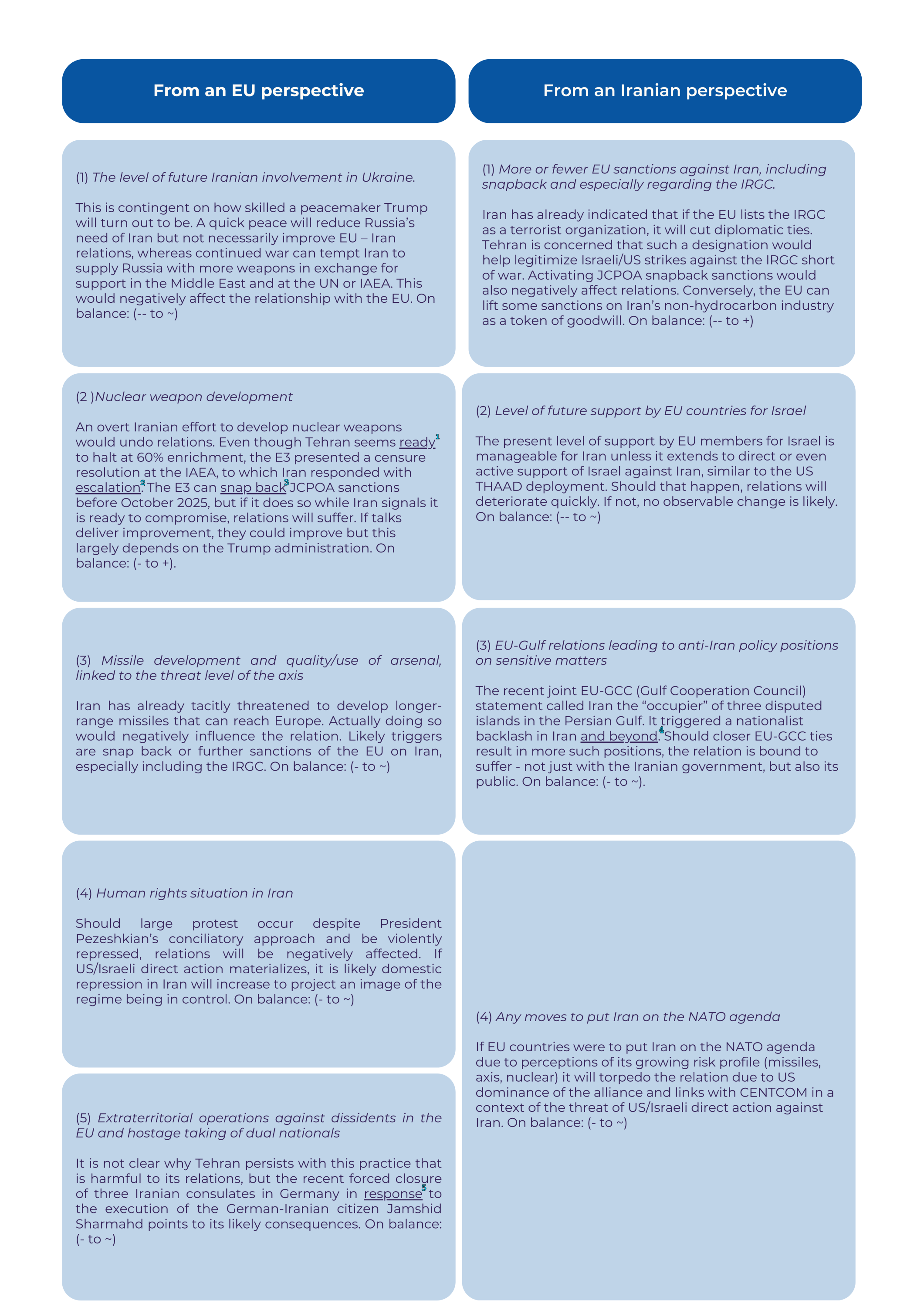
The preceding analysis brings us to the conclusion that the pragmatism focused on realizing mutual benefit, which used to characterize EU – Iran relations, is gradually being replaced by a more geopolitical confrontation. This accelerated in 2022-2023 due to Ukraine and Gaza, and was preceded by growing irrelevance of the EU from Tehran’s perspective due to the JCPOA. One important result consequence is that the EU’s interests in the Middle East have grown in the meantime – consider for example its quest for energy sources to replace Russian gas – while its foreign policy relevance in Iran have been diminished. This leaves the EU with few levers to address regional (in)security and (in)stability insofar as it pertains to Iran. In turn, this makes it useful to reflect which factors can influence EU – Iran relations going forward. We have summarized these in Table 1 below.
Table 1. Factors influencing EU – Iranian relations in the next two to three years
The problems of relational asymmetry
Table 1 illustrates three qualities of the present EU – Iran relationship. First, in purely quantitative terms Iran seems to be of greater concern to the EU than vice versa since there are more actions Iran can take that would negatively affect the relation (i.e. these are matters of concern to the EU) than that there are actions the EU can take that would have the same effect. Having said that, EU listing of the IRGC as terrorist organization or engaging in snap back would have a significant relational impact in qualitative terms. Second, both countries have limited means at their disposal to improve their relationship in the short-term. Each has only one factor of leverage that can positively influence the relation (Iran: nuclear compliance; the EU: lifting some sanctions). In brief, they do not have much to offer each other. Should improvement of the relationship become a goal in Brussels, more creative diplomacy and some policy re-development will be necessary. Countries like Italy or France might play a role in leading such an effort. Third, both parties have limited to no possibilities in their relationship to jointly counter any moves of the Trump administration that might lead to war.
In brief, the EU has become largely irrelevant in Tehran’s view, but the latter has also lost an option for creative diplomacy to mitigate any demands or actions from the US administration. This situation makes greater regional instability or even high-intensity war easier to occur, especially with Israel fanning the flames in DC. It is evident that the EU will be harder hit by the negative externalities such a conflict will produce. The realization of being an event-taker pursuing a policy that has run out of road, which is furthermore exposed to the negative consequences of decisions made elsewhere, should set off alarm bells across European capitals as well as in Brussels.
This blog is part of a project on scenarios for EU-Iran relations undertaken by the Heinrich-Böll-Stiftung European Union. The views and opinions in this article do not necessarily reflect those of the Heinrich-Böll-Stiftung European Union.
Read earlier blogs in this series.
footnotes from table:
- France 24 (2024, November 20). IAEA chief welcomes Iran's 'concrete step' on capping enriched uranium stockpile
- New York Times (2024, November 22). Iran Declares It Is Doing More Nuclear Enrichment After I.A.E.A. Rebuke
- Iran Wire (2024, November 25) How the Snapback Mechanism Brings Back Sanctions on Iran
- Iran International (2024, October 18) Persian Gulf islands outrage showcases rare Iranian unity
- Euronews (2024, October 31) Germany closes Iranian consulates over execution of dual national Jamshid Sharmahd