More Europe in defence: Three pathways
- While Europeans agree on the need to take greater responsibility for their security and defence, views differ on how to achieve it.
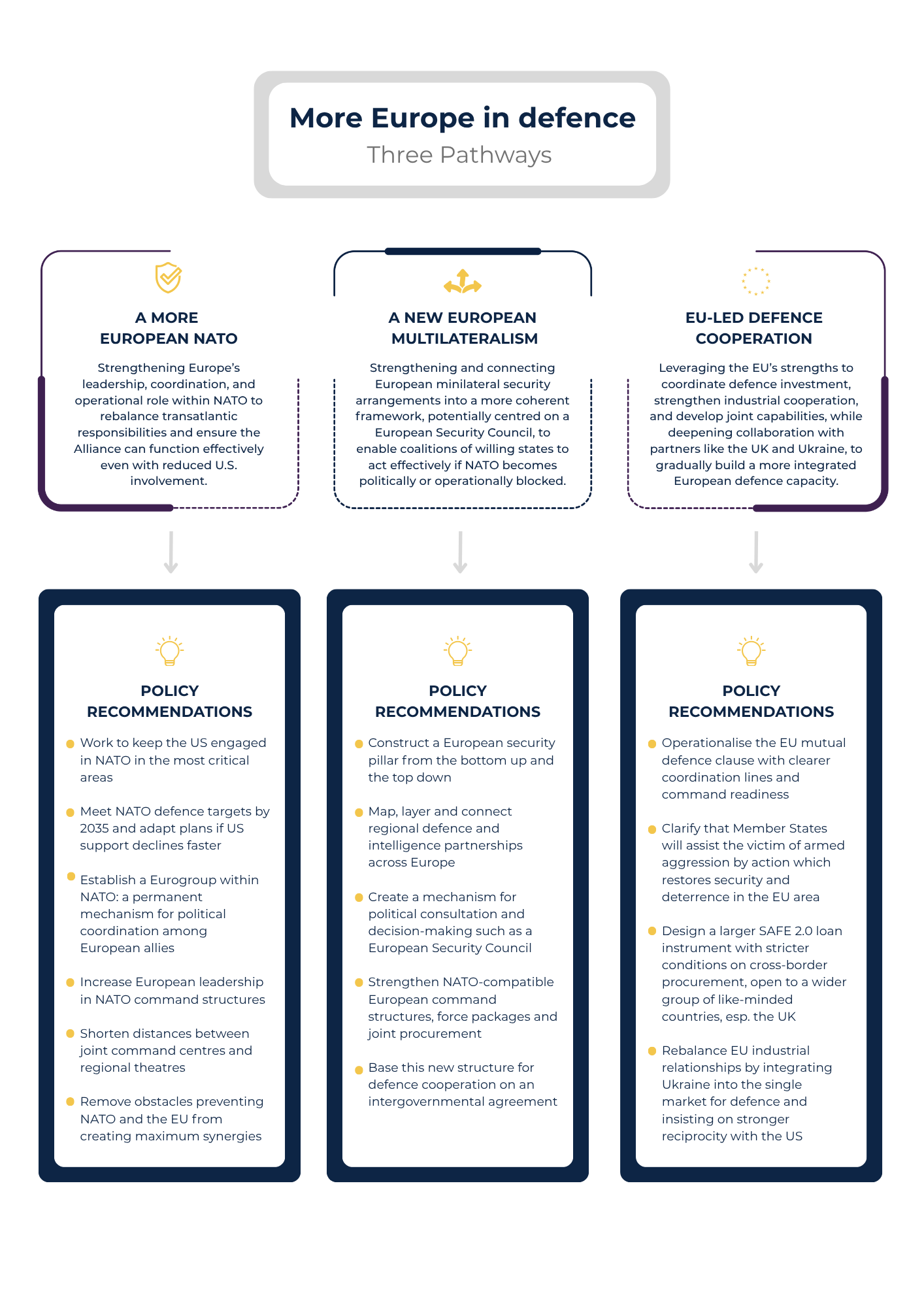
- This international task force of think tanks identified three credible pathways to stronger European defence — all of which should be explored in parallel.
- One: Strengthen the European role in NATO while preserving Transatlantic relations.
- Two: Upgrade existing minilateral cooperation formats and knit them together.
- Three: Leverage the EU’s strengths in industrial policy, capability development and mobilization of resources.
Since the end of the Cold War, Europe’s security architecture has been designed primarily around crisis response. This approach assumes a stable baseline of normality, punctuated by episodic disruptions that require temporary intervention before a return to normal.
Yet, this assumption no longer reflects today’s strategic environment. Europe is now operating in a context where major powers are actively reshaping the underlying rules of the international system. Two permanent members of the UN Security Council are currently engaged in armed conflict that they have initiated on spurious legal grounds; a third one may soon follow, raising serious concerns about the erosion of established legal and normative frameworks governing the use of force. In such an environment, the perceived threshold for military action appears to be lowering, with broader implications for global stability.
Against this backdrop, a reactive crisis-management model is ever more insufficient. Both the mitigation of risks and the ability to capitalise on emerging opportunities require earlier, anticipatory decision-making.
Recent developments in the Gulf illustrate this point. Despite the foresight and clear warning signs of escalating tensions involving Iran and the potential closure of the Strait of Hormuz – with well-understood global economic consequences – Europe’s response was largely reactive. Following the outbreak of conflict, efforts were characterised by urgency and improvisation, including questions around rapid deployments, the protection of regional assets and the defence of Cyprus, an EU Member State and host to British military bases. A more proactive posture – such as sustained engagement with regional partners and support for counter-drone and air defence resilience – could have been pursued in advance. The constraint was not a lack of information, expertise or capabilities, but rather a structural issue within decision-making processes, which do not consistently incentivise or compel early ministerial engagement.
The central lesson for Europe is clear: our defence, security and governance frameworks must evolve to enable timely, forward-looking decisions in an increasingly contested and unpredictable strategic landscape.