Georgia’s geopolitical choices: a process of elimination?
On 2 April 2026, Senior Research Fellow Marina Ohanjanyan speaks to the Foreign Affairs Committee of the Dutch House of Representatives. Read her position paper below or the Dutch version here. Watch the round-table session here.
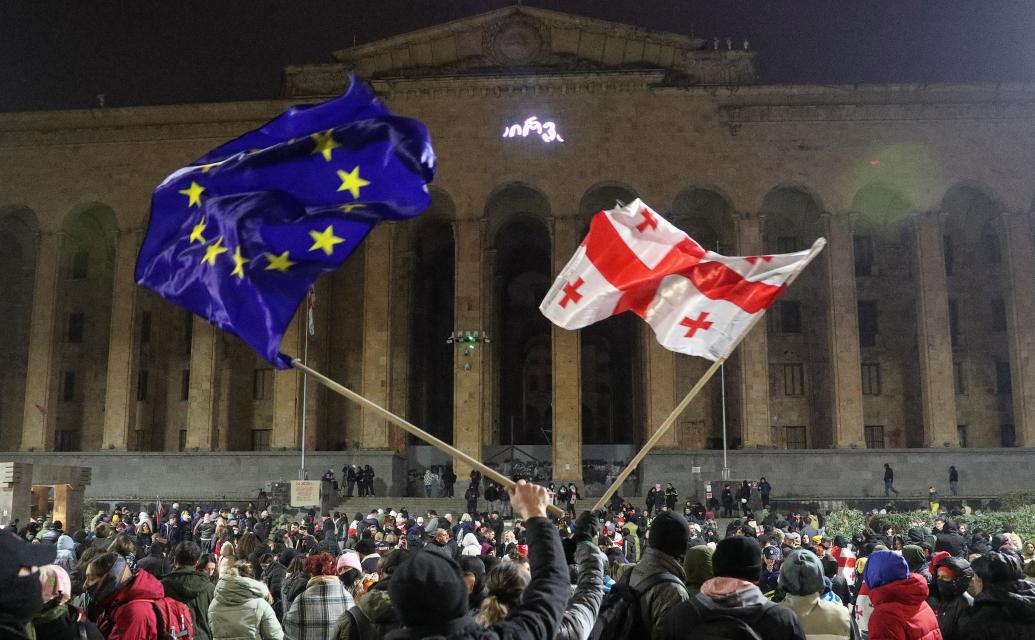
Georgia’s geopolitical turn away from the EU is rooted in its internal politics. Since 2012, the ruling Georgian Dream party, under the (informal) leadership of oligarch Bidzina Ivanishvili, has overseen a gradual consolidation of power and eroding of Georgia’s democratic institutions. This happened while still formally committing to widely popular EU and NATO aspirations, which required democratic progress.
For years, Georgian Dream managed to balance between these inherently contradictory directions. Following Russia’s full-scale invasion of Ukraine in 2022, however, the balancing became practically impossible. When forced to make choices, it became very clear very quickly, that the Georgian Dream government was not prepared to align fully with Ukraine and the West in their deepening rift with Russia, nor to take decisive steps forward on democratic reform. Tbilisi refused to join Western sanctions against Russia, and echoed Moscow by blaming the war in Ukraine on NATO expansion.
This (re)positioning by the Georgian government is not driven by internal public demand, which remains geared towards the EU. Rather, it is driven by the interests of individuals within the Georgian power structures, specifically Georgia's richest man, billionaire Bidzina Ivanishvili who made his money in metals and banking in Russia and those around him, who in the past several years turned against the West in their rhetoric and attitudes. They did so in reaction to developments like a 2022 list of conditions put forward by the EU for Georgia’s accession, that spoke of “de-oligarchisation” and the freezing of Ivanishvili’s assets in 2024 as a consequence of Western sanctions against Russia.
The result was Georgian Dream’s increasingly anti-Western rhetoric, that started to feature conspiracy theories. They claimed the West was not only targeting Ivanishvili personally, but also Georgia’s cultural identity and strategic interests, and that a “global war party” sought to open a second front against Russia in Georgia. This rhetoric was accompanied by the passing of legislation that the EU clearly and vocally described as incompatible with EU values. Although Georgia received EU-candidate status in November 2023, two years later the EU considered it a candidate “in name only” due “to serious democratic backsliding.”
This complex but relatively quick process of reorientation vis-à-vis the West opened up space for rapprochement with Russia. For the first time in decades, the interests of officials in Tbilisi and Moscow aligned in their adversity towards the West and embrace of (ultra)conservative values. In the past years, Georgian legislation has parroted Russian laws on curbing civil society and LGBTQI+ rights. The rhetoric coming from Tbilisi has increasingly resembled that of Moscow on topics like the war in Ukraine, the role of the West and traditional values. Despite some contentious issues – mainly related to the status of Georgia’s breakaway regions of Abkhazia and South-Ossetia - a path towards reconciliation became visible. While formal rapprochement has not (yet) occurred, there have been signs that both parties are prepared to work in that direction.
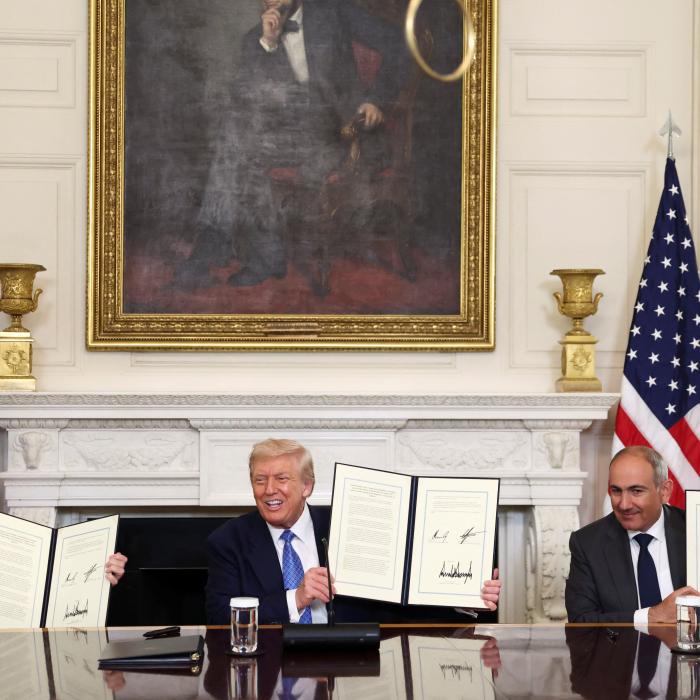
These developments occur in parallel with dramatic shifts and realignments taking place across the larger South Caucasus region [1]. Longtime Russia-ally Armenia is now distancing itself from Moscow and seeking closer ties with the West, while the ongoing Armenia-Azerbaijan peace process seems to take unprecedented steps forward. If that peace process leads to the envisaged opening of regional borders and transport connections, Georgia is at risk of losing its unique geostrategic position as an indispensable regional transit country. It is also at risk of being replaced by Armenia as the leading Western (political) partner in the region. At the same time, the other partnerships Georgia has sought to diversify its foreign relations (economically, diplomatically) – for instance with China and Iran - have not yet reached a level that would meaningfully replace the West, and rapprochement with Russia remains deeply unpopular among the Georgian population.
All these regional and national shifts, while comprehensive and significant, occur in what can -somewhat cynically - be described as a window of opportunity: Russia’s preoccupation with its war in Ukraine. If and when that preoccupation ends, Moscow can be expected to refocus on what it considers to be its (broader) sphere of influence, which includes the South Caucasus. For the time being, however, Russia has lost its previously unquestionable dominance in the region, and has been forced to accept regional (Türkiye) and “external” (US) powers increasing their clout. The EU has sought to take a leading role in some of the developments – like the Armenia-Azerbaijan peace process – but has been outmanoeuvred by other powers, for now. It is important to realise, however, that such shifts and realignments are still ongoing.
If the Netherlands wishes to gain a foothold in the geopolitical crossroad the region constitutes, straddling multiple strategically important logistical corridors, it could do several things:
- Define clear-eyed goals, based on well-defined interests, which range from general geopolitical positioning, to economic interests, to having stable and democratic outer perimeter of the EU. The EU and the Netherlands should also be realistic about their capacities and possibilities, and communicate about these openly and honestly. Now that EU-membership for Georgia seems unrealistic, what other forms of relationship are possible and desirable? What exactly does the Netherlands - or the EU, for that matter - aspire to in Georgia and South Caucasus? How does it see its role vis-à-vis the other regional and global players like Türkiye, Iran, China and the US?
- Be ambitious. Although the EU has been outmanoeuvred in South Caucasus for now, effectively losing its close partnership with Georgia and the momentum in the Armenia-Azerbaijan peace process, the Union and its members can still play a role. In the midst of unpredictable global shifts and a changing world order, the countries in the region will be looking to diversify their foreign relations. This opens up space for the EU and the Netherlands to step in and gain a foothold, if they are able and willing to be creative. On a regional level, this could include significant investments in the emerging regional logistical infrastructure as part of the Middle Corridor, support for the democratic development of emerging partner Armenia, technical assistance in the Armenian-Azerbaijani peace process. An increased footprint in the region would reintroduce Europe as a significant geopolitical player in South Caucasus and the logistical corridors it hosts, entail economic benefits – with the EU as the biggest trade partner for Georgia and Azerbaijan – and help provide leverage vis-à-vis a country like Georgia.
- Redefine the relationship with Georgia. While the country can no longer be considered a political ally, some sort of relationship will still have to be built. Depending on the aims and goals of that relationship (see previous points), the entire diplomatic toolkit for dealing with the Georgian Dream government should be on the table; both sticks and carrots. The EU and the Netherlands could strengthen their conditional approach to the Georgian Dream government, offering (economic, diplomatic) incentives, which may become more needed and meaningful especially if Georgia indeed starts to feel increasingly (economically, diplomatically) isolated. Incentives could be counterweighed by tough and clear sanctions for democratic backsliding or further geopolitical alignment with Russia.
In closure, these points will unavoidably run into a major dilemma that is larger than Georgia alone: the EU’s and the Netherlands’ position within the context of a changing world order, which pits normative interests (democratic values) against the geostrategic (security, economy). It is vital that the Netherlands weighs and defines its interests and takes a clear stand towards Georgia and the wider region accordingly.
Authors

Related
See all
The EU in the South Caucasus
Assessing the strength and stability of the Russian regime