Cyber and Artificial Intelligence courses at Clingendael Academy

Clingendael Academy is providing courses to equip nationally and internationally operating professionals with the knowledge and skills to work efficiently on related portfolios. Our team is specialised in different domains within this field, ranging from technological developments on artificial intelligence, and the governance of cyber security to disinformation operations. We work with experts from Clingendael, as well as renowned international and regional external experts that frequently contribute to our courses. For instance, we pride ourselves in working together with Prof. Nnenna Ifeanyi-Ajufo, a renowned expert in this field and the Vice-Chair of the African Union Cyber Security Experts Group.
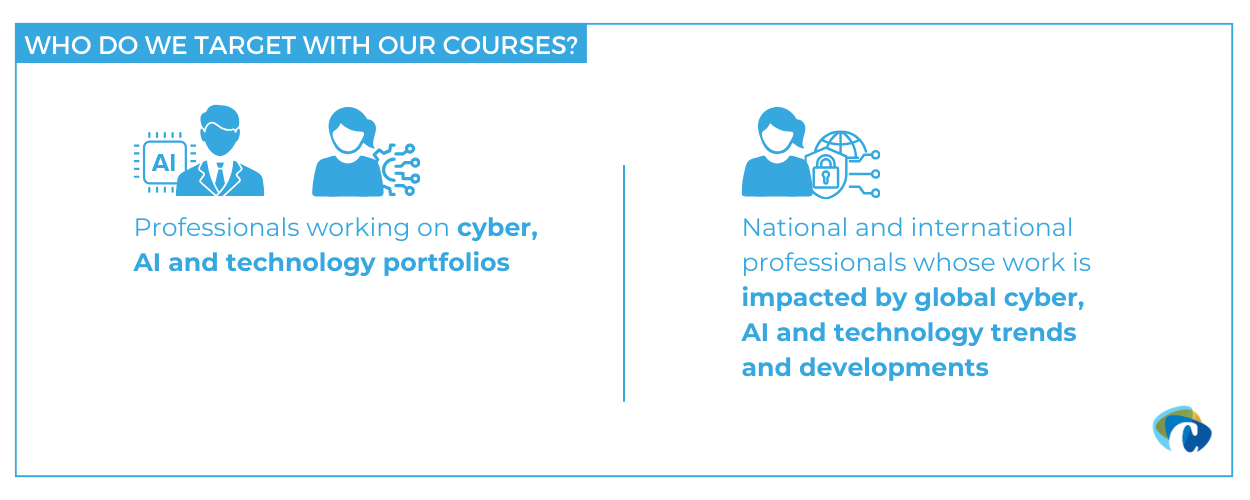
Diplomats have a different role to play than private sector employees, and policy makers at economic or trade departments have different goals for the cyber domain than police officers. Clingendael Academy therefore approaches the international cyber domain as relevant for two audiences:
The course modules
Our various thematic training modules are listed below. These can be integrated into a comprehensive package, or selected and matched in tailor-made trainings, depending on your learning needs and goals. We aim to provide courses that are practically relevant and directly applicable in the work practice of our participants. Our training therefore includes assignment and simulations in which the knowledge acquired in interactive lectures can be immediately applied.
Module 1: Mapping the risks and opportunities of new technologies
- The Cyber Threat Landscape
The theme of the first module in our courses is the cyber threat landscape. In it, we help participants identify malicious actors and their strategic goals, as well as what risks they pose to organisations and governments. We explore the tools and techniques used by hacktivists, criminal gangs, and state-sponsored hackers. How do these malicious actors gain initial access to the systems? What linkages exist between cyber criminals and states? With what strategic intent do major global cyber powers collect data? Afterwards, with the help of the risk analysis tool offered by Clingendael Academy, participants map those risks that are most urgent for their organisations.
Depending on specific learning wishes, there is a possibility to supplement this session with a deep-dive session on how to recognise disinformation operations and what tools can be used to address them. A second option is to add a deep-dive session on the proliferation of commercial spyware.
- Risks and Opportunities of Artificial Intelligence
Through the rapid development of technology, new technologies are introduced at a steady pace. Artificial Intelligence is a major disrupter, as computer systems are becoming increasingly capable of performing wide ranges of tasks similar to those only humans could undertake.
It is highly uncertain which direction the development of AI is taking and how it will influence our lives in the future. Nonetheless, it has already become an indispensable tool to many. From individual citizens who use ChatGPT to create travel packing lists, to the military that use autonomous targeting in their weapons systems, the application of AI systems is widespread.
At the same time, AI usage brings potential risks. Both AI security and AI safety are potentially high impact concerns. Large language models can leak dangerous information, and the risks of intelligent autonomous systems are real and need to be met before they have an opportunity to escalate. Meanwhile, the use of AI can already multiply the scale and effects of malicious cyber activities, enabling threat capacities for a larger audience. From the creation of malware to the use of deepfakes to spread disinformation, commit identity fraud, or extort victims.
In short, there are many concerns about these developments. This course aims to unpack these questions: What do we talk about when we refer to AI? What potential does this technology have? What are the chances and risks that come with using it? These are questions that are central to this course.
Depending on specific learning goals, this session can be supplemented with a workshop on the use of AI technology in the work practice. This workshop will focus on how particular large language models can be used safely and effectively. In an interactive assignment, participants will be asked to discuss dilemmas around the effective and secure use of AI and develop their own internal (organizational) guidelines.
Module 2: Moving towards solutions: cyber and AI governance
Building on the first module, the central question becomes: what can we do to address these risks and threats, while also fully benefiting from the opportunities these technologies present? In Module 2, participants find the necessary tools to answer this question. As a general starting point, we promote personal digital hygiene and offer tips and tricks in our online learning module. After these basics, we can go in-depth in three distinct ways:
2.1. Cyber governance
On a policy and strategic level, we offer insights into existing cyber governance structures on the national, regional, and international level. Participants explore the most important elements, key players and insights into ongoing negotiations of the UN discussions on cyber security.
We discuss the applicability of international law in the cyber domain and the norms for responsible state behaviour. Additionally, we analyse actors’ perspectives about the normative framework. We use strategic tools such as a stakeholder analysis to identify opportunities for regional and international cooperation in implementing the normative framework, including Confidence Building Measures and Cyber Capacity Building.
In this way, we aim to enable internationally operating professionals to make short- and long-term contributions to peace and stability in cyberspace. We are proud to have welcomed diplomats from various countries such as Indonesia, Oman and Thailand, South Africa and regions including Eastern Africa, Southern Africa and the Western Balkans as well as officials from regional organisations such the African Union Commission and ASEAN to our courses.
2.2. International and regional AI governance
It is a given that states have to find ways to benefit from AI technologies and protect themselves and their citizens against potential misuse. This is already reflected by a multitude of international and regional governance initiatives.
The aim of this training is to make internationally operating government officials familiar with existing AI governance initiatives. We explore the role of international law as a tool for governing the application of AI. this module requires participants to think strategically about the sectors in which AI is increasingly used, what needs to be prioritised in terms of governance, and which governance instruments would be most suitable to achieve their objectives.
This all would better enable our participants to actively engage in international discussions on this topic as well as in national policy discussions.
Module 3: Cyber attribution and response
When direct action is needed to uphold the norms for responsible state behaviour, on the government level, diplomats or civil servants may be tasked to respond to a malicious cyber operation. This module hands these professionals the tools to assess who should be held accountable (attribution) as well as the policy instruments to respond to a large-scale cyberattack. Participants then practice applying the tools in a fictitious cyber crisis simulation.
Join a cyber and AI course at Clingendael Academy and get in touch with us!
Are you interested in learning more about our cyber training courses? Join our open enrolment course (available in Dutch and English). Looking for a tailor made training for your organisation? Feel free to contact us.
Also when your organisation is looking for support with developing your own course curriculum, we are happy to get in contact with you. Clingendael Academy has extensive experience in providing training of trainers on a wide range of didactical elements. Finally, we also are able to provide skills workshops on for instance scenario building, international negotiations and intercultural communication in the context of cybersecurity and AI.